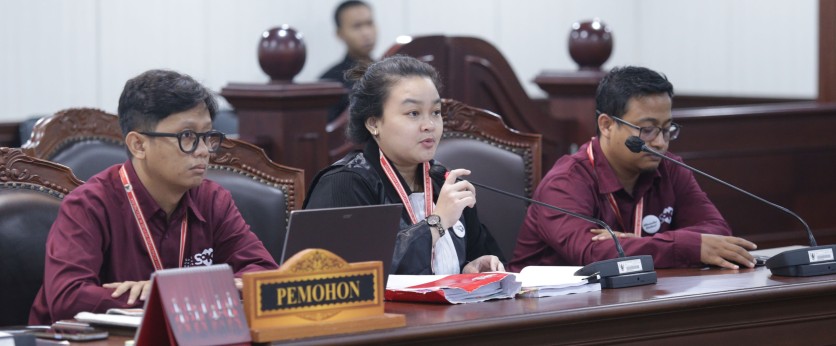
The Petitioners and their legal counsel attending the petition revision hearing for Case No. 272/PUU-XXIII/2025 on the material judicial review of Law No. 14 of 2005 on Teachers and Lecturers, Monday (1/26/2026). Photo by MKRI/Bay.
JAKARTA (MKRI) — The Constitutional Court of the Republic of Indonesia (MKRI) held another hearing for Petition No. 272/PUU-XXIII/2025 concerning the judicial review of Law No. 14 of 2005 on Teachers and Lecturers, which focuses on the issue of decent wages for lecturers. The petition was filed by the Campus Workers Union (Petitioner I), along with Isman Rahmani Yusron (Petitioner II) and Riski Alita Istiqomah (Petitioner III), both of whom work as private university lecturers.
At the second hearing, which examined the constitutionality of Article 52 paragraphs (1), (2), and (3) of the Teachers and Lecturers Law, the Petitioners’ legal counsel, R. Viola Reininda H., outlined the main revisions to the petition. These included the submission of additional evidence, an update to the legal basis underpinning the Court’s authority to review the a quo provisions, and a refinement of the Petitioners’ legal standing. In particular, the Campus Workers Union clarified its position as a collective of individuals, rather than a legal entity.
“We also added an explanation regarding legal remedies pursued through an appeal to the Ministry of Manpower during an industrial relations dispute involving the West Java Manpower Office, which was rooted in wage deficiencies stipulated in employment contracts. This serves as additional argumentation, demonstrating that the issue is not merely one of normative implementation, but rather concerns a legal norm governing the lower threshold of humane wages,” Viola explained.
Also read: Private University Lecturers Seek Decent Wages
Previously, at the preliminary hearing for Petition No. 272/PUU-XXIII/2025 held on Tuesday (1/13/2026), the Petitioners stated that the judicial review was prompted by their concerns over compensation and appreciation for lecturers and academic staff in higher education, which they deemed disproportionate to their dedication, workload, and qualifications. Ideally, lecturers’ service should be rewarded in accordance with humanitarian principles, as affirmed by the Constitutional Court in its legal consideration in Decision No. 67/PUU-XI/2013 dated September 11, 2014.
In their petition, the Petitioners argued that Article 52 paragraph (1) of the Teachers and Lecturers Law conditionally contradicts the constitutional guarantees of a decent livelihood and the right to fair and reasonable remuneration, as enshrined in Article 27 paragraph (2), Article 28D paragraph (1), and Article 28D paragraph (2) of the 1945 Constitution of the Republic of Indonesia. The provision, they asserted, fails to establish clear standards to ensure that lecturers receive a minimum living wage and adequate social security. In practice, lecturers’ incomes have yet to meet acceptable standards of decency.
The absence of legal certainty regarding the parameters of “minimum living needs” under the a quo law has had severe implications for lecturers’ welfare. Wages or salaries for educators are not merely figures in institutional financial reports, but constitute the fundamental basis for sustaining their own lives and those of their families. This view aligns with the Court’s stance in Decision No. 58/PUU-IX/2011, which emphasized that wages are a vital element of human dignity, serving as the primary support for workers and their families.
The Petitioners further contended that leaving lecturers’ wages entirely to “employment agreements” or “consensus,” as stipulated in Article 52 paragraph (3) of the Teachers and Lecturers Law, disregards the sociological realities of employment relations. In the relationship between education providers or foundations and lecturers, there is no equal bargaining position. Consequently, the principle of freedom of contract cannot be invoked to legitimize low wages.
Without constitutional interpretation by the Court, lecturers at both public and private higher education institutions, the Petitioners argued, will continue to face unjust wage practices, the absence of guarantees for a decent livelihood, and the erosion of their rights to fair and reasonable remuneration, as well as fair legal certainty, as guaranteed under Article 27 paragraph (2), Article 28D paragraph (1), and Article 28D paragraph (2) of the 1945 Constitution.
Explore the Case: Case No. 272/PUU-XXIII/2025
Author : Sri Pujianti
Editor : N. Rosi
PR : Andhini SF
Translator : Yuanna Sisilia
Disclaimer: The original version of the news is in Indonesian. In case of any differences between the English and the Indonesian versions, the Indonesian version will prevail.
Monday, January 26, 2026 | 17:14 WIB 72