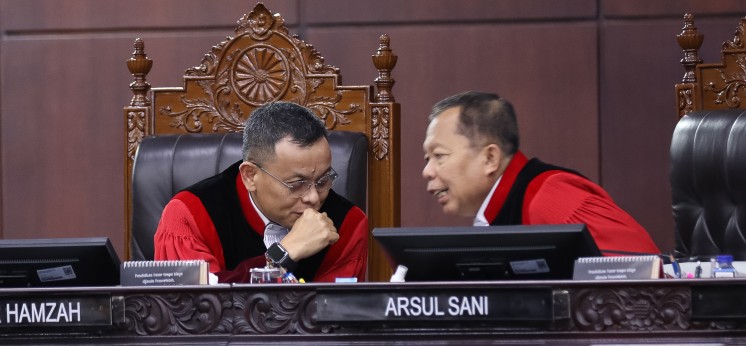
Constitutional Justices M. Guntur Hamzah and Arsul Sani attending the ruling hearing on the judicial review of Law No. 19 of 2019 on the Corruption Eradication Commission, Wednesday (4/29/2026). Photo by MKRI/Ifa.
JAKARTA (MKRI) — The Constitutional Court granted in part a petition for judicial review of Law No. 19 of 2019 on the Second Amendment to Law No. 30 of 2002 on the Corruption Eradication Commission (KPK Law) against the 1945 Constitution. The petition was filed by Marina Ria Aritonang, Syamsul Jahidin, and Ria Merryanti.
The ruling hearing for Case No. 70/PUU-XXIV/2026 took place on Wednesday, April 29, 2026, in the Plenary Courtroom of the Court’s Building I. In its verdict, the Court declared that the phrase “to relinquish” in Article 29 letter i and the phrase “not to practice” in Article 29 letter j of the KPK Law are contrary to the 1945 Constitution and conditionally unconstitutional, insofar as they are not interpreted as “to be inactive from.”
This ruling reflects the Court’s effort to preserve legal harmony and institutional differentiation within Indonesia’s legal system. The Court emphasized that imposing a uniform mechanism without regard for the specific characteristics of each profession would create legal uncertainty. Therefore, the term “inactive” is deemed more appropriate to ensure effective prevention of conflicts of interest without undermining the principle of proportionality for officials serving as KPK leaders.
In the Court’s legal considerations read out by Constitutional Justice M. Guntur Hamzah, it was asserted that, normatively, Indonesia’s legal system has already accommodated the objective of preventing conflicts of interest and dual office-holding through varied mechanisms tailored to the nature of each originating institution. Granting the petitioners’ request in its entirety, as formulated in their petitum, would disregard such differentiation and potentially create disharmony among statutory regulations.
The Court further observed that the a quo provisions fail to provide clarity on the form and legal consequences that must be fulfilled by each category of officials or professions referred to in Article 29, letters i and j, of the KPK Law. This ambiguity opens the door to multiple, inconsistent interpretations and risks overlooking more specific regulations under related laws.
Accordingly, based on these legal considerations, the Court held that the use of the term “inactive” is more precise, concrete, and capable of ensuring legal certainty. It allows for contextual adjustment in accordance with the respective legal regimes, in casu, for instance, temporary suspension for state civil apparatus personnel and resignation or retirement for members or officers of the National Police, thus safeguarding against conflicts of interest and dual office-holding without compromising proportionality and legal certainty. In this context, “inactive” refers to cessation from structural positions and the non-performance of any other office, duties, functions, authority, rank, and/or professional roles within the originating institution, including other administrative measures during the tenure as KPK leadership.
Granted in Part
The Court concluded that the word “to relinquish” in Article 29 letter i and the phrase “not to practice” in Article 29 letter j of the KPK Law contravene Article 28D paragraphs (1) and (3) of the 1945 Constitution and are conditionally unconstitutional, insofar as they are not interpreted as “to be inactive from.”
“Therefore, the Petitioners’ arguments are legally valid. However, since the interpretation adopted by the Court differs from what was requested by the Petitioners, their petition is legally justified in part,” Guntur stated.
Based on these legal considerations, the Court granted the petition in part. “In the verdict, the Court adjudicates: one, to grant the Petitioners’ petition in part,” said the Chief Justice while reading out the verdict alongside the eight other constitutional justices.
Also read:
Petitioners Revise Challenge to KPK Leadership Requirement
Petitioners Challenge Requirement for KPK Leaders to Relinquish Positions
Previously, during the preliminary hearing on Wednesday, February 25, 2026, the Petitioners challenged the phrase in Article 29 letter i of the KPK Law, which requires candidates for leadership of the Corruption Eradication Commission (KPK) to “relinquish structural and/or other positions during their tenure as members of the Commission.” According to the Petitioners, the terms “relinquish” and “during their tenure” are open to multiple interpretations, thereby allowing active members of the Indonesian National Armed Forces (TNI) or the National Police (Polri) to assume the position of KPK Chair without first resigning or retiring.
In addition, Article 29 letter j of the KPK Law, which requires candidates to “not practice their profession during their tenure as members of the Commission,” was also deemed insufficiently explicit. The Petitioners argued that this provision could lead to conflicts of interest if active TNI or Polri members served as KPK Chair.
Author: Sri Pujianti
Editor: N. Rosi
Translator: Yuanna Sisilia
Disclaimer: The original version of the news is in Indonesian. In case of any differences between the English and the Indonesian versions, the Indonesian version will prevail.
The complete decision: Decision No. 70/PUU-XXIV/2026
Wednesday, April 29, 2026 | 16:58 WIB 51