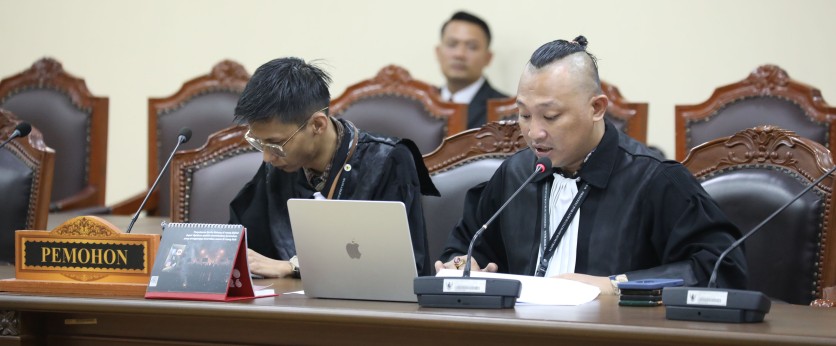
Petitioner Syamsul Jahiddin presenting the revised petition at a judicial review hearing of Law No. 30 of 2002 on the Corruption Eradication Commission (KPK Law) in the Constitutional Court’s panel courtroom, Tuesday (3/10/2026). Photo by MKRI/Panji.
JAKARTA (MKRI) — The Constitutional Court held another hearing for the judicial review of Article 29 letters i and j of Law No. 19 of 2019 on the Second Amendment to Law No. 30 of 2002 on the Corruption Eradication Commission (KPK Law) on Tuesday, March 10, 2026. The hearing was presided over by Chief Justice Suhartoyo, accompanied by Constitutional Justices Daniel Yusmic P. Foekh and M. Guntur Hamzah.
The petition for Case No. 70/PUU-XXIV/2026 was filed by Marina Ria Aritonang (Petitioner I), Syamsul Jahiddin (Petitioner II), and Ria Merryanti (Petitioner III). The Petitioners argue that Article 29 letters i and j of the KPK Law violate their constitutional rights as guaranteed under Article 27 paragraphs (1) and (3) as well as Article 28D paragraph (1) of the 1945 Constitution.
In their petition, the Petitioners challenge the phrase in Article 29 letter i requiring candidates for KPK leadership to “relinquish structural positions and/or other positions during their tenure as members of the Corruption Eradication Commission.”
During the hearing, Petitioner II Syamsul Jahiddin presented several revisions to the petition, particularly regarding the Court’s authority and the Petitioners’ legal standing. He explained that the revised petition now includes Article 24 paragraph (2) of the 1945 Constitution as the basis for the Court’s jurisdiction.
“On page 7, to meet the requirements under Article 51 paragraph (1) of the Constitutional Court Law, the Petitioners are individual Indonesian citizens as evidenced by their identity documents,” Syamsul said before the panel.
He added that the Petitioners have reaffirmed their legal standing as Indonesian citizens by attaching their respective identification documents. In addition, they strengthened their arguments, particularly concerning the phrase “relinquish positions” in Article 29 letter i of the KPK Law.
In their revised petitum, the Petitioners request that the Court grant the petition in its entirety. They also ask the Court to declare Article 29 letter i of Law No. 19 of 2019 unconstitutional and not legally binding insofar as it is not interpreted to mean that candidates for KPK leadership must “resign or retire from structural and/or other positions during their tenure as members of the Corruption Eradication Commission.”
Furthermore, they request the Court to declare Article 29 letter j of the KPK Law unconstitutional and not legally binding insofar as it is not interpreted to mean that candidates for KPK leadership must “resign or retire from their previous profession during their tenure as members of the Corruption Eradication Commission.”
Also read:
Petitioners Challenge Requirement for KPK Leaders to Relinquish Positions
Previously, during the preliminary hearing on Wednesday, February 25, 2026, the Petitioners questioned the same provision in Article 29 letter i of the KPK Law. They argued that the phrases “relinquish” and “during their tenure” are ambiguous and open to multiple interpretations, thus creating the possibility for active members of the Indonesian National Armed Forces (TNI) or the Indonesian National Police (Polri) to serve as KPK Chair without first resigning or retiring.
They also argued that Article 29 letter j, which requires candidates to “not practice their profession during their tenure as members of the Corruption Eradication Commission,” lacks clarity. According to the Petitioners, this provision may lead to conflicts of interest if active TNI or Polri personnel hold the position of KPK Chair.
The Petitioners compared this provision to Article 28 paragraph (3) of Law No. 2 of 2002 on the Indonesian National Police, which explicitly stipulates that police officers may hold positions outside the police institution only after resigning or retiring from service.
Syamsul Jahiddin emphasized that allowing active police officers to serve as KPK Chair without resignation would contradict the principle of neutrality, the doctrine of separation of powers (trias politica), and could undermine the independence of the anti-corruption body. He also referred to Decision No. 114/PUU-XXIII/2025 on “POLRI occupying civilian positions,” asserting that the ruling must be observed and implemented consistently. He added that state institutions and ministries should uphold the same spirit to ensure equal opportunity for state civil apparatus and civilians to compete for the position of KPK Chair.
Accordingly, he asserted that active members of the TNI and Polri cannot concurrently hold civilian positions, including that of KPK Chair, without first relinquishing their status as state apparatus.
Author: Utami Argawati
Editor: N. Rosi
PR: Raisa Ayuditha M.
Translator: Yuanna Sisilia
Disclaimer: The original version of the news is in Indonesian. In case of any differences between the English and the Indonesian versions, the Indonesian version will prevail.
Explore the case: Case No.70/PUU-XXIV/2026
Tuesday, March 10, 2026 | 14:29 WIB 41