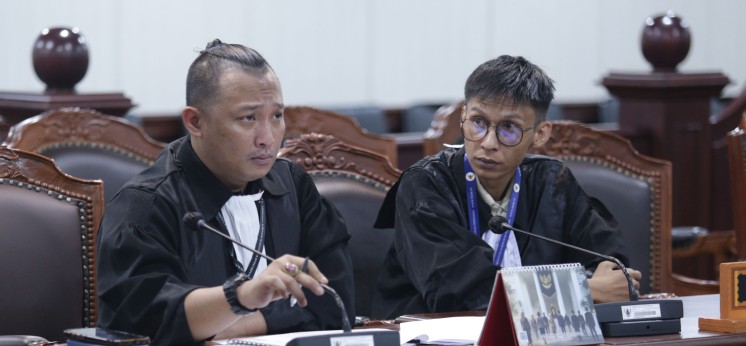
The Petitioner attending the preliminary hearing for Case No. 70/PUU-XXIV/2026 on the judicial review of Law No. 19 of 2019 on the Second Amendment to Law No. 30 of 2002 on the Corruption Eradication Commission, Wednesday (2/25/2026). Photo by MKRI/Bay.
JAKARTA (MKRI) — On Wednesday, February 25, 2026, the Constitutional Court (MK) held a preliminary hearing for the judicial review of Article 29 letter i and letter j of Law No. 19 of 2019 on the Second Amendment to Law No. 30 of 2002 on the Corruption Eradication Commission (KPK Law) against the 1945 Constitution.
The hearing for Case No. 70/PUU-XXIV/2026 was presided over by Chief Justice Suhartoyo, accompanied by Constitutional Justice Daniel Yusmic P. Foekh and Constitutional Justice M. Guntur Hamzah.
The petition was filed by Marina Ria Aritonang (Petitioner I), Syamsul Jahidin (Petitioner II), and Ria Merryanti (Petitioner III). The Petitioners argue that Article 29 letter i and letter j of the KPK Law infringe upon their constitutional rights as guaranteed under Article 27 paragraph (1), Article 27 paragraph (3), and Article 28D paragraph (1) of the 1945 Constitution.
The Petitioners specifically challenge the phrase in Article 29 letter i of the KPK Law requiring candidates for leadership of the Corruption Eradication Commission (KPK) to “relinquish structural positions and/or other positions during their tenure as members of the Corruption Eradication Commission.”
During the hearing, Syamsul Jahidin contended that the phrases “relinquish” and “during their tenure” are susceptible to multiple interpretations. According to him, such ambiguity opens the possibility for active members of the Indonesian National Armed Forces (TNI) or the Indonesian National Police (Polri) to assume the position of KPK Chair without first resigning or retiring from active service.
In addition, Article 29 letter j of the KPK Law, which requires KPK leadership candidates to “not practice their profession during their tenure as members of the Corruption Eradication Commission,” is likewise deemed insufficiently explicit. The Petitioners assert that the norm potentially gives rise to conflicts of interest if active TNI or Polri officers concurrently hold the office of KPK Chair.
They compared this provision to Article 28 paragraph (3) of Law No. 2 of 2002 on the Indonesian National Police, which unequivocally stipulates that members of Polri may occupy positions outside the police institution only after resigning or retiring from police service.
Syamsul argued that allowing an active Polri member to serve as KPK Chair without resignation would contravene the principles of neutrality and the doctrine of separation of powers (trias politica), and could impair the independence of the anti-corruption body. He further emphasized that, based on Constitutional Court Decision No. 114/PUU-XXIII/2025 concerning “Polri occupying civilian positions,” the Court had granted the petitioners’ request. Therefore, he maintained, the ruling must be observed and implemented consistently by all state institutions, including those overseeing the state civil apparatus (ASN), in the same spirit of ensuring equal opportunity for civil servants and members of the public to compete for and hold the position of KPK Chair.
“Article 30 paragraph (3) and paragraph (4) of the 1945 Constitution expressly place the TNI and the Indonesian National Police as state instruments, whereby the TNI exercises sovereignty functions and the Police perform security and public order functions, law enforcement, as well as protection and public service. Such status entails constitutional consequences, including a clear chain of command, political neutrality, and separation from civilian offices,” Syamsul explained.
Accordingly, active TNI and Polri personnel, by virtue of their constitutional status as state instruments, cannot concurrently hold civilian offices, including that of KPK Chair, without first relinquishing such status. “In Decision No. 114/PUU-XXIII/2025, the Constitutional Court has affirmed that active Polri members cannot be placed outside the police structure. The ruling is erga omnes and binding upon all state institutions, lawmakers, and government officials,” he stated.
He further stressed that the Court’s decision precludes any interpretation that would permit the placement of active Polri members outside the police structure through explanatory provisions, administrative policies, or technical regulations. On that basis, the Petitioners request the Court to declare Article 29 letter i and letter j of the KPK Law unconstitutional and not legally binding.
Judicial Advice
Responding to the Petitioners’ arguments, Constitutional Justice M. Guntur Hamzah advised them to refine and sharpen the posita of their petition in a more systematic and argumentative manner. According to Guntur, although Decision No. 114/PUU-XXIII/2025 had been invoked as a reference, the Petitioners must still elaborate on its relevance and compatibility with the norms currently under review.
“There needs to be further sharpening. It is true that Decision 114 has become a basis, but is it compatible? You must explain where the compatibility lies when relying on that decision. Otherwise, others reading it may find it incompatible for comparison. If you still wish to rely on it, then you must clearly demonstrate that compatibility,” Guntur stated during the hearing.
Moreover, in the posita section, Justice Guntur encouraged the Petitioners to strengthen their exposition regarding the alleged conflict of norms. They must clearly articulate where the unconstitutionality of Article 29 letter i and letter j lies, particularly concerning the term “relinquish,” which they seek to reinterpret as “retire” or “resign.”
He underscored the importance of providing a conceptual clarification of the term. “You must explain what ‘relinquish’ means. Is it not the same as ‘retire’ or ‘resign’? At the very least, are ‘retire’ and ‘resign’ not inherent elements of ‘relinquish’?” he remarked.
The panel of constitutional justices granted the Petitioners 14 days to revise their petition. The revised petition must be submitted no later than Tuesday, March 10, 2026, at 12:00 p.m. WIB.
Author: Utami Argawati
Editor: N. Rosi
Translator: Yuanna Sisilia
Disclaimer: The original version of the news is in Indonesian. In case of any differences between the English and the Indonesian versions, the Indonesian version will prevail.
Wednesday, February 25, 2026 | 15:15 WIB 128