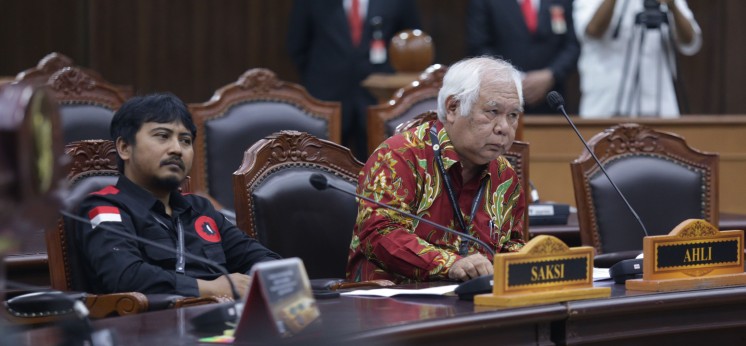
Resumed hearing of Case No. 238/PUU-XXIII/2025 on the material judicial review of Law No. 3 of 2025 on the Amendment to Law No. 34 of 2004 on the Indonesian National Armed Forces and Law No. 34 of 2004 on the Indonesian National Armed Forces on Wednesday (8/4/2026) to hear Petitioners’ expert and witness testimony. Photo by MKRI/Panji.
Jakarta (MKRI) - The Constitutional Court (MK) continued its review of Law No. 3 of 2025 on the Indonesian National Armed Forces (TNI Law) on Wednesday, April 8, 2026, hearing expert and witness testimony for Petition No. 238/PUU-XXIII/2025. Chief Justice Suhartoyo presided over the session together with seven other Constitutional Justices.
The Petitioners presented retired Rear Admiral Soleman B. Ponto as an expert, who focused on Article 47 paragraphs (1) and (2) of the TNI Law. He argued that these provisions open opportunities for active-duty soldiers to serve in posts across a number of ministries and agencies, including civilian administrative roles.
Soleman explained that active soldiers can be placed in institutions such as the Coordinating Ministry for Political and Security Affairs, the Ministry of Defence, the National Defence Council, the State Secretariat and Presidential Military Secretariat, the State Intelligence Agency, the National Cyber and Encryption Agency, the National Resilience Institute, the National Search and Rescue Agency, the National Counterterrorism Agency, the Attorney General’s Office, and even the Supreme Court.
He added that soldiers may also take on other civilian positions after resigning from or retiring from active service, and stressed the need for clear limits to prevent an unchecked expansion of the military’s role into civilian domains.
“Without limits, national defense can morph into the entire state structure. If this happens, what is lost is not only institutional boundaries, but also the balance between the state and the law,” Soleman told the Justices.
Soleman went on to outline Indonesia’s total people’s defense system, under which the TNI is the main component in facing military threats, supported by reserve and supporting components. “If these reserve and supporting components are not limited, the TNI will permeate the entire defense system. This is not merely a matter of norms, but of setting boundaries for where the military may be placed,” he said.
The Petitioners also called Angga Saputra, Secretary General of the Indonesian Airport Workers Federation for the 2023–2028 term, as a factual witness. He recounted his experience of active‑duty TNI involvement in an industrial relations process. On April 21, 2025, he accompanied workers of PT Mitra Angkasa Perdana (MAP) in bipartite negotiations over unpaid compensation owed to around 500 workers for 3 years.
“At around 14.00, a bipartite negotiation was held regarding PT Mitra Angkasa Perdana’s failure to pay three years’ worth of compensation owed to around 500 workers,” Angga said.
He testified that the presence of active TNI personnel during the negotiations created psychological pressure on workers. According to him, this climate affected freedom of association and even led some union members to withdraw from organizational activity.
In his view, such involvement undermines the principles of industrial dispute resolution, which should proceed fairly between workers and employers under Law No. 2 of 2004.
“The settlement process cannot be conducted fairly due to the active intervention of TNI members. This has a direct impact on freedom of association and collective bargaining in the workplace,” Angga said.
Also read:
Provision of Active-Duty Soldiers in Civil Service Positions Challenged
Petition on the Active-Duty Soldiers Holding Civilian Positions Revised
Government Affirms Priority of Civilian Positions for ASN
House: Placement of Armed Forces Personnel in Civilian Posts Optimizes Military Competence and Expertise
House Expert’s Submission Late, Court Postpones TNI Law Hearing
Active-Duty Soldiers Who Wish to Hold Civilian Positions Must Follow Meritocracy
Several citizens filed a constitutional review of Article 47 of the TNI Law, namely Syamsul Jahidin, Ria Merryanti, Ratih Mutiara Louk Fanggi, Marina Ria Aritonang, Yosephine Chrisan Eclesia Tamba, Achmad Azhari, and Edy Rudyanto. They argued that the government has misused Article 47 of the TNI Law to appoint active-duty soldiers to several strategic civilian positions. According to the Petitioners, the practice is inconsistent with the principle of civil supremacy and the goals of the 1998 reform.
The Petitioners referred to the National Assembly Decree (TAP MPR) No. VI/MPR/2000, which asserts that the socio-political role of the military in the past had caused democratic distortion. They argued that Constitutional Court Decision No. 114/PUU-XXIII/2025, which prohibits Police Officers from holding civilian positions, should apply to the Armed Forces, which bear the same role as the state’s tool to maintain the sovereignty of the Archipelagic State of the Republic of Indonesia.
Thus, the Petitioners requested that the Court provide constitutional certainty to ensure that the regulation governing the placement of soldiers in civilian positions remains consistent with the principles of the rule of law, democracy, and civilian supremacy.
In the petitum, the Petitioners request the Court to accept and grant the petition in its entirety. The Petitioners request that the Court declare Article 47 paragraphs (1) and (2) of Law No. 3 of 2025 contrary to the 1945 Constitution of the Republic of Indonesia and have no binding legal force. As an alternative, the Petitioners request that the provision be declared conditionally constitutional.
For Article 47 paragraph (1), the Petitioners request that the appointment of active-duty soldiers be interpreted as being allowed in the ministries or institutions that deal with national defense and security, including the National Defense Council, the state secretariat that handles presidential secretarial affairs, and the presidential military secretariat, state intelligence, cyber and state cryptography, the National Resilience Agency, search and rescue, counterterrorism, the Attorney General’s Office of the Republic of Indonesia, and the Supreme Court. Meanwhile, Article 47, paragraph (2), is requested to be interpreted to mean that soldiers may hold civilian positions only after resigning or retiring from active military service. (*)
Case tracking: Petition No. 238/PUU-XXIII/2025 (in Indonesian)
Author: Utami Argawati
Editor: Lulu Anjarsari P.
PR: Raisa Ayuditha
Translator: Rizky Kurnia Chaesario
Disclaimer: The original version of the news is in Indonesian. In case of any differences between the English and the Indonesian versions, the Indonesian version will prevail.
Wednesday, April 08, 2026 | 13:18 WIB 172