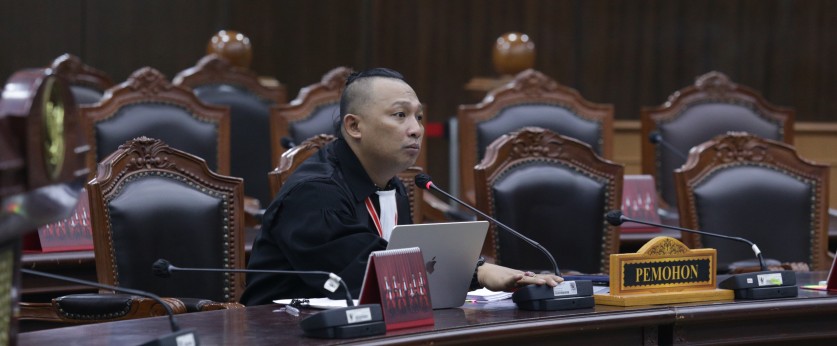
Petitioners attending the Petition Revision Hearing of Case No. 238/PUU-XXIII/2025 on the Material Judicial Review of Law No. 3 of 2025 on the Amendment to Law No. 34 of 2004 on the Indonesian National Armed Forces, Thursday (8/1/2026). Photo by MKRI/Bay.
Jakarta (MKRI) – The Constitutional Court resumed the material judicial review hearing of Article 47 paragraphs (1) and (2) of Law No. 3 of 2025 on the Amendment to Law No. 34 of 2004 on the Indonesian National Armed Forces (TNI Law) on Thursday, January 8, 2026.
Petitioners of Case No. 238/PUU-XXIII/2025 comprise citizens from various backgrounds. Petitioner I, Syamsul Jahidin, is a student, advocate, and curator. Petitioner II, Ria Merryanti, is a doctor and civil servant. Petitioners III and IV, Ratih Mutiara Louk Fanggi and Marina Ria Aritonang, are advocates and public policy observers. Petitioner V, Yosephone Chrisan Eclesia Tamba, is an employee of a state-owned enterprise and a law master student. Petitioner VI, Achmad Azhari, and Petitioner VII, Edy Rudyanto, are advocates and public policy observers.
The Petitioners consider that the provision of Article 47 paragraphs (1) and (2) of the TNI Law enables active-duty soldiers to hold civil positions without clear limitation. This condition may revive the practice of military dual-functions, which contradicts the principle of civil supremacy and the spirit of the 1998 Reform.
During the petition revision hearing led by Chief Justice Suhartoyo, Syamsul Jahidin stated that the petition's substance has not changed. The revision was made in redactional aspects and systematics, especially on the contradiction between the norm of Article 47 paragraphs (1) and (2) of Law No. 3 of 2025, as compared to the Constitutional Court Decision No. 114/PUU-XXIII/2025 and Decision No. 128/PUU-XXIII/2025 on the prohibition for Ministers and Deputy Ministers to hold concurrent offices.
In the petitum, the Petitioners request the Court to accept and grant the petition in its entirety. The Petitioners request that the Court declare Article 47 paragraphs (1) and (2) of Law No. 3 of 2025 contrary to the 1945 Constitution of the Republic of Indonesia and have no binding legal force. As an alternative, the Petitioners request that the provision be declared conditionally constitutional.
For Article 47 paragraph (1), the Petitioners request that the appointment of active-duty soldiers be interpreted as being allowed in the ministries or institutions that deal with national defense and security, including the National Defense Council, the state secretariat that handles presidential secretarial affairs, and the presidential military secretariat, state intelligence, cyber and state cryptography, the National Resilience Agency, search and rescue, counterterrorism, the Attorney General’s Office of the Republic of Indonesia, and the Supreme Court. Meanwhile, Article 47, paragraph (2), is requested to be interpreted to mean that soldiers may hold civilian positions only after resigning or retiring from active military service.
Also read:
Provision of Active-Duty Soldiers in Civil Service Positions Challenged
During the preliminary hearing, the Petitioners stated that the government has misused Article 47 of the TNI Law to appoint active-duty soldiers to several strategic civil service positions. According to the Petitioners, the practice does not align with the principle of civil supremacy and the goals of the 1998 reform.
The Petitioners referred to the National Assembly Decree (TAP MPR) No. VI/MPR/2000, which asserts that the socio-political role of the military in the past had caused democratic distortion. They argued that Constitutional Court Decision No. 114/PUU-XXIII/2025, which prohibits Police Officers from holding civil service positions, should apply to the Armed Forces, which bear the same role as the state’s tool to maintain the sovereignty of the Archipelagic State of the Republic of Indonesia.
Thus, the Petitioners requested that the Court provide constitutional certainty to ensure that the regulation governing the placement of soldiers in civilian positions remains consistent with the principles of the rule of law, democracy, and civilian supremacy.
Author: Utami Argawati
Editor: Lulu Anjarsari P.
PR: Andhini S.F.
Translator: Rizky Kurnia Chaesario
Disclaimer: The original version of the news is in Indonesian. In case of any differences between the English and the Indonesian versions, the Indonesian version will prevail.
Thursday, January 08, 2026 | 14:39 WIB 570