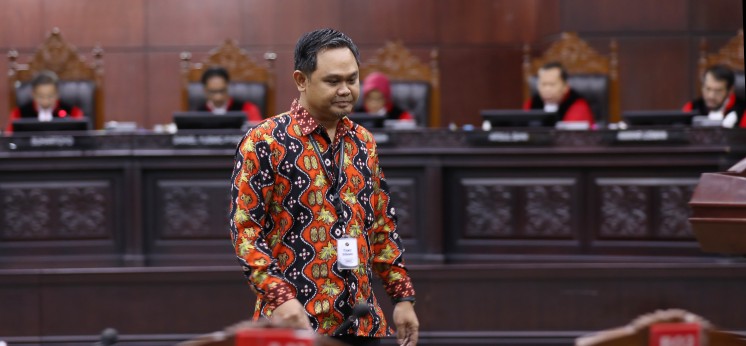
Law professor of Universitas Jenderal Soedirman, Tedi Sudrajat, attending the judicial review hearing of Law No. 3 of 2005 on the TNI Law as the DPR’s expert on Tuesday (03/03). Photo by MKRI/Ifa.
Jakarta (MKRI) - A judicial review hearing of Article 47 paragraphs (1) and (2) of Law No. 3 of 2025 on the Amendment to Law Number 34 of 2004 on the Indonesian National Armed Forces (TNI Law) was held on Tuesday, March 2, 2026, in the Plenary Courtroom of the Constitutional Court (MK).
In the hearing, the House of Representatives (DPR) presented Tedi Sudrajat, a Professor at the Faculty of Law, Universitas Jenderal Soedirman, as its expert witness. He explained that the placement of TNI soldiers in certain civilian positions is governed by an integrated legal framework comprising the 1945 Constitution, the State Civil Apparatus (ASN) Law, and the TNI Law.
According to Tedi, Article 1 paragraph (3) of the 1945 Constitution affirms the principle of the supremacy of law as both the source and the limit of state powers, including in the filling of certain civilian posts. Meanwhile, Article 30 paragraph (3) of the 1945 Constitution establishes the TNI as a state instrument in the field of defense tasked with defending, protecting, and maintaining the integrity and sovereignty of the state.
He added that the placement of soldiers in certain civilian positions is regulated in the ASN Law and the TNI Law. In the ASN Law, the object of regulation is certain ASN posts in central government agencies that may be filled by TNI soldiers as provided in Article 19 of the ASN Law. The system applied is the merit system or meritocracy, namely, the management of human resources based on qualifications, competence, potential, performance, integrity, and morality, implemented in a fair and reasonable manner.
By contrast, the TNI Law regulates the subject and the limitation of positions. The subject is TNI soldiers, with the restriction that they may only occupy posts in 14 ministries or institutions at the central level.
“The TNI Law, as a special regulation, affirms the subject and the limitations of the positions. The subject is TNI soldiers, and the limitation is that they may only occupy 14 ministries or institutions at the central level,” Tedi said before Chief Justice Suhartoyo, who chaired the session.
Tedi stated that the designation of those specific ministries or institutions is a matter of state political decision-making that involves complex political, security, and social considerations by institutions with democratic legitimacy, namely the President and the DPR.
“This can be understood as the incorporation of certain governmental affairs as strategic nodes of the state, referring to institutions that play a critical role in ensuring state stability and security and that have a high level of vulnerability to security threats. For that reason, there is the supremacy of law in Article 1 paragraph (3) and Article 30 paragraph (3) of the Constitution, Article 19 and Article 20 of the ASN Law, and Article 47 paragraphs (1) and (2) of the TNI Law,” he explained.
Choice for Legal Subjects
Tedi also interpreted the phrase “may occupy positions” in Article 47 paragraphs (1) and (2) of the TNI Law. The word “may”, he argued, indicates the existence of a choice for the legal subject to occupy or not to occupy a post, while still fulfilling the specified requirements. Those requirements refer to the provisions of Law No. 30 of 2014 on Government Administration, which regulate aspects of authority, procedure, and substance.
Thus, Article 47 of the TNI Law must be interpreted comprehensively to ensure the validity of TNI soldiers holding certain civilian posts based on the Government Administration Law, the ASN Law, and Government Regulation No. 11 of 2017 on Civil Servant Management. In practice, there is a strict and measurable filling pattern: first, there is job analysis, a set of competencies, and a job description; second, there is a request procedure from the heads of the 14 ministries or institutions to the TNI Commander; third, coordination is conducted between the Minister for Administrative and Bureaucratic Reform, the head of the National Civil Service Agency (BKN), and the TNI Commander; fourth, there is competency assessment to meet the substantive requirements of the position based on meritocracy; and fifth, the authority to appoint to certain ASN posts in terms of personnel law lies with the staffing supervisory officer.
Tedi stressed that the legal construction of certain civilian posts that may be filled by TNI soldiers is based on an integrated arrangement in the TNI Law and the ASN Law, which complement each other. These posts include managerial positions (senior executive posts/Jabatan Pimpinan Tinggi) filled through open selection and non-managerial positions (functional posts) at central government agencies, all based on the principle of meritocracy.
Furthermore, Tedi explained that the government bureaucracy recognizes a public service relationship (openbare dienstbetrekking), namely the relationship between the government and public officials that is subordinative in nature. In this relationship, officials are required to accept their appointments to certain posts and may not refuse assignments determined by the government, while the government has the authority to appoint someone to a particular position in accordance with statutory provisions.
Also read:
Provision of Active-Duty Soldiers in Civil Service Positions Challenged
Petition on the Active-Duty Soldiers Holding Civilian Positions Revised
Government Affirms Priority of Civilian Positions for ASN
House: Placement of Armed Forces Personnel in Civilian Posts Optimizes Military Competence and Expertise
House Expert’s Submission Late, Court Postpones TNI Law Hearing
During the preliminary hearing, the Petitioners stated that the government has misused Article 47 of the TNI Law to appoint active-duty soldiers to several strategic civilian positions. According to the Petitioners, the practice is inconsistent with the principle of civil supremacy and the goals of the 1998 reform.
The Petitioners referred to the National Assembly Decree (TAP MPR) No. VI/MPR/2000, which asserts that the socio-political role of the military in the past had caused democratic distortion. They argued that Constitutional Court Decision No. 114/PUU-XXIII/2025, which prohibits Police Officers from holding civilian positions, should apply to the Armed Forces, which bear the same role as the state’s tool to maintain the sovereignty of the Archipelagic State of the Republic of Indonesia.
Thus, the Petitioners requested that the Court provide constitutional certainty to ensure that the regulation governing the placement of soldiers in civilian positions remains consistent with the principles of the rule of law, democracy, and civilian supremacy.
In the petitum, the Petitioners request the Court to accept and grant the petition in its entirety. The Petitioners request that the Court declare Article 47 paragraphs (1) and (2) of Law No. 3 of 2025 contrary to the 1945 Constitution of the Republic of Indonesia and have no binding legal force. As an alternative, the Petitioners request that the provision be declared conditionally constitutional.
For Article 47 paragraph (1), the Petitioners request that the appointment of active-duty soldiers be interpreted as being allowed in the ministries or institutions that deal with national defense and security, including the National Defense Council, the state secretariat that handles presidential secretarial affairs, and the presidential military secretariat, state intelligence, cyber and state cryptography, the National Resilience Agency, search and rescue, counterterrorism, the Attorney General’s Office of the Republic of Indonesia, and the Supreme Court. Meanwhile, Article 47, paragraph (2), is requested to be interpreted to mean that soldiers may hold civilian positions only after resigning or retiring from active military service. (*)
Case tracking: Petition No. 238/PUU-XXIII/2025 (in Indonesian)
Author: Utami Argawati
Editor: Lulu Anjarsari P.
PR: Andhini S.F.
Translator: Rizky Kurnia Chaesario
Disclaimer: The original version of the news is in Indonesian. In case of any differences between the English and the Indonesian versions, the Indonesian version will prevail.
Tuesday, March 03, 2026 | 14:41 WIB 142