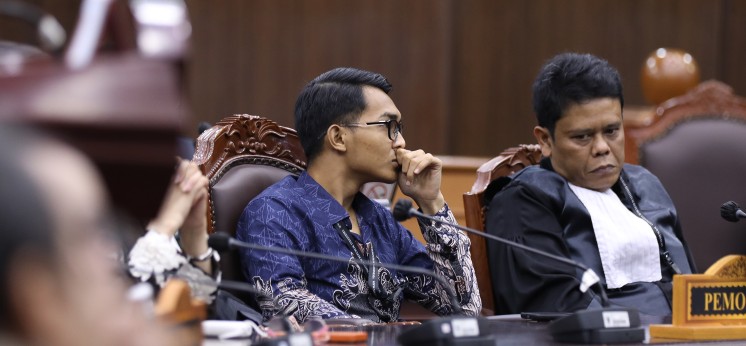
Petitioners (left) attending the ruling hearing on the judicial review of Law No. 19 of 2019 on the Corruption Eradication Commission, Monday (3/16/2026). Photo by MKRI/Ifa.
JAKARTA (MKRI) — The norm stipulated in Article 1 point 1 of Law No. 19 of 2019 on the Second Amendment to Law No. 30 of 2002 on the Corruption Eradication Commission (KPK Law) defines both the meaning and scope of corruption offenses falling under the authority of the Corruption Eradication Commission (KPK). As such, the a quo norm has set forth clear and definite limitations, thereby ensuring legal certainty.
Constitutional Justice Daniel Yusmic P. Foekh delivered this legal consideration during the ruling hearing for Case No. 106/PUU-XXIII/2025 on Monday, March 16, 2026. The petition was filed by Idalorita Daeli (Petitioner I), Haerul Kusuma (Petitioner II), and Andika Firmanta Sitepu (Petitioner III). The Petitioners challenged Article 1 point 1 and Article 6 letter e of Law No. 19 of 2019 on the Second Amendment to Law No. 30 of 2002 on the Corruption Eradication Commission, as well as Article 21 of Law No. 31 of 1999 on the Eradication of Corruption.
“Therefore, the Petitioners’ argument concerning the unconstitutionality of the phrase ‘corruption offense’ in Article 1 point 1 of Law No. 19 of 2019 is unfounded and must be declared legally groundless,” Justice Foekh stated.
Not Within the Court’s Authority
Regarding the alleged unconstitutionality of the phrase “corruption offense” in Article 6 letter e of Law No. 19 of 2019, the Court held that, when linked to the Petitioners’ petitum requesting that the phrase be interpreted as limited only to offenses regulated under Chapter II of the Corruption Eradication Law, the issue essentially pertains to the formulation of criminal law norms.
“If the Court were to add to or alter the formulation of norms—originally categorized as corruption offenses, into categories of non-corruption offenses, such action would fall under criminal policy. This is not within the Court’s authority to determine, but rather the domain of the lawmakers, as affirmed in Constitutional Court Decision No. 46/PUU-XIV/2016,” Foekh explained.
Loss of Object
As for the alleged unconstitutionality of the phrase “directly or indirectly” in Article 21 of the Corruption Eradication Law, the Court noted that it had already ruled on the matter in Decision No. 71/PUU-XXIII/2025. In that decision, the phrase “directly or indirectly” in Article 21 of Law No. 31 of 1999, as amended by Law No. 20 of 2001, was declared contrary to the 1945 Constitution and therefore not legally binding.
“Accordingly, the object of the Petitioners’ request is no longer consistent with the substance of the statutory norm being reviewed. Therefore, the Court concludes that the petition has lost its object,” Foekh said.
Verdict
Based on these legal considerations, the Court declared in its verdict that the Petitioners’ request concerning the review of the phrase “directly or indirectly” in Article 21 of Law No. 31 of 1999, as amended by Law No. 20 of 2001, is inadmissible.
“For the rest and remainder, the Court rejects the Petitioners’ petition,” stated Chief Justice Suhartoyo.
Also Read:
Response of DPR and KPK on Judicial Review of KPK’s Authority Limitation
Breaking the Chain of Organized and Systemic Corruption
Government, House Require More Time to Respond to KPK Judicial Review
Petitioners Reinforce Grounds for Challenging KPK’s Scope of Authority
Limit to KPK’s Authority Questioned
The petition in Case No. 106/PUU-XXIII/2025 was filed by Idalorita Daeli, Haerul Kusuma, and Andika Firmanta Sitepu. The Petitioners argued that Article 1 point 1 and Article 6 letter e of Law No. 19 of 2019 on the KPK, as well as Article 21 of Law No. 31 of 1999 on the Eradication of Corruption, contradict Article 1 paragraph (3), Article 28D paragraph (1), and Article 28I paragraph (4) of the 1945 Constitution.
At the preliminary hearing held at the Constitutional Court on Thursday, July 10, 2025, Idalorita explained that the KPK is mandated to conduct investigations, inquiries, and prosecutions of corruption offenses. However, for other criminal acts related to corruption, she argued that the KPK is not explicitly, specifically, and lawfully mandated by statute to exercise such authority. In practice, however, the KPK has carried out these functions as if it possessed a valid legal basis.
“The KPK can be said to have made a unilateral interpretation of the provisions contained in Article 1 point 1, Article 1 point 3, and the phrase ‘corruption offense’ in Article 6 letter e of Law No. 19 of 2019. In reality, Article 21 of Law No. 31 of 1999 is treated by the KPK as a corruption offense, whereas it belongs to the category of other criminal acts related to corruption,” said Idalorita, representing the Petitioners and acting in her capacity as an advocate.
The Petitioners further asserted that the KPK should only handle corruption offenses as regulated under Chapter II of the Corruption Eradication Law, which comprises 22 articles, namely Articles 2 through 20 of Law No. 31 of 1999 as amended by Law No. 20 of 2001. They contended that any deviation from this scope constitutes arbitrariness, abuse of power, or excess of power deliberately carried out by a law enforcement institution. Such conduct, they argued, contravenes the rule of law as enshrined in Article 1 paragraph (3) of the 1945 Constitution and sets a negative precedent for Indonesia’s law enforcement system.
Based on these arguments, the Petitioners requested the Court to declare Article 1 point 1 of the KPK Law unconstitutional and not legally binding unless interpreted as: “Corruption offenses are those defined under the chapter titled ‘Corruption Offenses’ in the law governing the eradication of corruption.”
They also sought a ruling that the phrase “corruption offense” in Article 6 letter e of the KPK Law is unconstitutional and not legally binding unless interpreted in the same limited sense. In addition, they requested the Court to declare the phrase “directly or indirectly” in Article 21 of Law No. 31 of 1999 unconstitutional and not legally binding.
Author: Sri Pujianti
Editor: N. Rosi
PR: Fauzan
Translator: Yuanna Sisilia
Disclaimer: The original version of the news is in Indonesian. In case of any differences between the English and the Indonesian versions, the Indonesian version will prevail.
Petition No. 106/PUU-XXIII/2025 (in Bahasa Indonesia)
Case No. 106/PUU-XXIII/2025 (in Bahasa Indonesia)
Complete Decision: Decion No. 106/PUU-XXIII/2025
Monday, March 16, 2026 | 12:23 WIB 80