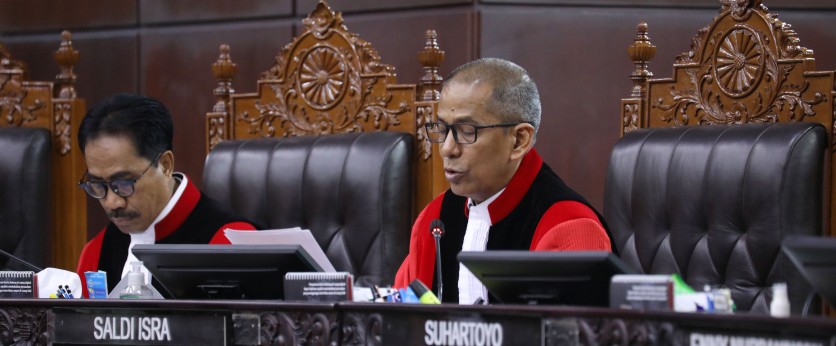
Deputy Chief Justice Saldi Isra reading out the ruling on the judicial review of the Law on Financial Sector Development and Strengthening (P2SK Law), Monday (3/2/2026). Photo by MKRI/Panji.
JAKARTA (MKRI) — The Constitutional Court (MK) declared the petition for judicial review of Article 238 paragraph (4) and Article 236 paragraph (1) of Law No. 4 of 2023 on Financial Sector Development and Strengthening (P2SK Law), as well as Article 8 paragraph (1) of Law No. 10 of 1998 on Banking, inadmissible. The Court found that the petition failed to satisfy the formal requirements for filing a judicial review.
“There is no doubt for the Court to declare that Petition No. 32/PUU-XXIV/2026 does not meet the formal requirements for submission,” said Deputy Chief Justice Saldi Isra while reading out the legal considerations of Decision No. 32/PUU-XXIV/2026 on Monday, March 2, 2026, in the Court’s plenary courtroom in Jakarta.
He explained that although the Petitioner had submitted evidence labeled P-1 through P-6, the documents were not affixed with sufficient stamp duty as required by statutory laws and regulations. Consequently, the evidence could not be validated in the hearing. Under the applicable procedural law, properly stamped documentary evidence constitutes an essential element in assessing whether a petition fulfills the formal admissibility threshold.
Also read:
Gresik Resident Revises Petition Challenging Banking Law and P2SK Law
Gresik Resident Files Judicial Review of Banking Law and P2SK Law
As previously reported, Petition No. 32/PUU-XXIV/2026 was filed by Rachmad Rofik, a resident of Gresik. He questioned what he described as concealed compound interest practices, the absence of regulatory provisions on mandatory debt repayment insurance, the right to obtain information and copies of fiduciary deeds, as well as the application of the reverse burden of proof and the status quo of assets. He argued that there exists a striking imbalance in standard-form contracts that are unilaterally imposed by creditors upon debtors.
According to the Petitioner, Article 28D paragraph (1) of the 1945 Constitution guarantees the right to fair legal certainty. In the banking context, such certainty, he contended, can only be realized when the “principal debt” refers strictly to the actual funds received by the debtor. The practice of incorporating the remaining interest from a prior contract into a new principal debt component, commonly referred to as anatocismus, within a top-up scheme amounts to a terminological manipulation that generates legal uncertainty and exploitation. The absence of an explicit prohibition in the Banking Law and the P2SK Law, he maintained, reflects the State’s failure to protect citizens from unjust and unfair financial practices.
The Petitioner further asserted that the lack of provisions mandating debt repayment insurance in the laws under review contravenes the principle of a just economy as enshrined in Article 33 paragraph (4) of the 1945 Constitution. That constitutional provision mandates togetherness and efficiency with justice. A banking system, he argued, should not allow debtors to bear economic risks alone. He emphasized that the insurance in question pertains not to insured objects or collateral, but to debt repayment insurance (credit life insurance).
He also argued that the absence of an obligation for creditors to automatically provide debtors with copies of fiduciary deeds and fiduciary certificates places debtors in a legally disadvantaged position. This, he claimed, undermines the right to information and the guarantee of protection of private property rights as stipulated in Article 28H paragraph (4) of the 1945 Constitution.
With respect to the reverse burden of proof and the status quo of assets in consumer disputes, the Petitioner maintained that creditors, as parties possessing accounting systems and detailed billing records, should bear the reverse burden of proof regarding billing details. In addition, he requested that collateral be automatically declared status quo, prohibited from execution, while a dispute is pending before a district court, in order to safeguard legal dignity and fairness.
In his petitum, the Petitioner requested the Court to declare Article 238 paragraph (4) of Law No. 4 of 2023 contrary to the 1945 Constitution and without binding legal force insofar as it is not interpreted to mean that any standard clause incorporating interest into the principal debt (anatocismus) or granting unilateral execution authority without a court ruling is null and void, and that financial service providers are obliged to restore the debtor’s position to the actual funds received.
He also sought a declaration that Article 8 paragraph (1) of Law No. 10 of 1998 is unconstitutional and not legally binding insofar as it is not interpreted to require commercial banks, in extending credit or financing, to transparently provide copies of loan agreements and fiduciary security deeds to debtors, and to include debt repayment insurance (credit life insurance) that releases the debtor from remaining obligations without any subrogation claim from any party, should the premium or coverage cost be borne by the debtor.
Furthermore, he requested the Court to declare Article 236 paragraph (1) of Law No. 4 of 2023 unconstitutional and not legally binding insofar as the prudential principle is not construed to include a prohibition against financial sector business actors combining accrued interest into a new principal debt (anatocismus) in restructuring or top-up schemes, as well as a prohibition against executing collateral while the object of security is under judicial dispute.
The Complete Decision: Decision No. 32/PUU-XXIV/2026 (in Bahasa Indonesia)
Author: Mimi Kartika
Editor: N. Rosi
Translator: Yuanna Sisilia
Disclaimer: The original version of the news is in Indonesian. In case of any differences between the English and the Indonesian versions, the Indonesian version will prevail.
Monday, March 02, 2026 | 10:28 WIB 65