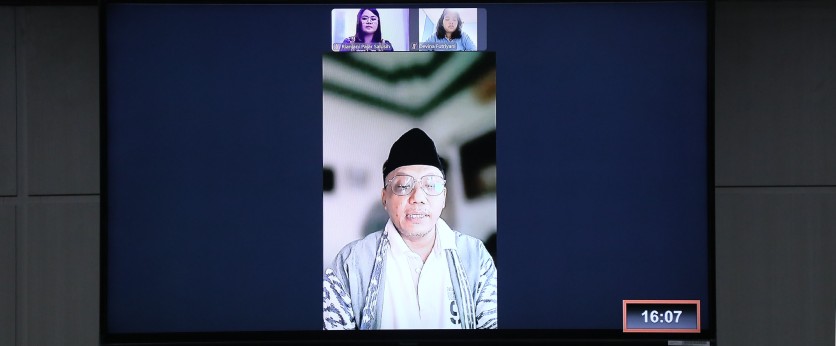
Rachmad Rofik presenting revisions to his petition for the judicial review of the Law on the Development and Strengthening of the Financial Sector (P2SK Law) online, Monday (2/9/2026). Photo by MKRI/Panji.
JAKARTA (MKRI) – Rachmad Rofik, a resident of Gresik, submitted revisions to Petition No. 32/PUU-XXIV/2026 before the Constitutional Court on Monday, February 9, 2026. He stated that he had amended the object of his petition to Article 238 paragraph (4) and Article 236 paragraph (1) of Law No. 4 of 2023 on the Development and Strengthening of the Financial Sector (P2SK Law), as well as Article 8 paragraph (1) of Law No. 10 of 1998 concerning Amendments to Law No. 7 of 1992 on Banking.
“The object of the petition and the drafting format have been adjusted,” Rachmad said during the petition revision hearing, which he attended online.
He argued that there is a profound imbalance in unilateral standard contracts between debtors and creditors. In his revised 50-page petition, he outlines five principal points, namely an urgent sociological reality, asymmetry of bargaining position, substantive protection through this petition, legal subject protection through credit insurance, and clarity of legal consequences.
In his petitum, the Petitioner requests the Court to declare Article 238 paragraph (4) of Law No. 4 of 2023 unconstitutional insofar as it is not interpreted to mean that any standard clause containing the practice of capitalizing interest into principal debt, known as anatocism, or granting unilateral execution authority without a court decision, shall be null and void by law, and that financial service providers must restore the customer’s debt position to the actual funds received.
He also requests the Court to declare Article 8 paragraph (1) of Law No. 10 of 1998 unconstitutional and not legally binding insofar as it is not interpreted to mean that in granting credit or financing, commercial banks are obliged to provide copies of the loan agreement and the fiduciary security deed transparently to the debtor, and must include Debt Repayment Insurance, or Credit Life Insurance, which releases the debtor from remaining obligations without any right of subrogation by any party, provided that the premium cost is borne by the debtor.
Furthermore, the Petitioner asks the Court to declare Article 236 paragraph (1) of Law No. 4 of 2023 unconstitutional and not legally binding insofar as it is not interpreted to mean that the prudential principle includes a prohibition for financial sector business actors from capitalizing accrued interest into new principal debt in restructuring or top-up schemes, as well as a prohibition on executing collateral while the object of the security is under judicial dispute.
Also read: Gresik Resident Files Judicial Review of Banking Law and P2SK Law
Previously, during the preliminary hearing on Tuesday, January 27, 2026, Rachmad had submitted a three-page petition. He challenged the practice of hidden compound interest, the absence of regulation on debt repayment insurance obligations, the right to obtain information and copies of fiduciary deeds, as well as the reverse burden of proof and the status quo of assets.
According to him, Article 28D paragraph (1) of the 1945 Constitution guarantees the right to fair legal certainty. In the banking context, such certainty exists only when “principal debt” refers strictly to the actual funds received by the debtor. The practice of incorporating the remaining interest from a previous contract into a new principal component, or anatocism, within a top-up scheme constitutes a manipulation of terminology that creates legal uncertainty and enables exploitation. The absence of explicit prohibitions in both the Banking Law and the P2SK Law, he contended, reflects a failure of the state to protect citizens from unjust and unfair financial practices.
He further argued that the lack of regulation concerning mandatory debt repayment insurance violates Article 33 paragraph (4) of the 1945 Constitution, which mandates the principles of togetherness and equitable efficiency in the national economy. The banking system, he maintained, must not allow debtors to bear economic risks alone. The insurance referred to is not property insurance, but credit insurance designed to settle outstanding obligations.
In addition, the absence of an obligation for creditors to automatically provide copies of fiduciary deeds and certificates places debtors in a legally disadvantaged position. This, he asserted, disregards the right to information and the constitutional guarantee of protection of private property under Article 28H paragraph (4) of the 1945 Constitution.
Regarding the reverse burden of proof and the status quo of assets, he maintained that in consumer disputes, creditors as parties possessing accounting systems must bear the burden of proving the accuracy of billing details. Moreover, collateral should be automatically declared under status quo, meaning it cannot be executed, while the object of the security remains under dispute before a district court, in order to safeguard legal dignity and prevent premature enforcement.
Explore case No. 32/PUU-XXIV/2026 (in Indonesian).
Author : Mimi Kartika
Editor : Lulu Anjarsari P.
Public Relations : Raisa Ayuditha M.
Translator : Yuanna Sisilia
Disclaimer: The original version of the news is in Indonesian. In case of any differences between the English and the Indonesian versions, the Indonesian version will prevail.
Monday, February 09, 2026 | 17:19 WIB 42