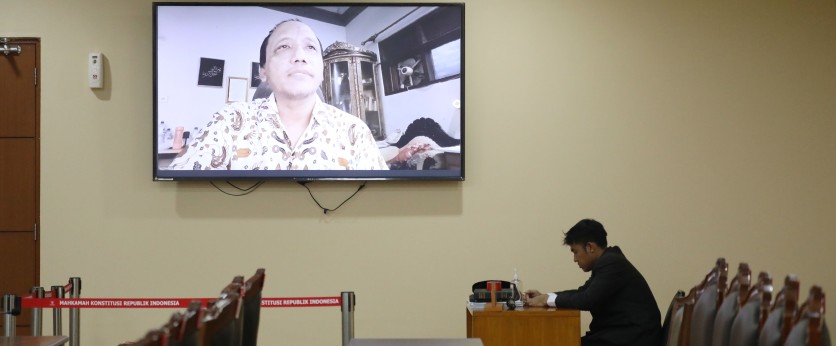
Rachmad Rofik presenting the main points of his petition at the preliminary hearing of Case No. 32/PUU-XXIV/2026, Tuesday (1/27/2026). Photo by MKRI/Panji.
JAKARTA (MKRI) – Rachmad Rofik, an entrepreneur residing in Gresik, filed a petition for judicial review of Article 8 paragraph (1) of Law No. 10 of 1998 on Banking (Banking Law) and Article 236 paragraph (1) of Law No. 4 of 2023 on the Development and Strengthening of the Financial Sector (P2SK Law) with the Constitutional Court (MK).
In his three-page petition, he challenges the practice of hidden compound interest, the lack of regulation of debt repayment insurance obligations, the right to obtain information and copies of fiduciary deeds, the imposition of a reverse burden of proof, and the status quo of collateral assets.
“The practice of hidden compound interest violates Article 28D paragraph (1) of the 1945 Constitution,” Rofik asserted during the preliminary hearing of Case No. 32/PUU-XXIV/2026 on Tuesday, January 27, 2026, which he attended online.
He elaborated that Article 28D paragraph (1) of the 1945 Constitution guarantees the right to fair legal certainty. In the banking context, such certainty can only be ensured when the “principal debt” refers strictly to the actual funds received by the debtor. The inclusion of accrued interest from a previous contract into a new principal debt, commonly known as anatocism, within a top-up scheme constitutes a manipulation of legal terminology that generates uncertainty and opens the door to exploitation. According to him, the absence of an explicit prohibition in both the Banking Law and the P2SK Law reflects the state’s failure to protect citizens from unjust financial practices.
Rofik further contended that the lack of statutory regulation concerning mandatory debt repayment insurance contravenes Article 33 paragraph (4) of the 1945 Constitution, which enshrines the principles of fairness and equitable efficiency in the national economy. He argued that the banking system should not allow debtors to bear economic risks alone. The insurance in question, he emphasized, is not property insurance but credit insurance that automatically settles outstanding obligations in the event of default without granting subrogation rights against the debtor.
In addition, he questioned the absence of an obligation for creditors to automatically provide copies of fiduciary deeds and fiduciary certificates to debtors. This, he argued, places debtors in a legally disadvantaged position and undermines their right to information as well as the constitutional guarantee of protection of private property under Article 28H paragraph (4) of the 1945 Constitution.
Regarding the reverse burden of proof and the status quo of assets, Rofik maintained that in consumer disputes, creditors as parties possessing accounting systems should bear the burden of proving the accuracy of billing details. He also proposed that collateral objects be automatically declared under status quo, meaning they cannot be executed, while a dispute is pending before a district court, in order to uphold legal dignity and prevent irreversible harm.
In his petitum, Rofik requests the Court to declare Article 8 paragraph (1) of the Banking Law unconstitutional insofar as it is not interpreted as requiring the inclusion of debt repayment insurance that automatically settles the debtor’s remaining obligations in the event of default without subrogation rights.
He also asks the Court to declare Article 236 of the P2SK Law unconstitutional insofar as it is not interpreted as prohibiting the inclusion of interest components from previous contracts into a new principal debt in top-up schemes; obligating creditors to provide copies of fiduciary deeds to debtors no later than seven working days after registration; imposing a reverse burden of proof on creditors regarding billing details; and prohibiting enforcement actions while collateral objects are under dispute before a district court. Furthermore, he seeks a declaration that any credit agreement violating these principles be deemed null and void.
Unusual Petition Structure
The panel hearing the case was chaired by Deputy Chief Justice Saldi Isra, accompanied by Constitutional Justices Ridwan Mansyur and Arsul Sani.
During the advisory session, Justice Ridwan observed that the petition, consisting of only three pages, was highly unusual. He noted that petitions must comply with the structure and formal requirements stipulated in Constitutional Court Regulation No. 7 of 2025 on Procedures in Judicial Review Cases.
“There are several aspects that remain insufficient, particularly in terms of structure and formal drafting, which do not yet conform to the applicable procedural guidelines,” Ridwan said.
Before adjourning the hearing, Deputy Chief Justice Saldi granted the Petitioner the opportunity to revise his petition. The revised submission, both in soft copy and hard copy, must be received by the Court no later than Monday, February 9, 2026, at 12:00 WIB.
Explore case No. 32/PUU-XXIV/2026 (in Indonesian).
Author : Mimi Kartika.
Editor : N. Rosi.
Translator : N. Valentino Rahadityo/Yuanna Sisilia
Disclaimer: The original version of the news is in Indonesian. In case of any differences between the English and the Indonesian versions, the Indonesian version will prevail.
Tuesday, January 27, 2026 | 17:20 WIB 55