Nia Kurniati, an expert presented by the House of Representatives (DPR), after delivering her testimony at the continued hearing of the judicial review concerning the state’s right to control land, Wednesday (01/21/2026), at the Constitutional Court courtroom. Photo by MKRI/Ifa.
JAKARTA, MKRI – The Constitutional Court (MK) once again convened a hearing in the judicial review of Law Number 6 of 2023 concerning the Stipulation of Government Regulation in Lieu of Law Number 2 of 2022 on Job Creation as Law (Job Creation Law) on Wednesday (4/2/2026).
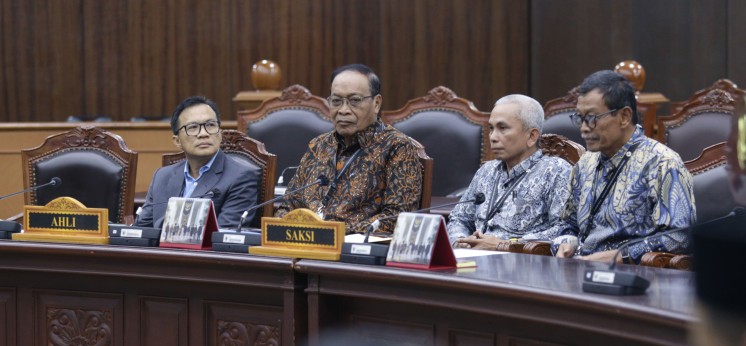
The eighth hearings for Petition Number 168/PUU-XXIII/2025 was held to hear statements from the President/Government’s Experts and Witnesses. The Government presented Rudy (Professor at the University of Lampung) and Budi Santosa (Professor at Universitas Gadjah Mada) as Experts, while Aride and Kasno appeared as Witnesses.
Budi Santosa explained that prioritizing water fulfillment within a river basin territory is essential due to competing demands for social, economic, and environmental purposes. Without such prioritization, economic interests could override social and environmental needs.
To ensure proper allocation in accordance with water availability, he said, it is necessary to record the number of users and usage quotas. This forms the basis for issuing Business Licensing and Approvals for Water Resources Utilization. Such arrangements are stipulated in Articles 44, 45, and 49 of Law Number 17 of 2019 on Water Resources (Water Resources Law), as amended by the Job Creation Law under Paragraph 9 Article 53 points 10, 11, and 12.
Article 44(1) of Water Resources Law, as amended on Article 53(10) of Job Creation Law, states that water resources utilization as stipulated on Article 29(2) letter c for business and non-business needs may only be carried out after obtaining Business Licensing or Approval for Water Resources Utilization.
Based on Article 45(1), as amended on Article 53(11), regulates approvals for non-business needs, including fulfillment of basic daily needs where water use alters the natural condition of the water source; and/or use requested by groups requiring water in large quantities.
Meanwhile, approval for the use of Water Resources to meet the needs of smallholder agriculture is required if the method of use is carried out by changing the natural conditions of the Water Source; and/or its use for smallholder agriculture outside the existing irrigation system. And approval for the use of Water Resources to meet the needs for activities other than to meet basic daily needs and smallholder agriculture that are not business activities. Although not a business activity, large-scale water use must still be recorded through approval mechanisms to support allocation planning and water balance calculations within a river basin.
“Thus, Article 49 paragraph (3) letters a, b, c, d, e, f, and g of the Water Resources Law, as amended by Job Creation Law under Paragraph 9 Article 53 point 12, further explains the sequence of licensing grants. Priority for approval of water resources utilization for non-business needs is regulated under letters a, b, c, and e as described in Article 45, while business licensing for business needs is regulated under letters d, f, and g. Accordingly, the provisions under letters a, b, c, and e must obtain approval for water resources utilization—not business licensing—so that allocation and prioritization can be guaranteed by Water Resources Managers, as explained in Article 45 and safeguarded under Article 47 of the Water Resources Law, namely the fulfillment of basic daily needs for groups requiring large quantities of water; fulfillment of daily needs that alter natural water source conditions; and smallholder agriculture outside existing irrigation systems,” Budi explained.
Japan’s Iriai-ken Concept
In his expert testimony, Rudy emphasized the need for legal instruments capable of operationally providing protection within a welfare state framework. He argued that recognition of communal rights does not imply the absence of formal state regulation. On the contrary, comparative experience shows communal rights endure and function fairly only when institutionalized within formal legal systems.
In modern public law theory, every right including communal rights requires a state legal framework to ensure certainty, clear boundaries, and enforcement mechanisms. Without formal regulation, communal rights are vulnerable to unilateral claims, misuse, or displacement by stronger economic interests. Japan’s iriai-ken system offers an important example. Iriai-ken refers to communal rights of local communities to jointly utilize forests, mountains, and certain water territories. However, these rights do not exist outside the state framework.
Similarly, he noted that normatively, the Job Creation Law does not eliminate recognition or protection of traditional, local, and Indigenous communities. Instead, it regulates them through public law mechanisms. The licensing regime reflects not a withdrawal of state control, but an active, measurable, and accountable exercise of that control.
“Legal certainty is important not only for business actors but also for communities, because permits provide a legal basis for objections, public oversight, and corrective measures in the event of violations. Conversely, the absence of permits opens space for unregulated and unaccountable exploitation, ultimately harming the broader public interest. In this framework, the use of administrative licensing regimes, including in natural resource governance, reflects the active exercise of state control, not its denial,” Rudy explained.
Legalization and Sustainable Forest Management
Witness Aride, currently Head of the Mattabulu Village Forest Management Institution (LPHD Mattabulu), recounted his past as an encroacher who illegally managed land within forest areas. He later received socialization and assistance from the Walanae Forest Management Unit, the Social Forestry and Environmental Partnership Center for the Sulawesi Region, and the South Sulawesi Provincial Forestry Office regarding Social Forestry schemes aimed at legalization and sustainable forest management.
During the licensing process, his group received assistance in fulfilling administrative requirements, including preparation of application maps, draft village regulations, and establishment of village forestry institutions. On 7 May 2018, they officially obtained a Social Forestry permit under the Village Forest scheme. Following approval, they developed social forestry enterprises by dividing management areas based on biophysical and community social conditions through Social Forestry Business Groups.
“In implementing sustainable social forestry management, LPHD Mattabulu has achieved various accomplishments, including through the KUPS Coffee group, where Mattabulu coffee was named Best 1 at the 2019 South Sulawesi Heritage Coffee Festival. Mattabulu coffee has participated in exhibitions in Soppeng Regency, Makassar, Jakarta, and Mandalika. We received the 2023 Wana Lestari Certificate, placing in the national Top 5 Village Forest category. LPHD Mattabulu has also participated in the Indonesian Tourism Village Awards since 2022/2024 and entered the Top 50 Tourism Villages. LPHD Mattabulu was also a Top 5 Nominee for Best KUPS at the 2025 Pesona Festival,” Aride explained.
Formulating Water Resource Allocation Recommendations
Another witness, Kasno, currently member of the Indonesian Farmers Harmony Association (HKTI) and the Water Resources Management Coordination Team (TKPSDA) for the Cimanuk-Cisanggarung River Basin, explained his role in recommending water allocation to the Minister of Public Works. The recommendations, according to Kasno, follow statutory priority orders: fulfillment of basic daily needs, smallholder agriculture, drinking water supply, and non-public commercial activities, as mandated by the Water Resources Law.
Each year, according to Kasno, TKPSDA holds plenary sessions to formulate allocation recommendations for the following year. Discussions are based on validated data on household needs, agriculture, drinking water, and commercial use, verified by independent consultants to ensure reliability and objectivity. Based on these data, plenary sessions deliberate and agree on allocation recommendations for ministerial determination.
Kasno added that the team also conducts monitoring and evaluation of allocation implementation, including when stakeholders propose additional water allocations, to ensure priority needs remain fulfilled.
“As representatives of non-governmental elements within TKPSDA, we are committed to ensuring that water allocation for commercial purposes does not override the priority fulfillment of basic community needs, farmers’ needs, and non-commercial public interests as regulated by laws and regulations,” Kasno stated.
Read also:
Farmers’ Union Questions Agricultural Commodity Imports and Traditional Fishermen’s Rights
Farmers’ Association Refines Petition on Agricultural Imports and Traditional Fishermen’s Rights
House Explains Licensing of Coastal Areas and Small Islands
Flexibility in Investment Policy in the Horticulture Sector
Farmer from Ale’ Sewo Village Criminalized for Farming in Forest Area
Job Creation Law Review: Petitioners’ Expert Addresses Defiance of Constitutional Court Decisions
DPR Expert Discusses Integration of Agrarian Reform into the Land Bank Agency
For information, Case Number 168/PUU-XXIII/2025 was filed by the Consortium for Agrarian Reform (KPA), Indonesia Human Rights for Social Justice (IHCS), Indonesia for Global Justice (IGJ), and the Institute for the Study and Education of Economic, Social and Cultural Rights.
The Petitioners challenge seven norms, including Article 20 paragraphs (1) and (2) insofar as the phrase “Business Licensing” in Law Number 27 of 2007 concerning the Management of Coastal Areas and Small Islands as amended by Law Number 1 of 2014 and subsequently amended in Chapter III Part Three Paragraph 2 Article 18 Point 18 of the Annex to the Job Creation Law.
They also challenge Article 30 paragraph (1) insofar as the phrase “Breeding Varieties” in Law Number 39 of 2014 concerning Plantations as amended in Chapter III Part Four Paragraph 3 Article 29 Point 7 of the Annex to the Job Creation Law. Furthermore, Article 30 paragraph (1) insofar as the phrase “Import of Agricultural Commodities” in Law Number 19 of 2013 concerning the Protection and Empowerment of Farmers as amended in Chapter III Part Four Paragraph 3 Article 32 Point 2 of the Annex to the Job Creation Law is also under review.
Article 20 paragraphs (1) and (2) concerning the phrase “Business Licensing” regulate the obligation of the Central Government to facilitate business licensing for the utilization of marine areas by Local Communities and Traditional Communities for their daily livelihoods. According to the Petitioners, this requirement hinders communities because they must obtain business licenses similar to corporate entities, potentially creating indirect discrimination and a lack of legal certainty.
In addition, the Petitioners argue that Article 30 paragraph (1) concerning the phrase “Breeding Varieties” was previously declared conditionally unconstitutional by the Constitutional Court in Decision Number 138/PUU-XIII/2015, insofar as it does not exclude breeding varieties developed by small domestic farmers for their own communities.
Explore the Case: Number 168/PUU-XXIII/2025
Author : Sri Pujianti
Editor : N. Rosi
Public Relations: Andhini SF.
Translator : SO
Disclaimer: The original version of the news is in Indonesian. In case of any differences between the English and the Indonesian versions, the Indonesian version will prevail.
Wednesday, February 04, 2026 | 17:03 WIB 70