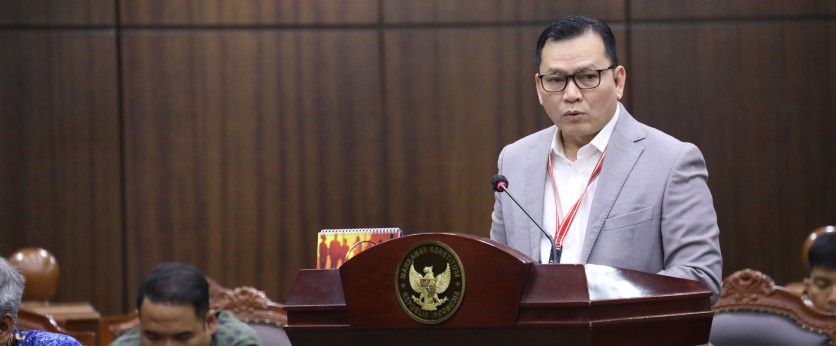
Elen Setiadi, representing the President/Government, delivers the Government’s statement in the judicial review hearing of Law Number 6 of 2023 on Job Creation, in the Plenary Courtroom of the Constitutional Court, on Monday (11/17/2025). Photo by MKRI/Panji.
JAKARTA, (MKRI) – The provisions under Law Number 6 of 2023 on the Stipulation of Government Regulation in Lieu of Law Number 2 of 2022 on Job Creation as Law (Job Creation Law) strengthen the authority of the state to determine the limits of investment activities through a risk-based business licensing system. The Government may reject, limit, or require partnerships for any investment plans in the horticulture sector based on the level of risk and impact on national interests. Through this mechanism, the state remains the main regulator, thereby preserving the principle of state control over vital branches of production as mandated by Article 33 of the 1945 Constitution of the Republic of Indonesia (UUD NRI 1945).
This statement was presented by Elen Setiadi during the continuation of the judicial review hearing of Law Number 6 of 2023 on the Stipulation of Government Regulation in Lieu of Law Number 2 of 2022 on Job Creation as Law (Job Creation Law) on Monday (11/17/2025). The fourth hearing in Case Number 168/PUU-XXIII/2025 was held to hear the Government’s explanation in the Plenary Courtroom of the Constitutional Court.
“The stipulation of the 30% figure in the previous law was static, while the needs for investment, technology, and horticultural markets are dynamic. The new system allows the Government to adjust foreign investment restrictions swiftly through a Presidential Regulation, without having to amend the law every time there is a shift in the global economy or national needs. Thus, this flexible investment policy is a manifestation of adaptive state control, not a relinquishment of state authority,” Elen Setiadi explained during the plenary hearing presided over by Chief Justice Suhartoyo.
Does Not Burden the Public
Furthermore, the Government addressed the provisions of Article 49 paragraph (3) letters a, b, and c of Paragraph 9 Article 53 number 1 of the Job Creation Law appendix. These norms are not intended to burden the public with commercial licensing obligations but to ensure that water resource management and utilization are conducted sustainably, fairly, and equitably among users.
The changes to water resource regulations in Law 6/2023 reflect adjustments to the national licensing system through a risk-based business licensing concept, emphasizing simplification and integration without altering the people's fundamental right to water.
“‘Business Licensing’ as referred to in Article 49 paragraph (3) is not intended for water use by the public for daily basic needs such as household drinking water and small-scale farming, but for commercial water use or uses impacting larger water systems,” said Elen Setiadi.
Prosperity for the People
The Government also clarified the purpose of Article 126 paragraph (1) of the Job Creation Law appendix, which aims to strengthen the state’s role in ensuring land availability to support equitable economic development. The norm is imperative and operational, reflecting the exercise of the state's right of control as stated in Article 33 paragraph (3) of the 1945 Constitution.
Elen Setiadi emphasized that the contested norm does not eliminate agrarian reform principles but integrates them into a broader national land policy that encompasses public interest, social needs, development, economic equity, and land consolidation. Agrarian reform is therefore not diminished but accommodated within a comprehensive land policy framework.
“The establishment of these six objectives for land availability is an elaboration of the principle of ‘the greatest prosperity of the people’ as mandated by Article 33 paragraph (3) of the 1945 Constitution. Hence, the norm is not unconstitutional but rather a concrete manifestation of the state’s obligation to guarantee equitable access to land and prevent excessive concentration of ownership,” Elen stated.
Read also:
Farmers’ Union Questions Agricultural Commodity Imports and Traditional Fishermen’s Rights
Farmers’ Association Refines Petition on Agricultural Imports and Traditional Fishermen’s Rights
House Explains Licensing of Coastal Areas and Small Islands
As additional information, the petition in Case Number 168/PUU-XXIII/2025 was filed by the Consortium for Agrarian Reform (KPA), Indonesia Human Rights for Social Justice (IHCS), Indonesia for Global Justice, and the Association for Economic, Social, and Cultural Rights Education and Advocacy. The Petitioners challenge seven provisions, including Article 20 paragraph (1) and (2) with regard to the phrase “Business Licensing” in Law 27/2007 on the Management of Coastal Areas and Small Islands as amended by Law 1/2014 and further amended in Chapter III Part Three Paragraph 2 Article 18 Number 18 of the Job Creation Law appendix. Another provision challenged is Article 30 paragraph (1) concerning “Breeding Results Variety” under Law 39/2014 on Plantations as amended in Chapter III Part Four Paragraph 3 Article 29 number 7 of the Job Creation Law appendix. Additionally, Article 30 paragraph (1) concerning “Agricultural Commodity Import” in Law 19/2013 on the Protection and Empowerment of Farmers as amended in Chapter III Part Four Paragraph 3 Article 32 Number 2 of the Job Creation Law appendix is also at issue.
Article 20 paragraph (1) and (2), particularly the phrase "Business Licensing" in Law 27/2007 on Coastal and Small Island Management, requires the Central Government to facilitate business licensing for resource utilization in coastal areas by local and traditional communities for daily needs.
The Petitioners argue that this requirement restricts communities from accessing coastal resources for subsistence as they are subjected to licensing procedures similar to corporate or large capital operators, potentially leading to indirect discrimination. The equal treatment of companies and local communities creates an absence of recognition, protection, and fair legal certainty for traditional communities.
Therefore, the Petitioners argue that Article 20 paragraph (1) and (2), particularly the phrase "Business Licensing" in the Coastal and Small Island Management Law as amended by the Job Creation Law, contradicts Article 28D paragraph (1) and Article 281 paragraph (2) of the 1945 Constitution unless interpreted as “Protection of Rights.”
The Petitioners also challenge Article 30 paragraph (1) concerning “Breeding Results Variety” in Law 39/2014 on Plantations, amended by the Job Creation Law. This provision requires that varieties resulting from breeding or introduced from abroad be released by the Central Government or launched by the variety owner before being distributed. The Constitutional Court previously declared this provision conditionally unconstitutional in Decision Number 138/PUU-XIII/2015, stating that it must not apply to varieties bred by small farmers for their own communities.
Lastly, the Petitioners contest Article 30 paragraph (1) concerning “Agricultural Commodity Import” in Law 19/2010 on the Protection and Empowerment of Farmers, as amended by the Job Creation Law. The provision stipulates that the Government’s food reserves must come primarily from domestic production and agricultural imports while protecting farmers’ interests. The Petitioners argue that the reserves should be met with domestic agricultural products and that limits on imports must be imposed to protect and empower farmers.
Author : Sri Pujianti
Editor : N. Rosi
PR: : Andhini S.F.
Translator : Agusweka Poltak Siregar
Disclaimer: The original version of the news is in Indonesian. In case of any differences between the English and the Indonesian versions, the Indonesian version prevails.
Case track: Number 168/PUU-XXIII/2025
Monday, November 17, 2025 | 18:31 WIB 418