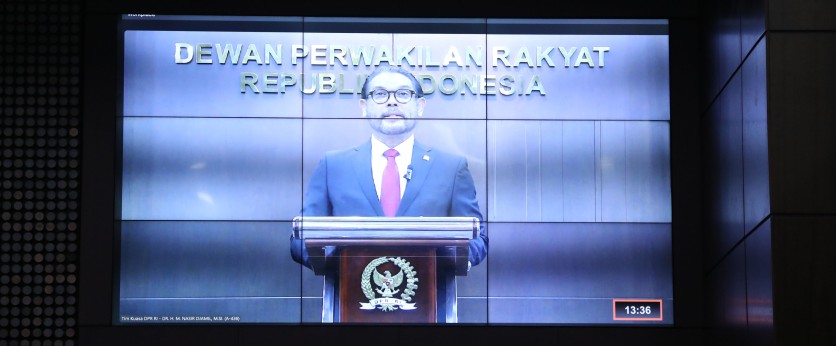
Member of Commission III of the House of Representatives (DPR), Nasir Djamil, delivers DPR’s statement online at the judicial review hearing of Law No. 6 of 2023 on Job Creation, Tuesday (11/4/2025). Photo by MKRI/Panji.
JAKARTA, (MKRI) – Business licensing contains distinctions between management rights and the utilization of small islands and surrounding waters, as clarified by the Constitutional Court (MK) in Decision No. 3/PUU-VIII/2010. The ruling prompted adjustments to business licensing mechanisms, including those under the Law on Coastal Areas. This clarification was delivered by DPR member Nasir Djamil during the continued hearing of the judicial review of Law No. 6 of 2023 on the Stipulation of Government Regulation in Lieu of Law No. 2 of 2022 on Job Creation as Law (Job Creation Law) on Tuesday (11/4/2025). The hearing agenda was to listen to the statements of the DPR and the Government/President. However, the Government requested a postponement of its presentation.
Nasir explained that Articles 20 (1) and (2) of Law No. 27 of 2007 are not standalone provisions but part of the broader regulation on business licensing for coastal areas and small islands. Thus, they cannot be considered contrary to the 1945 Constitution of the Republic of Indonesia (UUD 1945) or the Constitutional Court’s ruling. Based on the Court’s legal reasoning, licensing is not a transferable property right and therefore must include mechanisms that prioritize local and traditional communities.
In this context, the state may grant management rights through licensing mechanisms. However, granting licenses to private entities does not mean relinquishing state authority for the people’s welfare. Through the licensing system, private parties may manage resources without acquiring ownership rights or permanent control over state assets.
“Therefore, Articles 20 (1) and (2) of Law No. 27 of 2007 should be understood as provisions regulating business licensing in coastal and small-island areas. They are not inconsistent with the 1945 Constitution or the Constitutional Court’s decision,” explained Nasir Djamil.
Plant Breeding Exception for Small Farmers
Regarding the review of Article 29(7) of the Job Creation Law amending Article 30(1) of Law No. 39 of 2014 on Plantations, the DPR referred to Constitutional Court Decision No. 138/PUU-XIII/2015. The Court ruled that government authorization for plant breeding does not apply to domestic small-scale farmers who breed plants for their own communities.
This principle remains valid under related laws, including Law No. 22 of 2019 on Sustainable Agricultural Systems and Law No. 29 of 2000 on Plant Variety Protection. Accordingly, the DPR maintains that the relevant provisions of the Job Creation Law align with existing legislation, including its implementing regulations.
Nasir also cited Government Regulation No. 26 of 2021 on Agricultural Administration, as amended by Government Regulation No. 52 of 2023, which outlines licensing requirements for genetic resource collection and plant variety release. The regulation explicitly exempts small farmers from these requirements.
“Small farmers must only report their activities to provincial agricultural authorities, who will forward them to the minister. The resulting plant varieties may be distributed only within the same district or city,” Nasir clarified.
Read also:
Farmers’ Union Questions Agricultural Commodity Imports and Traditional Fishermen’s Rights
Farmers’ Association Refines Petition on Agricultural Imports and Traditional Fishermen’s Rights
Background of the Petition
The petition, Case No. 168/PUU-XXIII/2025, was filed by the Consortium for Agrarian Reform (KPA), Indonesia Human Rights for Social Justice (IHCS), Indonesia for Global Justice (IGJ), and the Institute for Economic, Social, and Cultural Rights Studies and Education. The petition challenges seven norms, including Articles 20(1) and (2) of the Law on Coastal Areas and Small Islands, as amended by the Job Creation Law, concerning business licensing for local and traditional communities, Article 30(1) of the Plantation Law, concerning plant variety breeding, Article 30(1) of the Law on Farmers’ Protection and Empowerment, concerning agricultural imports.
The petitioners argue that the requirement for local communities to obtain business licenses—similar to large corporations—creates indirect discrimination and fails to provide equal recognition and protection for traditional communities.
They also contend that unrestricted agricultural imports threaten local farmers’ welfare and violate Article 28D (1) and Article 28I (2) of the 1945 Constitution, which guarantee fair legal certainty and protection of citizens’ rights.
Author : Sri Pujianti
Editor : N. Rosi.
PR : Andhini SF.
Translator : Agusweka Poltak Siregar
Disclaimer: The original version of the news is in Indonesian. In case of any differences between the English and the Indonesian versions, the Indonesian version prevails.
Explore the Case: Case No. 168/PUU-XXIII/2025.
Tuesday, November 04, 2025 | 16:49 WIB 355