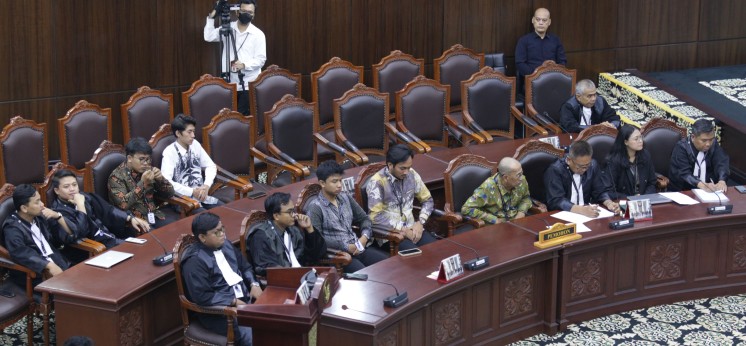
Chief Justice Suhartoyo delivering the ruling for Case No. 267/PUU-XXIII/2025 on the judicial review of Law No. 1 of 2023 on the Criminal Code and Law No. 20 of 2025 on the Criminal Procedure Code, Monday (2/2/2026). Photo by MKRI/Bayu.
JAKARTA (MKRI) — The Constitutional Court (MK) declared inadmissible the petition for judicial review of Article 488 of Law No. 1 of 2023 on the Criminal Code (KUHP) filed by Lina and Sandra Paramita. The Court held that the Petitioners failed to demonstrate that the legal issues they experienced were directly attributable to the enforcement of the challenged provision against the 1945 Constitution.
“Adjudicating, the Court declares Petition No. 267/PUU-XXIII/2025 inadmissible,” said Chief Justice Suhartoyo while delivering the ruling in the plenary courtroom on Monday, February 2, 2026.
In its legal considerations, delivered by Deputy Chief Justice Saldi Isra, the Court explained that pursuant to the transitional provision under Article 618 of Law No. 1 of 2023, all ongoing criminal proceedings involving Petitioner I and Petitioner II are governed by the new Criminal Code, in casu Law No. 1 of 2023.
However, the Petitioners were unable to submit sufficient evidence concerning the continuation of the investigative process after the issuance of the notice of commencement of investigation. They likewise failed to clarify their current legal status in the alleged criminal report, particularly in the absence of proof that they had formally been designated as suspects or charged under Article 488 of Law No. 1 of 2023.
“Based on the description and evidence presented by Petitioner I and Petitioner II, the Court does not possess sufficient proof or conviction that the problems experienced by the Petitioners are causally linked to the provision regulating aggravated embezzlement as stipulated in Article 488 of Law No. 1 of 2023, whose constitutionality is being challenged,” Saldi stated.
Therefore, although the Petitioners satisfied the formal requirements to file a judicial review, the Court found no causal relationship (causa verband) between the alleged constitutional impairment and the entry into force of the norm under review. The claimed constitutional losses, accordingly, could not be legally attributed to the contested article.
In their petitum, the Petitioners requested the Court to declare Article 488 of the Criminal Code contrary to the 1945 Constitution and without binding legal force insofar as it is not interpreted to mean:
(1) that if the act referred to in Article 486 is committed by a person whose control over the property arises from an employment relationship, profession, or remuneration, the person shall be subject to a maximum imprisonment of five years or a maximum category V fine; and
(2) that any person who commits the act referred to in paragraph (1) shall not be punished, provided that the act was carried out pursuant to a lawful official order from an authorized superior. According to the Petitioners, the contested provision impaired their constitutional rights as guaranteed under Article 27 paragraph (1), Article 28D paragraph (1), and Article 28G paragraph (1) of the 1945 Constitution.
At the preliminary hearing on Friday, January 9, 2025, their legal counsel, Leon Maulana Mirza Pasha, argued that the practical application of Article 488 opens space for abuse within hierarchical and unequal employment relationships. A superior, he contended, may shift criminal liability onto subordinates, resulting in fear, psychological pressure, and the threat of criminalization against employees who act in good faith in carrying out their duties.
The Petitioners previously worked as finance staff at two different companies. They claimed that the companies used employees’ personal bank accounts, including theirs, for corporate financial transactions. They frequently received instructions from the company director to use corporate funds and/or their personal funds for company purposes and, at times, for the director’s personal interests.
Although referring to two separate companies, the Petitioners identified the same individual as their superior. In early July 2024, both companies reportedly encountered financial difficulties. The superior subsequently accused the Petitioners of embezzling company funds, terminated their employment unilaterally, and filed a criminal complaint for embezzlement with the West Jakarta Metro Police.
Article 488 of the Criminal Code stipulates that if the act referred to in Article 486 is committed by a person whose control over the property arises from an employment relationship, profession, or remuneration, the offender shall be subject to a maximum imprisonment of five years or a category V fine. Meanwhile, Article 618 provides that, once the law enters into force, criminal acts that are undergoing judicial proceedings shall be adjudicated under the new law, unless the previous law is more favorable to the suspect or defendant.
The Petitioners further argued that in hierarchical and asymmetrical employment relations, the absence of preventive safeguards in Article 488 creates a structural imbalance. Subordinates must prove that they acted in good faith pursuant to a superior’s order, yet at the investigative stage under the Criminal Procedure Code they are not afforded equal opportunity to present their account compared to the complainant. This condition, they asserted, places subordinates in a particularly vulnerable position from the outset and undermines the principle of equality before the law.
Explore The Case: Case No. 267/PUU-XXIII/2025
Also read:
Petitioners Focus Challenge on Criminal Code Provision
Petitioners Challenge New Criminal Code and Criminal Procedure Code
Author: Mimi Kartika
Editor: N. Rosi
Translator: Yuanna Sisilia
The Complete Decision: Decision No. 267/PUU-XXIII/2025
Disclaimer: The original version of the news is in Indonesian. In case of any differences between the English and the Indonesian versions, the Indonesian version will prevail.
Monday, February 02, 2026 | 17:29 WIB 59