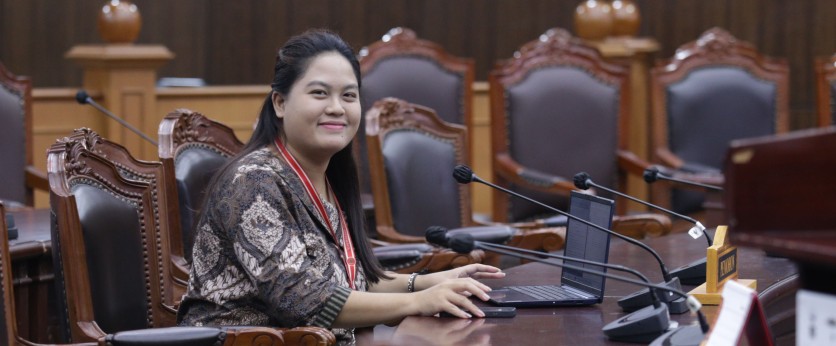
The Petitioners attending the petition revision hearing for Case No. 267/PUU-XXIII/2025, Thursday (1/22/2026). Photo by MKRI/Bay.
JAKARTA (MKRI), Petition No. 267/PUU-XXIII/2025 focuses on the material judicial review of Article 488 of Law No. 1 of 2023 on the Criminal Code (KUHP) against the 1945 Constitution of the Republic of Indonesia. The focus was conveyed by the Petitioners during the petition revision hearing held on Thursday (January 22, 2026).
At the previous preliminary hearing, in addition to challenging Article 488 of the KUHP, the Petitioners had also sought a judicial review of Article 16 paragraph (1), Article 19 paragraph (1), Article 22 paragraph (1), and Article 23 paragraph (5) of the new Criminal Procedure Code (KUHAP). “We have narrowed the scope of the judicial review solely to the Criminal Code, namely Article 488 of Law No. 1 of 2023 on the Criminal Code,” said the Petitioners’ legal counsel, Priskila Octaviani, in the Courtroom of the Constitutional Court.
Priskila further outlined the revised petitums submitted by the Petitioners. They request the Court to declare Article 488 of the KUHP unconstitutional and not legally binding insofar as it is not interpreted to mean that: “(1) Where the act as referred to in Article 486 is committed by a person whose control over the property arises from an employment relationship, professional capacity, or remuneration for such control, the person shall be subject to imprisonment of up to five (5) years or a fine of up to category V. (2) Any person who commits the act as referred to in paragraph (1) shall not be subject to criminal liability insofar as the act is carried out pursuant to a lawful order of office from a competent superior.”
Also read:
Petitioners Challenge New Criminal Code and Criminal Procedure Code
The Petitioners consist of two Indonesian citizens, Lina and Sandra Paramita. According to them, the challenged provision has impaired their constitutional rights as guaranteed under Article 27 paragraph (1), Article 28D paragraph (1), and Article 28G paragraph (1) of the 1945 Constitution.
“The application of Article 488 of the Criminal Code in practice opens room for abuse of power relations, whereby those in higher positions may hold their subordinates criminally liable due to unequal power dynamics. This situation gives rise to fear, psychological pressure, and the threat of criminalization against Petitioners who act in good faith in carrying out their duties and work as subordinates,” said another legal counsel for the Petitioners, Leon Maulana Mirza Pasha, during the preliminary hearing on Friday (January 9, 2025) at the Constitutional Court, Jakarta.
The Petitioners explained that they had previously worked as finance staff at different companies. The companies allegedly practiced the use of employees’ personal bank accounts, including the Petitioners’, for corporate financial transactions. They frequently received instructions from company directors, acting as their superiors, to use company funds and/or their personal funds for corporate purposes as well as for the personal interests of those superiors.
Although referring to two different companies, the Petitioners mentioned only one individual as their superior. In early July 2024, both companies began to experience financial difficulties, after which the superior allegedly accused the Petitioners of embezzling company funds, unilaterally dismissed them, and reported them to the West Jakarta Metropolitan Police on charges of embezzlement.
Article 488 of the Criminal Code stipulates: “Where the act as referred to in Article 486 is committed by a person whose control over the property arises from an employment relationship, professional capacity, or remuneration for such control, the person shall be subject to imprisonment of up to five (5) years or a fine of up to category V.” Meanwhile, Article 618 of the Criminal Code provides that: “At the time this Law comes into force, criminal cases currently in the judicial process shall be adjudicated under the provisions of this Law, unless the law governing the relevant criminal offense is more favorable to the suspect or defendant.”
According to the Petitioners, within hierarchical and asymmetric employment relationships, the absence of preventive protection under Article 488 of the Criminal Code creates a fundamental imbalance. Subordinates must prove that they acted under the orders of their superiors in good faith, while at the investigation stage, as regulated under Articles 16, 19, and 22 of the Criminal Procedure Code, subordinates are not afforded equal opportunity as complainants to present their statements. This condition places subordinates in an extremely weak and unequal position from the outset of the investigation process, thereby violating the principle of equality before the law.
Explore the Case: Case No. 267/PUU-XXIII/2025
Author : Mimi Kartika
Editor : N. Rosi
PR : Fauzan F.
Translator : Yuanna Sisilia
Disclaimer: The original version of the news is in Indonesian. In case of any differences between the English and the Indonesian versions, the Indonesian version will prevail.
Thursday, January 22, 2026 | 19:08 WIB 57