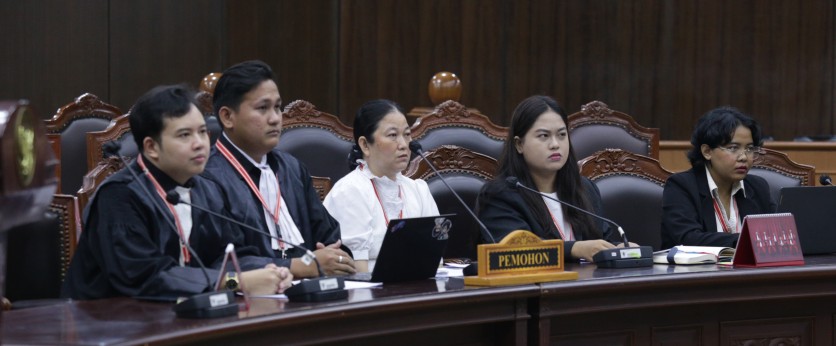
The Petitioners and their legal counsel attending the preliminary hearing for Case No. 267/PUU-XXIII/2025, Friday (1/9/2026). Photo by MKRI/Bay.
JAKARTA (MKRI) — Two Indonesian citizens, Lina and Sandra Paramita, have filed a petition for a judicial review of Article 488 of Law No. 1 of 2023 on the Criminal Code (KUHP) and Article 16 paragraph (1), Article 19 paragraph (1), Article 22 paragraph (1), and Article 23 paragraph (5) of the new Criminal Procedure Code (KUHAP) with the Constitutional Court. According to the Petitioners, the contested provisions impair their constitutional rights as guaranteed under Article 27 paragraph (1), Article 28D paragraph (1), and Article 28G paragraph (1) of the 1945 Constitution of the Republic of Indonesia.
“The application of Article 488 of the Criminal Code in practice opens room for abuse of power relations, whereby those in superior positions may hold their subordinates criminally liable due to unequal relations. This situation gives rise to fear, psychological pressure, and the threat of criminalization against the Petitioners, who acted in good faith in carrying out their duties and work as subordinates,” said the Petitioners’ legal counsel, Leon Maulana Mirza Pasha, during the preliminary hearing for Petition No. 267/PUU-XXIII/2025 on Friday (1/9/2025) at the Constitutional Court courtroom in Jakarta.
The Petitioners explained that they had previously worked as finance staff members at different companies. In practice, the companies required employees, including the Petitioners, to use their personal bank accounts to carry out corporate financial transactions. They frequently received instructions from the company director, as their superior, to use company funds and/or their personal funds for corporate purposes as well as for the personal interests of their superior.
Although they referred to two different companies, the Petitioners mentioned only one individual as their superior. In early July 2024, both companies began to experience financial difficulties. Their superior allegedly accused the Petitioners of embezzling company funds, dismissed them unilaterally, and reported them to the West Jakarta Metro Police for alleged embezzlement.
The provisions under review read, in full, as follows:
Article 488 of the Criminal Code:
“In the event that the act referred to in Article 486 is committed by a person who has control over the property due to an employment relationship, profession, or because they receive remuneration for such control, the perpetrator shall be punished with imprisonment of up to five (5) years or a fine of up to category V.”
Furthermore, Article 618 of the Criminal Code stipulates:
“At the time this Law comes into force, criminal cases that are currently in judicial proceedings shall be subject to the provisions of this Law, unless the law governing such criminal acts is more favorable to the suspect or defendant.”
Article 16 paragraph (1) of the Criminal Procedure Code:
“An investigation may be carried out by means of: a. processing the crime scene; b. observation; c. interviews; d. surveillance; e. undercover operations; f. controlled delivery; g. controlled handover; h. tracking; i. examination and analysis of documents; j. approaching or summoning a person to obtain information; and/or k. other activities not contrary to statutory regulations.”
Article 19 paragraph (1) of the Criminal Procedure Code:
“A case exposition on the results of the investigation as referred to in Article 18 paragraph (1) shall be conducted by investigators to determine whether the incident described in the investigation results constitutes a criminal offense or not.”
Article 22 paragraph (1) of the Criminal Procedure Code:
“For the purposes of investigation, investigators may summon or approach a person to obtain information without first granting that person the status of suspect or witness.”
Article 23 paragraph (5) of the Criminal Procedure Code:
“After receiving a report or complaint, the investigator or investigating officer must provide a receipt for the report or complaint to the relevant party.”
According to the Petitioners, in the context of hierarchical and asymmetric employment relationships, the absence of preventive safeguards in Article 488 of the Criminal Code creates a fundamental imbalance. Subordinates are required to prove that they acted on the orders of their superiors in good faith, while during the investigation stage, as regulated under Articles 16, 19, and 22 of the Criminal Procedure Code, subordinates are not afforded an equal opportunity with the reporting party to present their accounts. This condition places subordinates in a highly vulnerable and unequal position from the outset of the investigation process, thereby violating the principle of equality before the law.
The Petitioners also challenged the phrase “an investigation may be carried out by means of … interviews …” in Article 16 paragraph (1) of the Criminal Procedure Code. In their view, the word “may” renders interviews merely facultative, meaning they can be conducted or omitted entirely without clear standards or conditions as to when interviews are mandatory. As a result, the conduct of investigations is left entirely to the discretion of investigators, without firm normative limitations.
They further argued that Article 16 paragraph (1) of the Criminal Procedure Code does not clearly or minimally specify to whom interviews during the investigation stage must be conducted, whether to the reporting party, the reporter’s witnesses, the reported party’s witnesses, or a prospective suspect. This lack of clarity allows investigations to rely solely on one-sided information, without a normative obligation to hear other interested parties, thus potentially violating the principle of due process of law.
“The Petitioners were reported, yet they were never interviewed or examined. Suddenly, the case was escalated to the investigation stage. That is why we request that, before a case is elevated to investigation, interviews with the reported party must be mandatory,” said another legal counsel for the Petitioners, Zico Leonard Djagardo Simanjuntak.
In their petitum, the Petitioners request the Court to declare Article 488 of the Criminal Code unconstitutional and not legally binding insofar as it is not supplemented by an additional paragraph stipulating that individuals shall not be punished if the act is carried out pursuant to a lawful order of office from an authorized superior. They also seek to have Article 16 paragraph (1) of the Criminal Procedure Code declared unconstitutional unless supplemented with a provision requiring investigators to first clarify matters with the reported party before escalating a case to the investigation stage; Article 19 paragraph (1) declared unconstitutional insofar as it does not mandate notification and involvement of directly interested parties, namely the reporter and the reported party, in case expositions; Article 22 paragraph (1) declared conditionally unconstitutional unless it specifies that persons summoned are to be designated as prospective suspects or witnesses; and Article 23 paragraph (5) declared unconstitutional unless interpreted to require that receipts for reports or complaints be provided to both the reporter and the reported party as equally interested parties.
Judges’ Advice
The petition was heard by a panel of constitutional justices chaired by Chief Justice Suhartoyo, with Constitutional Justices Daniel Yusmic P. Foekh and M. Guntur Hamzah as panel members. During the advisory session, Suhartoyo advised the Petitioners to reconsider whether it was appropriate to challenge Article 16 paragraph (1) of the new Criminal Procedure Code in light of their current legal circumstances.
“That provision does not concern the investigation stage, but rather the stage of determining a suspect. The determination of a suspect occurs either at the beginning or at the end of the investigation,” Suhartoyo explained.
He emphasized that this issue is highly crucial and therefore requires the Petitioners to exercise caution and precision in formulating the legal grounds of their judicial review petition in accordance with their present legal situation.
Before adjourning the hearing, Suhartoyo stated that the Petitioners are granted 14 days to revise their petition. The revised petition, in both softcopy and hardcopy, must be submitted to the Court no later than Thursday, January 22, 2025, at 12:00 p.m. Western Indonesian Time.
Explore Further: Case No. 267/PUU-XXIII/2025 (in Bahasa Indonesia)
Author : Mimi Kartika
Editor : N. Rosi
Translator : Yuanna Sisilia
Disclaimer: The original version of the news is in Indonesian. In case of any differences between the English and the Indonesian versions, the Indonesian version will prevail.
Friday, January 09, 2026 | 10:56 WIB 284