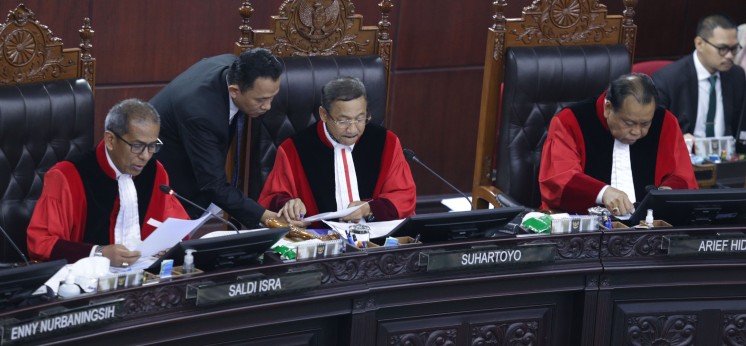
Decision Pronouncement Hearing of Case No. 278/PUU-XXIII/2025 on the material judicial review of Law No. 13 of 2016 on Patent, Monday (2/2). Photo by MKRI/Bay.
Jakarta (MKRI) - The Constitutional Court (MK) declared inadmissible a petition for judicial review of Article 12 paragraphs (1) and (2) of Law No. 13 of 2016 on Patents (Patent Law) against the 1945 Constitution of the Republic of Indonesia. The pronouncement of Decision No. 278/PUU-XXIII/2025 was presided over by Chief Justice Suhartoyo, sitting with eight other constitutional justices, on Monday, February 2, 2026, in the Plenary Courtroom.
In the Court’s legal considerations read out by Chief Justice Suhartoyo, the Court emphasized that the Petitioner had failed to clearly set out any contradiction between the challenged provisions and the constitutional norms cited as the standard of review. “In the petition, the Petitioner outlines a number of patent law concepts from various countries and compares them with the provisions of Article 12 paragraphs (1) and (2) of Law No. 13 of 2016, but does not clearly explain how these provisions conflict with norms in the 1945 Constitution,” he said.
The Court also found that the petition was inconsistent in its explanation of the grounds of review. The Petitioner asserted a conflict between Article 12 paragraphs (1) and (2) of the Patent Law and Article 28C paragraph (1), creating uncertainty as to whether the alleged conflict was with Article 28C paragraph (1) of the 1945 Constitution or with another provision within the Patent Law itself.
The Court further noted that although the Petitioner cited Article 28C paragraph (1) of the 1945 Constitution in a table appended to the petition, this reference was not accompanied by any explanation of the alleged inconsistency between the challenged provisions and the constitutional norm. The same table also lists Article 24C paragraph (1) of the 1945 Constitution without any explanation of its relevance.
“Without a clear explanation of how the challenged provisions conflict with the 1945 Constitution as the standard of review, the grounds of the petition are unclear and cannot be further examined,” Chief Justice Suhartoyo stressed. Based on all the facts and legal considerations, the Court concluded that the petition a quo was vague or obscure (obscuur). Therefore, although the Court has jurisdiction to adjudicate the matter, it found the petition to be unclear and declared it inadmissible, without proceeding to a substantive examination.
Also read:
Breaking Down Invention Ownership Bias in Patent Law
Petition to Review Ownership of Inventions under Patent Law Revised
Petition on the material judicial review of the Patent Law was filed by Arga Prianggara. During the preliminary hearing on Tuesday, January 13, 2026, legal counsel Rega Felix explained that the Petitioner is both a student and an employee. Within the campus environment, the petitioner is encouraged to produce innovations and inventions. However, he is simultaneously bound by employment relationships with companies. This situation raises legal issues regarding patent ownership of the inventions produced.
“On campus, the petitioner is encouraged to produce innovations and inventions, but on the other hand, he is also bound by employment relationships,” he said.
The Petitioner highlighted the provisions of Article 12 paragraph (1) of the Patent Law, which places the patent owner with the employer if the invention is produced in the course of employment. Meanwhile, Article 12 paragraph (2) of the Patent Law essentially states that the invention becomes the property of the employer if the employee uses data and/or facilities available in their work.
In addition, the Petitioner considers that there is bias in the interpretation of the phrase “unless otherwise agreed” in Article 12 paragraph (1) and the phrase “using available data and/or means” in Article 12 paragraph (2) of the Patent Law. These phrases are considered overly broad and could serve as grounds for companies to claim ownership of employees' inventions.
The Petitioner considers that the provisions of Article 12 paragraphs (1) and (2) of the Patent Law infringe upon his constitutional rights. He argues that these norms unduly narrow employees' ability to obtain patents or receive fair compensation, risking the stifling of individual creativity and innovation.
Case tracking: Petition No. 278/PUU-XXIII/2025 (in Indonesian)
Decision No. 278/PUU-XXIII/2025 (in Indonesian)
Author: Utami Argawati
Editor: N. Rosi.
Translator: Rizky Kurnia Chaesario
Disclaimer: The original version of the news is in Indonesian. In case of any differences between the English and the Indonesian versions, the Indonesian version will prevail.
Monday, February 02, 2026 | 15:46 WIB 94