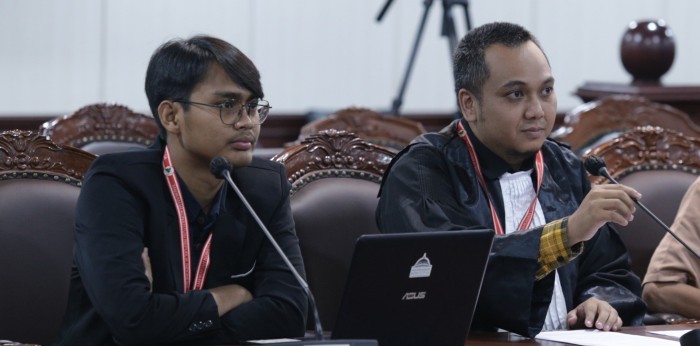
Petitioner attending the preliminary hearing of Case No. 278/PUU-XXIII/2025 on the material judicial review of Law No. 13 of 2016 on Patent, Tuesday (13/1/2016). Photo by MKRI/Bay
Jakarta (MKRI) – Petitioner Arga Prianggara has filed a material judicial review of Article 12 paragraphs (1) and (2) of Law 13 of 2016 on Patent (Patent Law) against the 1945 Constitution of the Republic of Indonesia to the Constitutional Court (MK). The petition was registered as Case No. 278/PUU-XXIII/2025.
The preliminary hearing of the case took place on Tuesday, January 13, 2026, and was presided over by Deputy Chief Justice Saldi Isra, along with Justices Ridwan Mansyur and Arsul Sani.
Legal counsel Rega Felix explained that the Petitioner is both a student and an employee. Within the campus environment, the petitioner is encouraged to produce innovations and inventions. However, he is simultaneously bound by employment relationships with companies. This situation raises legal issues regarding patent ownership of the inventions produced.
“On campus, the petitioner is encouraged to produce innovations and inventions, but on the other hand, he is also bound by employment relationships,” he said.
Rega Felix highlighted the provisions of Article 12 paragraph (1) of the Patent Law, which places the patent owner with the employer if the invention is produced in the course of employment. Meanwhile, Article 12 paragraph (2) of the Patent Law essentially states that the invention becomes the property of the employer if the employee uses data and/or facilities available in their work.
In addition, the Petitioner considers that there is bias in the interpretation of the phrase “unless otherwise agreed” in Article 12 paragraph (1) and the phrase “using available data and/or means” in Article 12 paragraph (2) of the Patent Law. These phrases are considered overly broad and could serve as grounds for companies to claim ownership of employees' inventions.
According to the Petitioner, this issue is further complicated for employees who work while pursuing their education. As a student at a technology-based university that encourages innovation and patent registration, the Petitioner questioned whether the use of company data or facilities automatically makes all work produced the company's property, and whether inventors are entitled only to compensation, without patent ownership.
In its petition, the Petitioner also compared patent policy in Indonesia with practices in Germany. In Germany, patent law adheres to the principle that inventions are the result of individual creativity. Germany distinguishes between service inventions and free inventions under the Employee Invention Act, so that not all employee inventions automatically become the property of the company.
On that basis, the Petitioner considers Article 12 paragraphs (1) and (2) of the Patent Law to be detrimental to his constitutional rights. These provisions are considered to limit the scope for employees to obtain patents and fair compensation, and have the potential to inhibit individual creativity due to concerns that inventions could easily be taken over by companies.
The petitioner concluded that the provisions of Article 12 paragraphs (1) and (2) of the Patent Law conflict with Article 28C paragraph (1) of the 1945 Constitution of the Republic of Indonesia because they hinder the constitutional rights of citizens to develop themselves through the fulfillment of basic needs, education, and the development of science, technology, and the arts through innovation and creativity.
Therefore, in the petitum, the Petitioner requests that the Court declare Article 12 Paragraph (1) of the Patent Law to be contrary to the 1945 Constitution of the Republic of Indonesia and to have no binding legal force as long as it is not interpreted as follows “The Patent Holder of an invention produced by an inventor in an employment relationship is the party that provides the work if the invention is produced under a specific employment agreement or work order, unless otherwise agreed.” The Petitioner also requests that the Court declare Article 12 Paragraph (2) of the Patent Law is contrary to the 1945 Constitution of the Republic of Indonesia and does not have binding legal force as long as it is not interpreted as “The provisions referred to in paragraph (1) also apply to inventions produced by employees and workers who use data and/or facilities available in their work if the inventions are produced under a specific employment agreement or work order.”
Justices’ Advice
In response to the Petitioner's request, Justice Ridwan Mansyur advised the Petitioner to clarify the Petitioner's legal standing in the petition. In addition, the Petitioner was also asked to strengthen the argument by adding relevant theories and expert opinions, particularly those related to Article 28C of the 1945 Constitution of the Republic of Indonesia.
Justice Ridwan Mansyur emphasized the importance of linking the norms being tested to the specific case experienced by the Petitioner. According to Ridwan, the practices questioned in the petition are common occurrences, so it is necessary to explain in detail the causal relationship between the application of the norms being tested and the potential or actual constitutional harm experienced by the Petitioner.
“Theories or expert opinions regarding Article 28C can also be added to this. Link it to concrete cases. This does happen often,” he explained.
The Panel of Justices granted the Petitioner 14 days to revise the petition. The revised petition must be submitted no later than January 27, 2026.
Case tracking: Petition No. 278/PUU-XXIII/2025 (in Indonesian)
Author: Utami Argawati
Editor: N. Rosi.
Translator: Rizky Kurnia Chaesario
Disclaimer: The original version of the news is in Indonesian. In case of any differences between the English and the Indonesian versions, the Indonesian version will prevail.
Tuesday, January 13, 2026 | 18:15 WIB 263