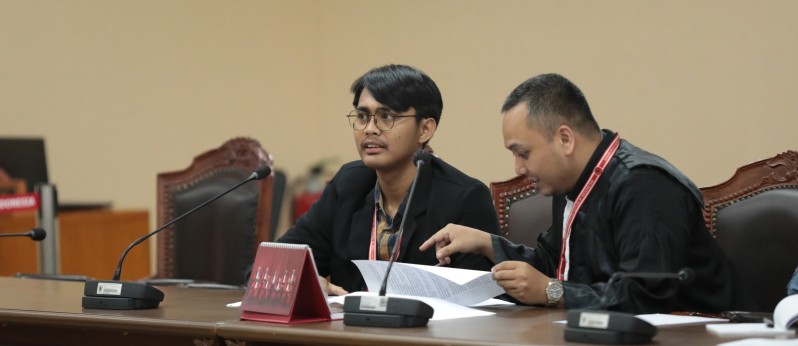
Petitioner on the judicial review of the Patent Law explaining the revised petition before the Panel of Justices on Monday (26/1/2026). Photo by MKRI/IlhamWM.
Jakarta (MKRI) - The Constitutional Court (MK) has again held a hearing in Case No. 278/PUU-XXIII/2025 on the judicial review of Article 12 paragraphs (1) and (2) of Law No. 13 of 2016 on Patent (Patent Law) against the 1945 Constitution of the Republic of Indonesia. The hearing, which examined revisions to the petition, took place on Monday, January 26, 2026, and was chaired by Deputy Chief Justice Saldi Isra, with Justices Ridwan Mansyur and Arsul Sani in attendance.
During the hearing, the Petitioner’s counsel, Rega Felix, stated that the main improvements to the petition concerned the Petitioner’s legal standing. He outlined the Petitioner’s educational background as being relevant to the disputed invention.
“Before studying at ITB, the Petitioner graduated from the Faculty of Film and Television at the Jakarta Institute of the Arts (IKJ). The Petitioner has a particular interest in camera work, with the aim of creating dramatic visuals using short static,” Rega Felix told the Panel.
He added that while the substance of the petition remained essentially the same, it had been supplemented with comparative data on patent systems in Indonesia, Germany, and India to bolster the Petitioner’s constitutional arguments.
Also read:
Breaking Down Invention Ownership Bias in Patent Law
Petition on the material judicial review of the Patent Law was filed by Arga Prianggara. During the preliminary hearing on Tuesday, January 13, 2026, legal counsel Rega Felix explained that the Petitioner is both a student and an employee. Within the campus environment, the petitioner is encouraged to produce innovations and inventions. However, he is simultaneously bound by employment relationships with companies. This situation raises legal issues regarding patent ownership of the inventions produced.
“On campus, the petitioner is encouraged to produce innovations and inventions, but on the other hand, he is also bound by employment relationships,” he said.
The Petitioner highlighted the provisions of Article 12 paragraph (1) of the Patent Law, which places the patent owner with the employer if the invention is produced in the course of employment. Meanwhile, Article 12 paragraph (2) of the Patent Law essentially states that the invention becomes the property of the employer if the employee uses data and/or facilities available in their work.
In addition, the Petitioner considers that there is bias in the interpretation of the phrase “unless otherwise agreed” in Article 12 paragraph (1) and the phrase “using available data and/or means” in Article 12 paragraph (2) of the Patent Law. These phrases are considered overly broad and could serve as grounds for companies to claim ownership of employees' inventions.
The Petitioner considers that the provisions of Article 12 paragraphs (1) and (2) of the Patent Law infringe upon his constitutional rights. He argues that these norms unduly narrow employees' ability to obtain patents or receive fair compensation, risking the stifling of individual creativity and innovation.
Case tracking: Petition No. 278/PUU-XXIII/2025 (in Indonesian)
Author: Utami Argawati
Editor: N. Rosi.
Translator: Rizky Kurnia Chaesario
Disclaimer: The original version of the news is in Indonesian. In case of any differences between the English and the Indonesian versions, the Indonesian version will prevail.
Monday, January 26, 2026 | 19:43 WIB 95