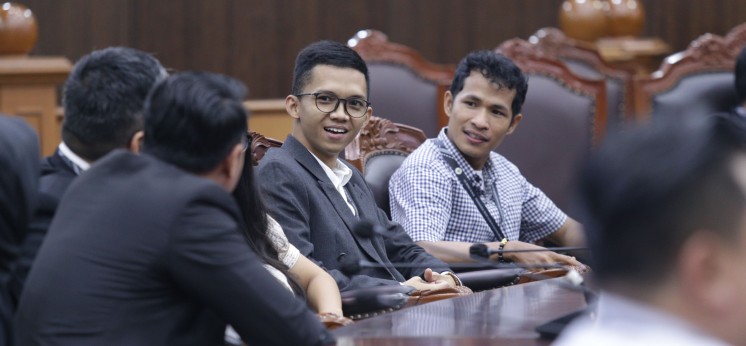
The Petitioner at the ruling hearing for the judicial review of Law No. 1 of 1974 on Marriage in case No. 212/PUU-XXIII/2025, Monday (2/2/2026). Photo by MKRI/Bayu.
JAKARTA (MKRI) — The Constitutional Court rejected the material judicial review petition of Article 2 paragraph (1) of Law No. 1 of 1974 on Marriage against the 1945 Constitution, filed by Muhamad Anugrah Firmansyah. The Devision No. 212/PUU-XXIII/2025 was delivered at a ruling hearing on Monday, February 2, 2026 in the plenary courtroom. “The Court rejected the Petitioner’s petition in its entirety,” said Chief Justice Suhartoyo delivering the verdict.
In its legal reasoning delivered by Constitutional Justice Ridwan Mansyur, the Court stated that the constitutional issue raised by the Petitioner essentially concerns the validity of marriage. The Court emphasized that its position on the validity of marriage has been consistently articulated in Decision No. 68/PUU-XII/2014, which was subsequently reaffirmed in Decisions No. 24/PUU-XX/2022 and No. 146/PUU-XXII/2024.
The Court held that, although the Petitioner advanced different arguments, the substance of the petition a quo is, in essence, the same as the earlier petitions—namely, the issue of the validity of marriage. Accordingly, the legal considerations set out in the prior decisions apply mutatis mutandis to the present case. To date, the Court has also stated that it has no strong and fundamental reasons to depart from its established legal position.
Ridwan further explained that, based on excerpts from the Court’s legal considerations and when read in conjunction with the Petitioner’s arguments, even though the Petitioner presented grounds that differ from those in several previously decided cases, the substance of the petition a quo remains essentially identical to that of Petition No. 68/PUU-XII/2014, Petition No. 24/PUU-XX/2022, and Petition No. 146/PUU-XXII/2024, all of which concern the validity of marriage.
“Therefore, the legal considerations in those decisions apply mutatis mutandis in assessing the arguments of the Petitioner in the case a quo, because to date the Court has not found strong and fundamental reasons to depart from the legal position adopted in the reasoning of those decisions. In this regard, with respect to Constitutional Court Decision No. 24/PUU-XX/2022, there were two Constitutional Justices—Justice Suhartoyo and Justice Daniel Yusmic P. Foekh—who expressed concurring opinions,” Ridwan explained.
In addition, with respect to the Petitioner’s argument challenging Supreme Court Circular Letter (SEMA) No. 2 of 2023, which was alleged to further underscore inconsistency in the application of Article 2 paragraph (1) of the Marriage Law, the Court found the argument to be unfounded. This is because the content or substance regulated in SEMA No. 2 of 2023 does not fall within the Court’s authority to review. Accordingly, the Petitioner’s argument was deemed legally unfounded.
Meanwhile, in the case a quo, there was one dissenting opinion from Constitutional Justice M. Guntur Hamzah, who was of the view that the Petitioner lacked legal standing, and therefore the petition should have been declared inadmissible.
Also read:
Petitioner Claims Ban of Interfaith Marriage Discriminatory
Petitioner Revises Benchmark for Petition on Marriage Law
The Petitioner, a Muslim, stated that he had been in a relationship for two years with an Indonesian citizen who is a Christian. They have mutual respect for each other’s faiths, and their families have already met. However, the Petitioner felt aggrieved by the enforcement of Article 2 paragraph (1) of the Marriage Law, which stipulates that “A marriage shall be legitimate if it is performed according to the laws of the respective religions and beliefs of the parties concerned.”
The Petitioner argued that the norm had resulted in multiple interpretations and legal uncertainty of the registration of interfaith marriages. He believed the article had been interpreted as a prohibition against registering interfaith marriages, effectively eliminating access to the registration for interfaith marriages. He also claimed that practice in the field had been inconsistent—some courts had granted such petitions, while others had rejected them.
Explore case No. 212/PUU-XXIII/2025 (in Indonesian).
Author : Utami Argawati
Editor : Lulu Anjarsari P.
PR : Raisa Ayuditha M.
Translator : Yuniar Widiastuti (NL)
Disclaimer: The original version of the news is in Indonesian. In case of any differences between the English and the Indonesian versions, the Indonesian version will prevail.
Monday, February 02, 2026 | 15:55 WIB 1436