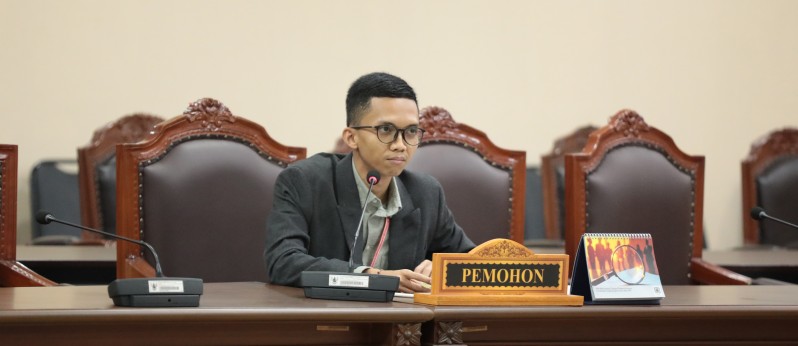
Muhamad Anugrah Firmansyah explaining the revisions to his petition of Law No. 1 of 1974 on Marriage in case No. 212/PUU-XXIII/2025, Tuesday (11/25/2025). Photo by MKRI/Ilham W. M.
JAKARTA (MKRI) — The Constitutional Court held the second hearing for the material judicial review of Article 2 paragraph (1) of Law No. 1 of 1974 on Marriage against the 1945 Constitution on Tuesday, November 25, 2025 in one of the Court’s panel courtrooms. The case No. 212/PUU-XXIII/2025 was filed by Muhamad Anugrah Firmansyah. The hearing was presided over by Deputy Chief Justice Saldi Isra alongside Constitutional Justices Ridwan Mansyur and Asrul Sani.
At the hearing, the Petitioner presented the revisions to his petition. He explained that one of the fundamental changes is the removal of Article 28B paragraph (1) of the 1945 Constitution as benchmark for the review. “Therefore, the benchmarks used are Article 1 paragraph (2), Article 28D paragraph (1), and Article 28I paragraph (4) of the 1945 Constitution,” he said before the panel.
He has also revised the argument supporting his claim of constitutional impairment, from actual to potential. The petitums (requests) have also been revised.
Also read: Petitioner Claims Ban of Interfaith Marriage Discriminatory
In the petition, the Petitioner, a Muslim, stated that he has been in a relationship for two years with an Indonesian citizen who is a Christian. They have mutual respect for each other’s faiths, and their families have already met. However, the Petitioner felt aggrieved by the enforcement of Article 2 paragraph (1) of the Marriage Law, which stipulates that “A marriage shall be legitimate if it is performed according to the laws of the respective religions and beliefs of the parties concerned.”
“This provision gives rise to multiple interpretations and legal uncertainty regarding the registration of interfaith marriages,” he said.
The Petitioner argued that the article has been interpreted as a prohibition against registering interfaith marriages, as though only marriages between persons of the same faith could be officially registered. As a result, access to registration for interfaith marriages has effectively been made impossible. The Petitioner also claimed that his loss became more apparent following the issuance of Supreme Court Circular (SEMA) No. 2 of 2023, which essentially prohibits courts from granting registration of interfaith marriages.
Although similar issues have previously been reviewed by the Constitutional Court in Decisions No. 68/PUU-XII/2014 and No. 24/PUU-XX/2022, the Petitioner argued that his petition is different, as it presents a new approach, new grounds for review, and new legal facts (novum). He emphasized that this petition focuses on the ambiguity of the provision that causes legal uncertainty, rather than on religious interpretation per se.
He also argued that population administration laws actually allow for the registration of interfaith marriages through a court ruling. However, practice in the field has been inconsistent—some courts have granted such petitions, while others have rejected them—resulting in legal uncertainty and unequal application of the law.
Track the Case No. 212/PUU-XXIII/2025 here.
Author : Utami Argawati
Editor : Lulu Anjarsari P.
PR : Raisa Ayuditha M.
Translator : Yuniar Widiastuti (NL)
Disclaimer: The original version of the news is in Indonesian. In case of any differences between the English and the Indonesian versions, the Indonesian version will prevail.
Tuesday, November 25, 2025 | 18:51 WIB 222