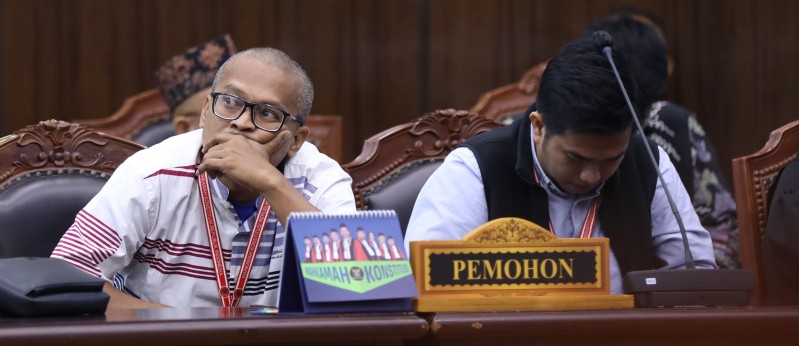
Petitioners’ legal counsel, Teguh Sugiharto (Left), attending the Ruling Hearing for Material Judicial Review of Law on Civil Registration, Friday (1/3) at the Courtroom. Photo by MKRI/Panji.
JAKARTA (MKRI) — The Constitutional Court (MK) declared the Petitioners’ case for review of Article 302 paragraph (1) of Law No. 1 of 2023 on Criminal Code (KUHP) inadmissible. Meanwhile, the Court rejected the other and the rest of the petition. In addition to the KUHP, the Petitioners for Case No. 146/PUU-XXII/2024 on Criminal Code tested Article 22 of Law No. 39 of 1999 on Human Rights (Human Rights Law), Article 61 paragraph (1) and Article 64 paragraph (1) of Law No. 23 of 2006 on Civil Registration (Civil Registration Law), Article 2 paragraph (1) of Law No. 1 of 1974 on Marriage, and Article 12 paragraph (1) letter a and Article 37 of Law No. 20 of 2003 on National Education System (National Education System Law).
The Petitioners argued that the freedom of religion, as guaranteed by the 1945 Constitution in its implementation, should include the freedom not to adhere to a particular religion or belief in God. For this reason, the Petitioners request a review of a number of norms in the law concerning the implementation of religious rights, such as the recognition of the right to not have a religion in the human rights law, the right not to expose a particular religion or belief in population data, the right to obtain marriage recognition that is not based on religion or belief, and the right not to participate in religious education in the elementary, secondary, or higher education.
In the Court's legal considerations, Justice Daniel Yusmic P Foekh stated that the material contained in the 1945 Constitution is explicitly supplemented with religious phrases or principles. The religiously nuanced content includes the opening of the third paragraph, the fourth paragraph, Article 9 paragraph (1), Article 28E paragraph (1), Article 28E paragraph (2), Article 28I paragraph (1), Article 28J paragraph (2), Article 29 paragraph (1), Article 29 paragraph (2), and Article 31 paragraph (3).
"It is clear that the 1945 Constitution is a constitution that believes in the existence of God, or it can be said to be a religious constitution (godly constitution)," Justice Daniel said on the ruling hearing on Friday, January 3, 2025.
However, regarding the relationship between religion and the state, Indonesia is not a religious country where the government relies on a particular religion and is not a secular state that separates them. Thus, Indonesia is a third-world country where the state links, integrates, and synergizes between various religions and states in relation to viewing the relationship between religion and state. This country is based on the Almighty God as stated in Article 29 paragraph (1) of the 1945 Constitution. This means that the values and principles of all religions and beliefs that contain values of goodness and are universal are used as the basis for organizing the state.
Democracy Without Nomocracy Leads to Disorder
Justice Daniel added that in its implementation, the nomocracy principle must accompany democracy and vice versa. Democracy without nomocracy will lead to disorder in society and vice versa; it will cause arbitrary actions. The principles of democracy and nomocracy must be based on the principle of theocracy because a country was founded with the spirit of theology that underpins governance. The founding fathers have upheld the noble values of Pancasila, which are inspired by the spirit of God, so that they become a fundamental basis in the life of our nation.
Referring to the legal considerations, it is clear that religion and the principle of belief in God are important elements that shape the character of positive law in Indonesia. Its application in positive law is inevitable because the 1945 Constitution—the legal basis of Indonesia, clearly places the Almighty God as the basis of the state. This fact is rooted in the principles contained in Pancasila, which have been agreed upon as the basis and ideology of the state. The manifestation of this principle in positive law is realized in the form of protection and guarantee of the right to practice religious life by believing in the Almighty God in various aspects of citizens' lives.
Freedom of Religion and Belief in God
In addition, Justice Arief Hidayat explained that the Court believes that religion and belief in God are the most important elements in preserving the character of the nation as mandated by Pancasila and the 1945 Constitution. Practically, people are still given the freedom to practice religion or adhere to a belief in God based on their respective beliefs.
"In this context, the implementation of every person in believing in God in positive law is having religion and adhering to the belief freely, which is much more appropriate than not having one. Thus, restrictions on citizens' freedom not to have any religion or belief in God are proportional restrictions and are not contrary to the constitution," Justice Arief explained.
According to the Court, the provisions of Article 22 of the Human Rights Law, Article 61 paragraph (1) and Article 64 paragraph (1) of the Civil Registration Law, Article 2 paragraph (1) of the Marriage Law, and Article 12 paragraph (1) letter a and Article 37 of the National Education System Law are not contrary to the right to equal status before the law and government, the right to fair legal certainty, the right to receive convenience and special treatment, the right to self-protection over discrimination, the right to form a family, and the right to freely have religion and worship according to one's religion as guaranteed in the 1945 Constitution, not as argued by the Petitioners. Thus, the Petitioners' arguments are legally groundless for all four laws.
Also read:
The Absence of No-Religion Option in Resident and Family ID Card Questioned
Petitioners Revises Petition for No-Religion Option to be Included in Civil Registration
The Petitioners wished the religion column in the resident identification containing information on the religion or belief in the Family Identification Card (KK) and Resident Identification Card (KTP) to be filled with "no religion." The Petitioners, Raymon Kamil (Petitioner I) and Indra Syahputra (Petitioner II), submitted a petition while admitting to having no religion or belief, including religions and beliefs acknowledged by the state of Indonesia. The Petitioners claimed they suffered a loss of constitutional rights as they had to fill in the religion column in the civil registration by choosing a religion or belief, even though they wanted to be recognized as having no religion.
The Petitioners asked the Court to declare Article 22 of Law No. 39 of 1999 contradictory to the 1945 Constitution and has no binding legal force as long as it is not interpreted as everyone is free to have their own religion or not to, and to worship according to their religion and beliefs or not to worship, and the state guarantees these freedoms. In addition, they asked the Court to declare that Article 61 paragraph (91) and Article 64 paragraph (1) of Law No. 23 of 2006, Article 2 paragraph (1) of Law No. 1 of 1974 on Marriage, Article 12 paragraph (1) and Article 37 paragraph 1 and paragraph (2) of Law No. 20 of 2003 on National Education System are contradictory to the 1945 Constitution and has no binding legal force as long as it is not interpreted as the Petitioners requested in their petitums.
Author : Mimi Kartika
Editor : Lulu Anjarsari P.
PR : Fauzan Febriyan
Translator : Syifa Amelia/Rizky Kurnia Chaesario
Disclaimer: The original version of the news is in Indonesian. In case of any differences between the English and the Indonesian versions, the Indonesian version will prevail.
Friday, January 03, 2025 | 16:15 WIB 3014