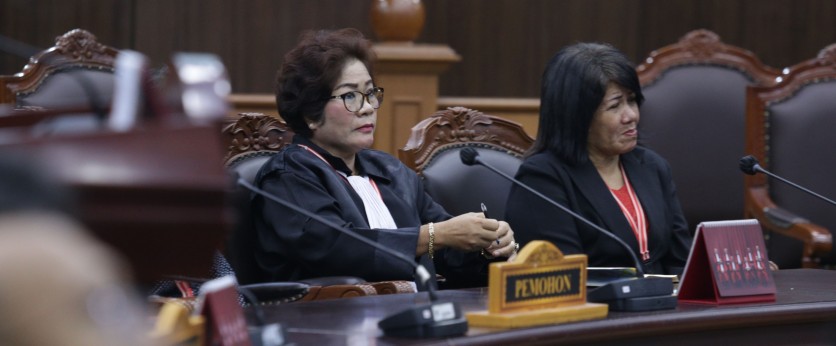
Petitioners’ legal counsel attending the Decision Pronouncement Hearing of Case No. 156/PUU-XXIII/2024 on the material judicial review of Law No. 17 of 2023 on Health, Monday (19/1/2026). Photo by MKRI/Bay.
Jakarta (MKRI) - The Constitutional Court (MK) has ruled that the requirement for a recommendation from the Professional Disciplinary Council (MDP) does not apply to medical personnel and health workers who are held liable for alleged criminal acts that are unrelated to health services. The Court stressed that MDP recommendations must not be used as an instrument to shield medical personnel and health workers who, in fact, violate professional, service, and standard operating procedures in the provision of health services.
This was outlined in the Court’s legal considerations in Case No. 156/PUU-XXII/2024 on the judicial review of Law No. 17 of 2023 on Health (Health Law), heard on Monday, January 19, 2026, in the Plenary Courtroom. “The existence of an MDP recommendation must be read and understood as an assessment of whether professional standards, service standards, and standard operating procedures have been fulfilled, and this assessment must take place before legal proceedings are initiated against medical personnel and health workers,” Justice Enny Nurbaningsih stated.
The Court went on to elaborate on the issues connected to the Petitioners’ arguments, who essentially felt hindered by the MDP recommendation requirement when seeking to pursue legal action against medical personnel and health workers under Article 308 paragraphs (1) and (5) of the Health Law. In essence, these provisions stipulate that, for medical personnel and health workers suspected of committing unlawful acts that may carry criminal sanctions, an MDP recommendation must first be requested to determine whether an investigation may proceed.
Also read:
IDI Board and 52 Citizens of Various Professional Backgrounds to Test 24 Articles in the Health Law
IDI Board and 52 Citizens Question the Dismissal of Collegium in Health Law
House: Medical Workers Mentoring and Supervision Under Government Authority
Health Minister: Collegium Under Professional Organizations Creates Conflict of Interest
Perdesti Never Officially Recognized Under IDI
AFDOKGI: Current Collegium Vulnerable to Executive Interference
According to the Court, although the wording of Article 308 paragraph (5) of the Health Law contains the phrase “may or may not be subject to investigation”, another provision states that if, within a maximum of 14 working days, the recommendation is not issued, the MDP is deemed to have given a recommendation allowing an investigation into the alleged criminal offence by medical personnel and health workers. In this context, an MDP recommendation must be read and understood as an assessment of whether professional standards, service standards, and standard operating procedures have been met, and such an assessment must occur before legal proceedings are initiated against medical personnel and health workers.
Justice Enny went on to say that the MDP is not a pro justitia body in the context of criminal law, and the functions assigned to it are not intended to replace or take over the powers of investigators, public prosecutors, or judges. Positioning the MDP recommendation as part of the initial procedure does not mean applying due process of law at the MDP level, but rather ensuring that due process of law at the stages of investigation, prosecution, and trial proceeds accurately, proportionally, and on the basis of scientific evidence.
If law enforcement officials proceed without a sufficient professional foundation, there is a risk of harm to both medical personnel and health workers, as well as to patients and the public at large. Proper standards for medical personnel and health workers in the course of law enforcement have previously been affirmed in Constitutional Court Decision Number 14/PUU-XII/2014, pronounced on April 25, 2015.
The Court held that the requirement for a recommendation in Article 308 paragraph (1) of the Health Law, expressed by the phrase “must first obtain a recommendation from the council as referred to in Article 304”, and in Article 308 paragraph (2) by the phrase “a recommendation must be obtained from the council as referred to in Article 304 of the Health Law”, does not create discriminatory differential treatment but constitutes a proportional regulation in line with the particular characteristics of the medical profession.
“In addition, MDP recommendations are intended to ensure that medical actions are properly evaluated before any legal proceedings are initiated,” Justice Enny said.
Within reasonable bounds of judgment, removing the MDP recommendation requirement would risk, among other things, criminalisation, thereby generating insecurity in medical practice that would ultimately hinder the objective of organising health services as set out in Article 3 of the Health Law. Accordingly, based on the above legal considerations, the Petitioners’ arguments that Article 308 paragraphs (1) and (2) are inconsistent with Article 27 paragraph (1), Article 28D paragraph (1), and Article 28H paragraph (1) of the 1945 Constitution are unfounded in law.
Since Article 308 paragraphs (1) and (2) of the Health Law do not present any issue of constitutional validity, it follows as a legal consequence that there is likewise no constitutional problem with the norms contained in Article 308 paragraphs (3), (4), (5), (6), (7), (8), and (9) of the Health Law. Therefore, the Court saw no need to further consider the Petitioners’ arguments regarding the provisions in those paragraphs.
“Verdict, ruling, rejecting the Petitioners’ petition in its entirety,” Chief Justice Suhartoyo declared.
Decision No. 156/PUU-XXII/2024 (in Indonesian)
Author : Mimi Kartika
Editor : Lulu Anjarsari P.
PR : Fauzan Febriyan
Translator : Rizky Kurnia Chaesario/Yuniar Widiastuti (NL)
Disclaimer: The original version of the news is in Indonesian. In case of any differences between the English and the Indonesian versions, the Indonesian version will prevail.
Monday, January 19, 2026 | 17:37 WIB 110