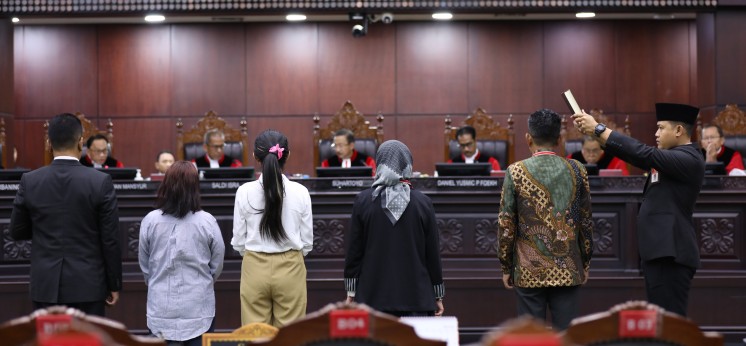
Petitioners’ experts and witnesses being sworn in before the panel of justices at the continued hearing of the judicial review of Law No. 3 of 2025 on the Indonesian National Armed Forces, Wednesday (1/14/2026. Photo by MKRI/Ifa.
JAKARTA (MKRI) — The Petitioners argued that the provisions of Article 7 paragraphs (3) and (4) of the Indonesian National Armed Forces (TNI) Law have reduced the role of the House of Representatives (DPR) in authorizing the deployment of TNI forces by limiting parliamentary involvement solely to military operations for war (OMP). Meanwhile, military operations other than war are no longer subject to DPR approval or consideration, as their regulation is delegated to Government Regulations or Presidential Regulations.
According to the Petitioners, the mechanism of DPR approval and consideration represents a manifestation of the principle of popular sovereignty and serves as an instrument to uphold checks and balances, as reflected in the DPR’s oversight function under Article 20A paragraph (1) of the 1945 Constitution.
This argument was conveyed by Muchamad Ali Safa’at in his capacity as an Expert for the Petitioners at the continued hearing of the material judicial review of Law No. 3 of 2025 on the Amendment to Law No. 34 of 2004 on the Indonesian National Armed Forces and Law No. 34 of 2004 on the Indonesian National Armed Forces (the TNI Law), held on Wednesday (1/14/2026). The fourth hearing for Case No. 197/PUU-XXIII/2025 was scheduled to hear expert testimony from the Petitioners.
“More importantly, in the absence of oversight, the implementation of military operations other than war (OMSP) may potentially open the door to abuse of power and an expansion of TNI authority, which runs counter to Article 30 paragraph (3) of the 1945 Constitution,” said the Professor of Constitutional Law from Brawijaya University before the Plenary Panel of Justices.
Investigative and Prosecutorial Authority
With regard to the authority of military courts to adjudicate general criminal offenses committed by military personnel, Ali Safa’at explained that the legal framework has been laid down in the People’s Consultative Assembly Decree No. VII/MPR/2000 and subsequently elaborated in the TNI Law. This legal policy, he said, contains three key elements.
First, the military court system adopted is a permanent court, not an ad hoc one. Second, the jurisdiction of military courts is limited to military criminal offenses committed by TNI personnel. Third, general criminal offenses committed by TNI personnel fall under the jurisdiction of general courts.
Ali Safa’at further noted that the mandate to limit military court jurisdiction solely to military offenses was intended to safeguard judicial independence and ensure equality before the law. Ignoring this mandate, he argued, is considered to be inconsistent with Article 24 paragraph (1) and Article 27 paragraph (1) of the 1945 Constitution.
“Compliance with constitutional and legal norms concerning the jurisdiction of general and military courts can be enforced by declaring Article 74 paragraph (2) of the TNI Law unconstitutional. Annulment of this provision will not create a legal vacuum, as both general and military courts already exist. What is required is a clearer arrangement of investigative and prosecutorial authority for criminal offenses among the National Police, the Military Police, the Public Prosecutor’s Office, and Military Prosecutors,” Ali Safa’at explained.
Civil–Military Relations
The Petitioners also presented expert Amira Paripurna, who highlighted that a number of countries have decided to abolish military courts altogether. Countries such as Slovakia, Latvia, and the Czech Republic have taken this step, while Germany, Austria, Belgium, Denmark, Slovenia, Estonia, France, Sweden, Norway, the Netherlands, and Portugal have abolished military courts during peacetime.
She explained that this development has been strongly influenced by international human rights law and the work of international organizations focusing on human rights protection. From a comparative perspective, the comparison between military justice systems in European Union countries and Indonesia is methodologically legitimate and normatively relevant, as both face similar challenges.
“European Union countries have gradually arranged civil–military relations within the framework of a democratic rule-of-law state. From a functional comparative law perspective, the validity of such comparison does not depend solely on shared historical or legal traditions, but on the equivalence of the functions of military justice in regulating discipline, accountability, and law enforcement for military personnel,” Amira stated.
She further explained that European Union countries provide important reference points because their military justice practices have evolved in line with universal principles of the rule of law, fair trial, and judicial independence. These principles are also recognized and binding within Indonesia’s legal system through international human rights instruments. In addition, the experience of many European Union countries as post-authoritarian states offers a historical context comparable to Indonesia’s post-Reform era, particularly in ongoing efforts to strengthen civilian supremacy.
According to Amira, Article 65 of the TNI Law affirms that TNI personnel are subject to military courts for military criminal offenses and to general courts for general criminal offenses. This distinction is based on the nature of the offense, not purely on the status of the perpetrator, placing Indonesia closer to a hybrid jurisdictional model.
She emphasized that military court jurisdiction must be strictly limited to offenses of a distinctly military nature, while general criminal acts, even when committed by military personnel, must be regarded as violations of the civilian legal order and therefore adjudicated by civilian courts. However, the existence of Article 74 of the TNI Law has resulted in the postponement of the implementation of Article 65 pending the enactment of a new military justice law, while continuing to apply Law No. 31 of 1997 on Military Courts during the transitional period.
“From the perspective of criminal law and the criminal justice system, Article 74 implicitly preserves the determination of court jurisdiction based on the personal status of the perpetrator, rather than on the nature of the offense. This approach contradicts the fundamental philosophy of civilian justice, which views criminal law as a mechanism for protecting public interests and victims, rather than as an internal instrument of a state institution,” Amira explained.
Legal Uncertainty and Lack of Transparency
The Petitioners also presented witnesses Eva Melianie Pasaribu and Lenny Damanik. In her testimony, Eva recounted the chronology of the killing of her father, Rico Sampurna Pasaribu, a journalist with Tribrata TV. According to Eva, her father was allegedly killed following his reporting on gambling activities.
Eva explained that civilian perpetrators were tried through a swift judicial process with full public access, while proceedings involving perpetrators from the TNI were conducted with limited information and without open mechanisms. This situation, she said, has left her with a sense of legal uncertainty as she continues to seek justice.
Child’s Death Case
Witness Lenny Damanik recounted the death of her child, who was allegedly assaulted by a TNI soldier. She explained that when she went to the local police station to file a death report, she was directed to submit the report to the Military Police Commander instead.
Lenny stated that she filed the report on May 28, 2024, but saw no progress for months. She then sought assistance from a legal aid organization and traveled to Jakarta to submit complaints to the National Commission on Human Rights and the Indonesian Child Protection Commission.
“Only after that did the Military Police take action by naming a suspect in January 2025,” Lenny said, describing her prolonged effort to obtain legal clarity over her child’s death.
Also read:
DPR and Government Explain Legal Framework of TNI’s OMSP
Court Refines Arguments on TNI’s Operations Beyond Defense
Court Reviews Petition on TNI’s Operational Duties Beyond Defense
Author: Sri Pujianti
Editor: N. Rosi
PR: Raisa Ayuditha Marsaulina
Translator: Yuanna Sisilia
Disclaimer: The original version of the news is in Indonesian. In case of any differences between the English and the Indonesian versions, the Indonesian version will prevail.
Wednesday, January 14, 2026 | 14:52 WIB 141