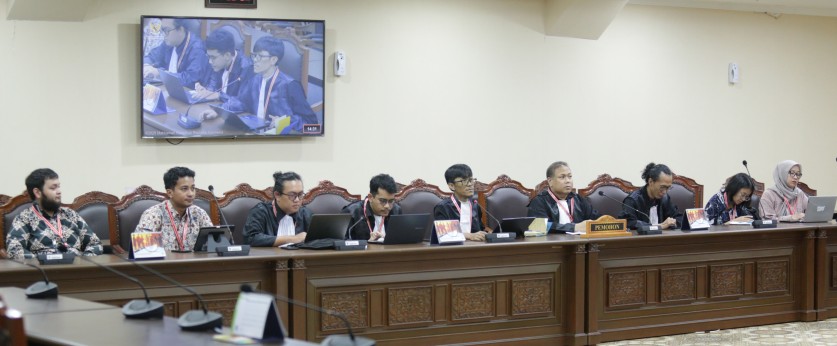
The Petitioners and their legal counsel attending the petition revision hearing for Case No. 197/PUU-XXIII/2025, Monday (11/17/2025). Photo by MKRI/Bay.
JAKARTA (MKRI) — The Constitutional Court held another hearing on a petition filed by five private legal entities under the Civil Society Coalition for Security Sector Reform and five individual citizens for the judicial review of Law No. 3 of 2025 on the Amendment to Law No. 34 of 2004 on the Indonesian National Armed Forces and Law No. 34 of 2004 on the Indonesian National Armed Forces (TNI Law). This second hearing for Case No. 197/PUU-XXIII/2025 was scheduled to hear the main points of the petition revision submitted by Imparsial (Petitioner I), the Indonesian Legal Aid Foundation (YLBHI/Petitioner II), the Commission for the Disappeared and Victims of Violence (KontraS/Petitioner III), the Alliance of Independent Journalists (Petitioner IV), the APIK Legal Aid Foundation Jakarta (Petitioner V), and three individual Petitioners: Ikhsan Yosarie (Petitioner VI), Mochamad Adli Wafi (Petitioner VII), and Muhammad Kevin Setio Haryanto (Petitioner VIII).
Afif Abdul Qoyim, legal counsel for the Petitioners, stated before the bench that they had refined the legal standing of each Petitioner, strengthened the constitutional arguments concerning Article 30 of the 1945 Constitution (45C), and revised the challenged provisions, particularly Article 53 paragraph (3) of the TNI Law, which they argued is intertwined with other norms under review.
He proceeded to read one of the petitums before the panel chaired by Deputy Chief Justice Saldi Isra, joined by Justice Ridwan Mansyur and Justice Arsul Sani:
“To declare Article 7 paragraph (2) letter b number 9 of Law No. 3 of 2025 on the Amendment to Law No. 34 of 2004 on the Indonesian National Armed Forces contrary to the 1945 Constitution and not legally binding insofar as it is not construed as: ‘assisting the implementation of governmental functions in situations and conditions requiring the instruments, means, and capabilities of the TNI to address ongoing problems, including responding to natural disasters and rehabilitating infrastructures.’”
Also read:
Court Reviews Petition on TNI’s Operational Duties Beyond Defense
At the preliminary hearing held on Tuesday, November 4, 2025, the Petitioners argued that Article 7 paragraph (2) letter b numbers 9 and 15; Article 7 paragraph (4); Article 47 paragraph (1); Article 53 paragraph (2) letters b-e; Article 53 paragraph (4); and Article 74 paragraphs (1) and (2) of the TNI Law conflict with the 1945 Constitution.
They asserted that the TNI’s principal task in non-war military operations (OMSP), specifically, assisting local governments, conflicts with Article 28E paragraph (3) and Article 28D paragraph (1) of the 45C. Article 7 paragraph (2) letter b number 9 authorizes the TNI to assist regional governments, while its elucidation mentions broader roles such as handling natural disasters, rehabilitating infrastructure, addressing strikes, and managing communal conflicts.
According to the Petitioners, the inclusion of the phrase “communal conflicts” deviates from the legal framework governing social conflict management, particularly regarding the TNI’s deployment to halt such conflicts. They warned that this provision risks infringing upon citizens’ constitutional rights.
The Petitioners also challenged the provision granting the TNI authority in cyber defense, arguing that Article 7 paragraph (2) number 15 is inconsistent with Article 30 paragraph (3) and Article 28D paragraph (1) of the 45C. In their view, cyber defense falls squarely within the TNI’s core mandate in wartime military operations (OMP) rather than OMSP.
The petition further questioned the requirement of House of Representatives (DPR) approval within the framework of “state political policies and decisions” for OMSP authorization. The Petitioners argued that OMSP, like OMP, should involve both the President and the DPR concurrently in the decision-making process. This arrangement would act as a preventive safeguard against potential executive overreach, given the President’s position as Commander-in-Chief of the Army, Navy, and Air Force.
Thus, they argued that Article 7 paragraph (4) and the elucidation of Article 7 paragraph (2) letter b numbers 1 and 2 of the TNI Law contradict Articles 10, 11 paragraph (1), and 20A paragraph (1) of the 45C and should therefore be declared unconstitutional.
Explore the Case: Case No. 197/PUU-XXIII/2025
Author: Sri Pujianti
Editor: N. Rosi
PR: Raisa Ayuditha Marsaulina
Translator: Yuanna Sisilia
Disclaimer: The original version of the news is in Indonesian. In case of any differences between the English and the Indonesian versions, the Indonesian version will prevail.
Monday, November 17, 2025 | 18:48 WIB 157