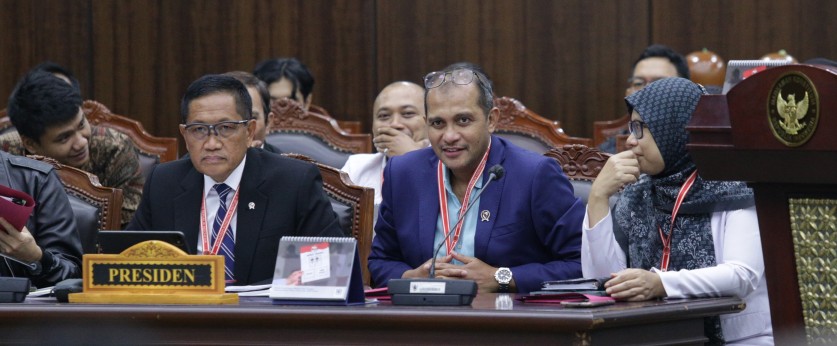
DPR and President delivering statements at the hearing of Case No. 197/PUU-XXIII/2025 on the judicial review of Law No. 3 of 2025 amending Law No. 34 of 2004 on the Indonesian National Armed Forces and Law No. 34 of 2004 on the Indonesian National Armed Forces, Wednesday (12/3/2025). Photo by MKRI/Bay.
JAKARTA (MKRI) — Non-war military operations (OMSP) do not prioritize the use of force but rather humanitarian assistance and disaster response. OMSP are also an integral pillar in safeguarding the sovereignty and territorial integrity of the state in the modern era.
This was conveyed by the House of Representatives (DPR) through Utut Adianto at the follow-up hearing of the material judicial review of Law No. 3 of 2025 amending Law No. 34 of 2004 on the Indonesian National Armed Forces (TNI). The third hearing of Case No. 197/PUU-XXIII/2025 heard statements from the DPR and the Government/President.
Utut explained that Article 18 paragraph (1) of the 1945 Constitution states that the Unitary State of the Republic of Indonesia (NKRI) is divided into provinces and regencies/municipalities, each with its own regional government. Consequently, the territory that must be safeguarded by the TNI encompasses the entire NKRI, including all regional governments.
“Thus, the TNI’s role in assisting regional governments through OMSP is highly relevant and grounded in the 1945 Constitution,” Utut stated.
The DPR then clarified the phrase “addressing issues arising from strikes” in the explanatory section of the disputed provision. According to the DPR, the phrase does not restrict citizens’ constitutional right to express opinions. It should not be interpreted as authorizing a vis-à-vis deployment of TNI forces against citizens exercising such rights.
The DPR further addressed the phrase “communal conflict may be addressed”, asserting that it does not introduce a substantive distinction between “communal conflict” and “social conflict” as defined under Law No. 7 of 2012. Both refer to conflicts among groups within society. A comparison between Law No. 7 of 2012 and Minister of Defense Regulation No. 35 of 2011 also reveals no significant difference in conflict-handling mechanisms: TNI assistance to regional governments is discretionary (“may”), carried out upon regional request, and coordinated with the National Police (Polri). Moreover, due to the hierarchy of laws and regulations, Law No. 7 of 2012 and Government Regulation No. 2 of 2015 serve as the primary framework for conflict management.
The DPR also responded to the phrase “to assist” in Article 7 letter d of the TNI Law, which the Petitioners associated with cyber defense. Utut emphasized that cyber defense is inherently part of the TNI’s principal duties within war military operations (OMP), as mandated by Article 7 paragraph (2) of the TNI Law, while OMP must always be preceded by a formal declaration of war.
DPR’s Supervisory Function
Utut also addressed the DPR’s supervisory role, noting that the House operates through commissions responsible for overseeing the implementation of statutory laws and the state budget. Regarding defense affairs, Commission I partners with the Ministry of Defense and the TNI.
“Commission I carries out supervision through working meetings, the formation of working committees, and working visits. Thus, it is inaccurate to suggest that the DPR has lost its supervisory role in the context of OMSP,” he asserted.
Placement of TNI Personnel in 14 Ministries
The DPR also clarified Article 47 paragraph (1) of the TNI Law, which regulates the placement of TNI personnel in 14 ministries and institutions, including those handling presidential secretariat affairs, narcotics affairs, and the Attorney General’s Office. Utut noted that one of the duties of the Presidential Secretariat is protocol affairs related to state events attended by the President at home and abroad. Ensuring the President’s security at such events necessitates specially trained personnel with specific competencies.
“Based on Presidential Secretariat Regulation No. 12 of 2016 on the implementation of adjutant duties, the President’s and Vice President’s adjutants are TNI or Polri officers. Therefore, the phrase ‘presidential secretariat affairs’ is relevant and does not blur the boundary between defense roles and socio-political functions,” Utut explained.
Government: Assistance Only Upon Regional Request
Deputy Minister of Law Edward Omar Sharif Hiariej, representing the Government/President, stated that under Law No. 7 of 2012 and Minister of Defense Regulation No. 35 of 2011, OMSP assistance by the TNI to regional governments can only be carried out upon request, in coordination with the National Police and other law enforcement agencies, and only under exceptional circumstances. These include strikes that escalate into significant threats or communal conflicts of high scale and severity that disrupt regional governance, hinder public services, or endanger community safety.
“Thus, TNI assistance to regional governments is performed within a subsidiarity framework. The TNI does not replace the authority of existing institutions but intervenes only when regional governments lack the capacity, infrastructure, or human resources to address critical situations effectively,” Eddy Hiariej clarified.
Cyber Defense and Legal Boundaries
The Government also emphasized that the phrase “to assist in efforts to address cyber defense threats” in Article 7 paragraph (2) letter b number 15 of Law No. 3 of 2025 does not designate cyber defense as a principal duty of the TNI. Rather, the provision underscores the TNI’s supporting role, preventing overlapping authority with other institutions more focused on cyber law enforcement, such as the National Cyber and Encryption Agency (BSSN).
“The use of the phrase confirms the TNI’s supportive function in responding to cyber threats and distinguishes it from its core duties on land, sea, and air. Therefore, the Petitioners’ argument is unfounded,” Eddy stressed.
Internal and Open Selection Mechanisms
Eddy also explained that before TNI personnel may participate in open selection processes at ministries or institutions, they must first undergo an internal selection process within the TNI, as regulated under TNI Commander Regulation No. 52 of 2020. Open selection at receiving ministries or institutions then follows applicable statutory requirements and internal procedures.
Accordingly, Article 47 paragraph (1) of the TNI Law clearly limits the participation of active TNI personnel in positions outside the TNI structure. Placement in 14 ministries and institutions is based strictly on institutional needs, as stipulated in Article 47 paragraph (4).
“Therefore, the internal selection ensures that only personnel whose competencies align with institutional needs are proposed for open selection,” Eddy added.
Also read:
Court Reviews Petition on TNI’s Operational Duties Beyond Defense
Court Refines Arguments on TNI’s Operations Beyond Defense
The petition was filed by the People’s Initiative Association for a Just Transition (Imparsial/Petitioner I), the Indonesian Legal Aid Foundation (YLBHI/Petitioner II), the Commission for the Disappeared and Victims of Violence (KontraS/Petitioner III), the Alliance of Independent Journalists (Petitioner IV), and the Jakarta Women’s Legal Aid Foundation (APIK/Petitioner V). Three individuals, Ikhsan Yosarie (Petitioner VI), Mochamad Adli Wafi (Petitioner VII), and Muhammad Kevin Setio Haryanto (Petitioner VIII), also joined as petitioners.
At the preliminary hearing on Tuesday, November 4, 2025, the Petitioners argued that Article 7 paragraph (2) letter b numbers 9 and 15; Article 7 paragraph (4); Article 47 paragraph (1); Article 53 paragraph (2) letters b, c, d, and e; Article 53 paragraph (4); and Article 74 paragraphs (1) and (2) of the TNI Law violate the 1945 Constitution. According to the Petitioners, the TNI’s principal duty in OMSP to assist regional governments contradicts Article 28E paragraph (3) and Article 28D paragraph (1) of the 1945 Constitution.
They contended that the inclusion of the phrase “communal conflict” deviates from the legal regime of social conflict management, particularly concerning the deployment of TNI forces in conflict termination, thereby potentially threatening citizens’ constitutional rights.
The Petitioners also argued that designating cyber defense assistance as part of the TNI’s principal duties in OMSP is inconsistent with Article 30 paragraph (3) and Article 28D paragraph (1) of the 1945 Constitution. In their view, cyber defense squarely falls within the TNI’s principal mandate under war military operations (OMP).
They further challenged the involvement of the DPR in approving presidential decisions related to OMSP, asserting that OMSP should require joint decision-making by the President and the DPR, similar to OMP. They argued that this supervisory structure serves as a preventive safeguard against potential executive overreach.
Accordingly, the Petitioners claimed that Article 7 paragraph (4) and the explanatory provisions of Article 7 paragraph (2) letter b numbers 1 and 2 are unconstitutional.
Author: Sri Pujianti
Editor: N. Rosi
PR: Raisa Ayuditha Marsaulina
Translator: Yuanna Sisilia
Disclaimer: The original version of the news is in Indonesian. In case of any differences between the English and the Indonesian versions, the Indonesian version will prevail.
Explore the case: Tracking Case No.197/PUU-XXIII/2025
Wednesday, December 03, 2025 | 17:13 WIB 457