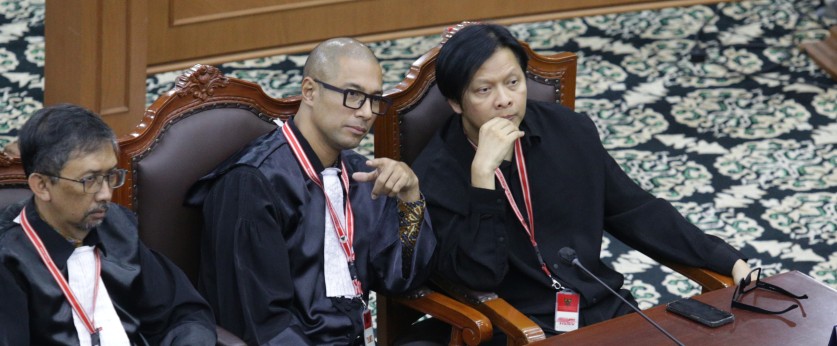
Petitioners attending the Decision Pronouncement Hearing of Case No. 28/PUU-XXIII/2025 on the material judicial review of Law No. 28 of 2014 on Copyright, Wednesday (17/12). Photo by MKRI/Bay.
Jakarta (MKRI) - The Constitutional Court (MK) partially granted a petition filed by Tubagus Arman Maulana, popularly known as Armand Maulana, Nazriel Irham, widely known as Ariel, and 27 other musicians grouped under the One Vision Movement. In Decision Number 28/PUU-XXIII/2025, the Court introduced a new interpretation of the provisions on parties entitled to use copyrighted works for commercial purposes under Article 23 paragraph (5) of the Copyright Law; the rules on the payment of royalty remuneration under Article 87 paragraph (1); and the criminal sanctions under Article 113 paragraph (2) of the Copyright Law.
In the verdict, the Court held that the phrase “any person” in Article 23 paragraph (5) of Law No. 28 of 2014 on Copyright (Copyright Law) is inconsistent with the 1945 Constitution of the Republic of Indonesia and conditionally unconstitutional insofar as it is not interpreted to “include commercial event organizers.” The Court further held that the phrase “letter f” in Article 113 paragraph (2) of the Copyright Law is inconsistent with the 1945 Constitution and conditionally unconstitutional insofar as it is not interpreted to mean that “in the application of criminal sanctions, a restorative justice approach must first be applied.”
“[The Court] declares that the phrase ‘fair remuneration’ in Article 87 paragraph (1) of the Copyright Law is inconsistent with the 1945 Constitution and conditionally unconstitutional insofar as it is not interpreted as ‘fair remuneration in accordance with mechanisms and tariffs stipulated under laws and regulations,’” Chief Justice Suhartoyo stated in reading out the verdict of the ruling.
The Court found that these three provisions conflict with the principle of fair legal certainty and infringe the right to a sense of security and protection from fear to act or refrain from acting, as guaranteed by Article 28D paragraph (1) and Article 28G paragraph (1) of the 1945 Constitution. Justice Enny Nurbaningsih clarified that, in the context of copyright, the phrase “any person” in Article 23 paragraph (5) of the Copyright Law cannot be separated from the definition of “person” in Article 1 point 27 of the same law, namely an individual or legal entity.
Under this definition, every legal subject, whether an individual, a group of persons, or a legal entity, may use a copyrighted work in a commercial performance without prior authorization from the author or copyright holder, provided that royalties are paid to the author or copyright holder through a Collective Management Organization (LMK).
In a literal sense, the phrase “any person” in Article 23 paragraph (5) essentially refers to anyone whose actions make a performance possible.
Given this understanding, the phrase “any person” in Article 23 paragraph (5) creates room for multiple interpretations and legal uncertainty in its application regarding who is obliged to pay royalties to the author or copyright holder through an LMK when a copyrighted work is used in a commercial performance, considering that a performance involves at least both an organizer and the performers.
In this context, the Court held that, within reasonable bounds, the value of a commercial performance is determined by the number of tickets sold and that the party with detailed knowledge of ticket sales is the event organizer.
“Therefore, in the Court’s view, the party that must pay royalties to the author or copyright holder through an LMK when a copyrighted work is used in a commercial performance is the event organizer. The same applies to royalty payments for commercial performances based on direct licenses granted by the author or copyright holder without authorizing an LMK. Accordingly, the phrase ‘any person’ in Article 23 paragraph (5) of the Copyright Law must be understood as ‘including event organizers’,” Justice Enny stressed.
Parameters for “fair remuneration”
In the legal considerations read out by Justice Enny Nurbaningsih, the Court held that the phrase “fair remuneration” in Article 87 paragraph (1) of the Copyright Law leaves room for interpretation and legal uncertainty as to what constitutes fair remuneration or royalties. Clarification is therefore required that the fairness parameter refers to tariffs set out in legislation issued by competent bodies or institutions, with the participation of relevant stakeholders.
Justice Enny added that remuneration for the use of copyrighted works must not disregard the public interest in being able to express and enjoy creative works easily and at an affordable cost. This provision must also be implemented in accordance with Article 23 paragraph (5) of the Copyright Law, provided that event organizers and performers act in good faith. Furthermore, for royalty collection, LMKs or their equivalents must coordinate and set royalty amounts in line with prevailing practice and the principle of fairness. In this regard, the legislature must promptly regulate royalties or remuneration that are measurable and proportionate and do not unduly burden users of copyrighted works and the public at large.
“Based on these legal considerations, the petitioners’ arguments regarding the phrase ‘fair remuneration’ in Article 87 paragraph (1) of the Copyright Law—namely that it is inconsistent with the 1945 Constitution and conditionally unconstitutional insofar as it is not interpreted as ‘fair remuneration in accordance with mechanisms and tariffs stipulated under laws and regulations—are well‑founded in law,” Justice Enny stated.
Restorative justice approach
The Court then addressed Article 113 paragraph (2) of Law No. 28 of 2014. Basically, this article is a secondary norm that follows Article 9 paragraph (1) letters c, d, f, and/or h, which grants authors or copyright holders economic rights as exclusive rights to obtain economic benefits from their works through, among other things, translation, adaptation, arrangement or transformation, performance, and communication of the work.
Therefore, infringements of the author’s or copyright holder’s economic rights through the commercial use of works without their permission should primarily be addressed through administrative sanctions and civil mechanisms rather than criminal penalties. This aligns with the principle of ultimum remedium in criminal law, which holds that criminal sanctions are a last resort. The principal aims of administrative and civil resolution are to settle disputes, safeguard individual rights, and provide restoration and compensation to injured parties.
In this regard, the Court took note of the petitioners’ wish to have the phrase “letter f” in Article 113 paragraph (2) of Law No. 28 of 2014 removed, so that Article 9 paragraph (1) letter f, which specifically regulates performances as an economic right of the author or copyright holder, would be excluded from imprisonment and/or fines under Article 113 paragraph (2). However, the Court emphasized that criminal sanctions should be a measure of last resort not only for infringements of performance rights under Article 9 paragraph (1) letter f, but also for other violations related to the commercial use of copyrighted works. Even where mediation and other non-litigation steps have failed, administrative sanctions should be applied first before criminal penalties.
“Although criminal sanctions in the Copyright Law are valid, because such sanctions form part of the legislature’s policy choices, the Court stresses that their enforcement must be carried out using a restorative justice approach as part of the application of the ultimum remedium principle. On this basis, the petitioners’ arguments concerning the phrase ‘letter f’ in Article 113 paragraph (2) of Law No. 28 of 2014 are well-founded in law,” Justice Enny explained.
Timing of royalty payments
The Court further clarified that Article 23 paragraph (5) of Law No. 28 of 2014 does not specify and does not exempt when royalties must be paid. This is because the mechanism under Article 23 paragraph (5), namely a blanket licence, differs from a direct licence. Therefore, to provide legal certainty for all parties, the Court held that the government and LMKs must establish clear and detailed rules on the timing of royalty payments in connection with performances, taking into account technical and non-technical factors that affect how performances are conducted, so that an appropriate time frame and deadline for payment to authors or copyright holders through LMKs can be determined while still protecting their rights.
“For this reason, more stringent procedures are needed for the payment of royalties through LMKs or similar entities for the use of copyrighted works in performances,” Justice Enny stated.
Improving LMK performance
The Court also highlighted the need to improve LMKs' performance to ensure royalties are distributed to authors or copyright holders in a timely, fair, and transparent manner. For example, LMKs could establish procedures and deadlines for royalty payments, whether before or after performances, and for their subsequent distribution to authors or copyright holders. In this regard, Justice Enny added that, to ensure that collective royalty collection functions effectively and is trusted, LMKs or equivalent entities must adopt accountable, transparent governance in the management and distribution of royalties.
The legislature is therefore required to design a simpler system for the collective collection of royalties through LMKs or equivalent bodies to ensure effectiveness and efficiency. In line with technological advances and the digital era, it is important to consider integrating a database-based system to streamline access and licensing processes, as well as the collection and distribution of royalties.
Mutatis mutandis
With respect to Petition No. 37/PUU-XXIII/2025, filed by five performers who are members of the band Terinspirasi Koes Plus (T’Koes Band) and Saartje Sylvia, a performer known as the “Lady Rocker,” Justice Arief Hidayat read out the Court’s legal considerations on the application of Article 9 paragraph (2) of the Copyright Law, which the petitioners claimed had harmed them.
In substance, the petitioners’ arguments on the conditional unconstitutionality of Article 9 paragraph (2) of Law No. 28 of 2014 had already been examined in Decision No. 28/PUU-XXIII/2025. In that case, the Court addressed the provision's constitutionality. Accordingly, the Court’s legal reasoning in Decision No. 28/PUU-XXIII/2025 applies mutatis mutandis to the issue of the constitutionality of Article 9 paragraph (2) of Law No. 28 of 2014.
“Thus, the petitioners’ arguments that Article 9 paragraph (2) of Law No. 28 of 2014 is conditionally inconsistent with Article 28D paragraph (1) and Article 28G paragraph (1) of the 1945 Constitution are unfounded in law,” Justice Arief stated.
Loss of object
As for the constitutionality of Article 113 paragraph (2) of Law No. 28 of 2014, Decision No. 28/PUU-XXIII/2025 has already reinterpreted the phrase “letter f” in that provision. As a result, the substance of Article 113 paragraph (2) currently in force is no longer identical to the norm challenged by the petitioners, as the Court has given it a different meaning. Accordingly, the petition challenging Article 113 paragraph (2) of Law No. 28 of 2014 has lost its object and is no longer subject to further consideration.
“[The Court] declares the petition of the petitioners regarding Article 113 paragraph (2) of Law No. 28 of 2014 on Copyright inadmissible; [and] rejects the petition of the petitioners in all other respects,” Chief Justice Suhartoyo stated in reading out the verdict of Decision No. 37/PUU-XXIII/2025 from the Plenary Courtroom.
In both decisions, Justice Daniel Yusmic P. Foekh delivered a dissenting opinion. In his view, the Court should have issued guidelines on the legal issues raised by the petitioners and encouraged the legislature—in this case, the House of Representatives (DPR) and the Government—to revise and improve the Copyright Law.
Also read:
Copyright Law’s Petitioners Compare Collective Management Organizations in Other Countries
Copyright Law: Criminal Prosecution May Be Pursued if Civil Remedies Fail
LMKN, PAPPRI, and AKSI Appointed as Related Parties in Copyright Law Review
Sammy Simorangkir and Lesti Kejora Attend Copyright Law Review Hearing as Witnesses
Ramli: We Must Promote the Campaign “Let’s Use Our Country’s Music”
Case No. 28/PUU-XXIII/2025 on the judicial review of Copyright Law was held simultaneously with Case No. 37/PUU-XXIII/2025. Petitioners in Case No. 28/PUU-XXIII/2025, consisting of Tubagus Arman Maulana, known as Armand Maulana, Nazriel Irham, commonly called Ariel, along with 27 other musicians active in the Indonesian music industry, argue that they face potential legal issues arising from the challenged provisions.
This judicial review is prompted by several cases, such as that involving Agnes Monica, better known as Agnezmo. Agnezmo was sued and criminally reported by Ari Bias, the creator of the song “Bilang Saja,” on the grounds that Agnezmo allegedly did not obtain direct permission or pay royalties directly to Ari Bias. The Commercial Court Panel at the Central Jakarta District Court ruled against Agnezmo, ordering her to pay compensation of IDR 1.5 billion to Ari Bias. Subsequently, Agnezmo was also criminally reported to the Indonesian National Police for alleged violation of Article 113 paragraph (2) of the Copyright Law.
Case No. 37/PUU-XXIII/2025 was submitted by five performers of a musical group inspired by Koes Plus of T’Koes Band and Saartje Sylvia, a performer dubbed the first Lady Rocker. T’Koes Band often performs old songs by other musicians, such as Koes Plus, D’Mercys, The Everly Brothers, and The Beatles. However, as of September 22, 2023, Koes Plus’ beneficiaries banned T'Koes from performing Koes Plus.
According to them, it proves that the implementation of Article 9 paragraph (2) of the Copyright Law has harmed the Petitioner, and there is no legal certainty to get permission. However, the Petitioners stated that in every performance, T’Koes Band has asked for a license and/or paid royalties to the LMK in Indonesia, and approached Koes Plus’ beneficiaries, paying them compensation, although not to the extent the beneficiaries wished.
Author: Mimi Kartika
Editor: Lulu Anjarsari P.
PR: Raisa Ayuditha M.
Translator: Rizky Kurnia Chaesario
Disclaimer: The original version of the news is in Indonesian. In case of any differences between the English and the Indonesian versions, the Indonesian version will prevail.
Wednesday, December 17, 2025 | 17:01 WIB 360