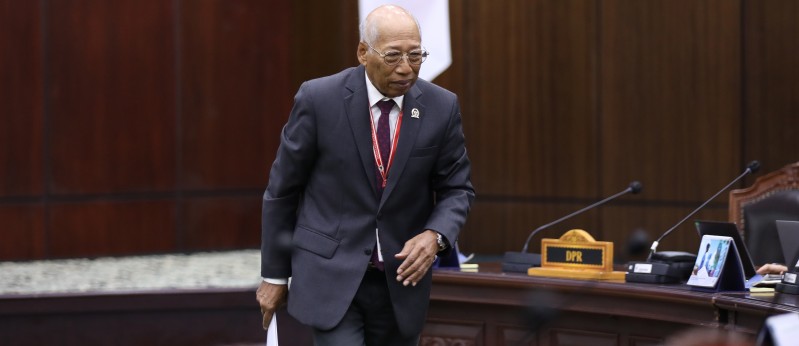
Member of the Third Commission of the House of Representatives, I Wayan Sudirta, attending the judicial review hearing of the Copyright Law to testify, Monday (30/6). Photo by MKRI/Ifa.
Jakarta (MKRI) – The Constitutional Court resumed the material judicial review hearing of Article 9 paragraph (2), Article 9 paragraph (3), Article 23 paragraph (5), Article 81, Article 87 paragraph (1), and Article 113 paragraph (2) of Law No. 28 of 2014 on Copyright to hear testimony from the House of Representatives and Presiden. Case No. 28/PUU-XXIII/2025 and Case No. 37/PUU-XXIII/2025 were held on Monday, June 30, 2025. The Deputy Director of Intellectual Property at the Ministry of Law, Razilu, stated that the Copyright Law is an administrative penal law, which disposes criminal remedies as the last resort or ultimum remedium. Accordingly, dispute resolution should primarily be pursued through civil remedies, such as arbitration, commercial courts, or mediation.
“Criminal prosecution can only be pursued if civil remedies fail, vide Article 95 paragraph (4) of the Copyright Law of 2014,” Razilu stated in front of the Panel of Justices.
He explained that Article 95 paragraph (4) of the Copyright Law explicitly mandates mediation as a prerequisite before initiating criminal prosecution for copyright and/or related rights infringement (excluding piracy), provided the disputing parties are known and/or located within the territory of the Republic of Indonesia. This alternative dispute resolution or mediation process must be conducted formally by a government-recognized official body, such as the Indonesian National Arbitration Board (BANI), which is regulated by Law No. 30 of 1999 on Arbitration and Alternative Dispute Resolution. The outcome must be recorded in a mediation report during the implementation process.
Alternative dispute resolution or mediation is often misunderstood; generally, the public considers a formal warning letter (somasi) as a form of mediation. However, these two are distinct. The results of mediation must be documented in a mediation report, whether the parties reach an agreement or not, as this report serves as the legal basis for determining whether the criminal case will proceed.
The government states that the provisions of Article 113 of the Copyright Law, which regulate criminal sanctions, constitute an open legal policy adopted by the legislature itself. The relevant provision reads:
“Any person who, without rights and/or without permission from the Creator or Copyright Holder, commits an infringement of Economic Rights as referred to in Article 9 paragraph (1) letters c, d, f, and/or h for Commercial Use shall be subject to imprisonment for a maximum of 3 (three) years and/or a maximum fine of IDR 500,000,000 (five hundred million rupiah).”
This is an open legal policy by the lawmaker.
The government explains that the purpose of Article 113 of the Copyright Law is to provide a deterrent effect against copyright and related rights infringements committed commercially, meaning for economic gain. Copyright and related rights (Neighboring Rights) infringements conducted for non-commercial purposes (such as personal use) are not subject to criminal sanctions but may be subject to civil penalties.
Furthermore, Article 113 paragraph (4) of the Copyright Law emphasizes that large-scale piracy (for example, mass production of pirated CDs, illegal online film distribution, and others) is considered a serious crime and is subject to much heavier penalties. Meanwhile, if the use of a creation (for example, a commercial performance) meets the criteria of the three-step test (i.e., it is a special case, does not conflict with normal exploitation, and does not harm the legitimate interests of the creator because royalties have been paid through the Collective Management Organization), then logically, such acts should not be classified as “without rights and/or without permission” punishable by criminal law.
Moreover, Article 120 of the Copyright Law stipulates that copyright infringement is a complaint offense (delik aduan). This means law enforcement cannot proceed with a case without a report or complaint from the creator or copyright holder who feels aggrieved. This grants the rights holder control to decide whether to pursue criminal or civil action (for example, seeking damages). The principles of ultimum remedium and complaint offense serve as crucial checks and balances against the potential for disproportionate criminalization.
In their petition, the Petitioners in Case No. 28/PUU-XXIII/2025, consisting of Tubagus Arman Maulana, known as Armand Maulana, Nazriel Irham, commonly called Ariel, along with 27 other musicians active in the Indonesian music industry, face potential legal issues arising from the challenged provisions.
This judicial review is prompted by several cases, such as that involving Agnes Monica, better known as Agnezmo. Agnezmo was sued and criminally reported by Ari Bias, the creator of the song “Bilang Saja,” on the grounds that Agnezmo allegedly did not obtain direct permission or pay royalties directly to Ari Bias. The Commercial Court Panel at the Central Jakarta District Court ruled against Agnezmo, ordering her to pay compensation of IDR 1.5 billion to Ari Bias. Subsequently, Agnezmo was also criminally reported to the Indonesian National Police for alleged violation of Article 113 paragraph (2) of the Copyright Law.
Also read:
Armand Maulana, Ariel NOAH to Bernadya Question the Obligation to Seek Permission from Songwriters
Copyright Law’s Petitioners Compare Collective Management Organizations in Other Countries
Refusal from Copyright Inheritors
Case No. 37/PUU-XXIII/2025 was submitted by five performers of a musical group inspired by Koes Plus of T’Koes Band and Saartje Sylvia, a performer dubbed the first Lady Rocker. T’Koes Band often performs old songs by other musicians, such as Koes Plus, D’Mercys, The Everly Brothers, and The Beatles. However, as of September 22, 2023, Koes Plus’ beneficiaries banned T'Koes from performing Koes Plus.
According to them, it proves that the implementation of Article 9 paragraph (2) of the Copyright Law has harmed the Petitioner, and there is no legal certainty to get permission. However, the Petitioners stated that in every performance, T’Koes Band has asked for a license and/or paid royalties to the LMK in Indonesia, and approached Koes Plus’ beneficiaries, paying them compensation, although not to the extent the beneficiaries wished.
Member of the Third Commission of the House of Representatives, I Wayan Sudirta, who was present in the courtroom, stated that the refusal of the heirs as copyright holders to allow the Petitioners to perform works by Koes Plus constitutes a concrete issue and an implementation of the provisions of the Copyright Law. Therefore, in his view, a joint resolution is necessary between the Petitioners, the copyright holders, and the Collective Management Organizations (LMK/LMKN), which serve as the forum for the Petitioners to pay royalties.
“If the refusal to grant permission is solely due to the heirs of the creator of the Koes Plus band’s song not understanding the licensing system for the use of copyrighted works as regulated in the Copyright Law and Government Regulation No. 56 of 2021, then the provisions of the article in question do not automatically become unconstitutional,” Wayan explained.
Author: Mimi Kartika
Editor: Lulu Anjarsari P.
PR: Raisa Ayuditha M.
Translator: Rizky Kurnia Chaesario
Disclaimer: The original version of the news is in Indonesian. In case of any differences between the English and the Indonesian versions, the Indonesian version will prevail.
Monday, June 30, 2025 | 14:15 WIB 1858