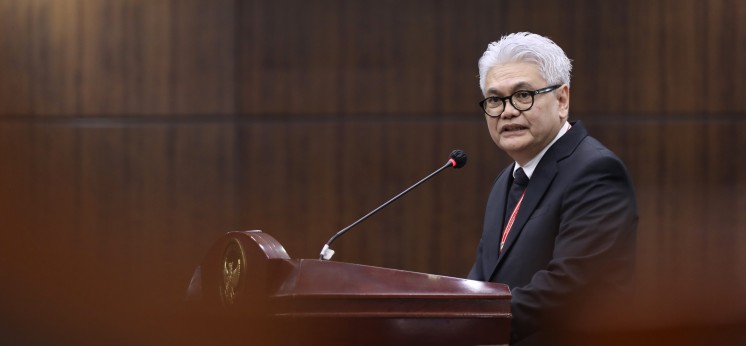
Professor of Universitas Padjajaran, Ahmad M. Ramli, attending the hearing as an expert from the government, delivering his statement on the resumed hearing of the judicial review of Law No. 28 of 2014 on Copyright, Thursday (07/08), at the Courtroom. Photo by MKRI/Ifa.
Jakarta (MKRI) – Professor of Law at Padjajaran University, Ahmad M. Ramli, stated that the fear of using music due to the risk of legal lawsuits could trigger an "anti-music" movement in public and commercial spaces. As a result, business owners might prefer alternative options to fill their commercial spaces. He made this statement as an expert witness invited by the President in the judicial review of Law No. 28 of 2014 on Copyright (Copyright Law) for Case No. 28/PUU-XXIII/2025 and 37/PUU-XXIII/2025 at the Constitutional Court on Thursday, August 7, 2025.
“All stakeholders should actively promote the campaign ‘let’s use our country’s music’ and fulfill the rights of creators and related rights holders. Users are the market of this industry that must continue to grow by using songs and music objects while consistently fulfilling royalty payments,” Ramli said, an intellectual property expert, at the Plenary Courtroom.
Ramli explained that the music industry ecosystem is a complex system involving various actors with interconnected roles and contributions. These include creators or song composers, singers, musicians, and related rights holders, as well as users. Commercial users encompass a wide range such as restaurants, hotels, cafes, shopping centers, karaoke venues, and event and performance organizers.
In today’s digital era, there are many alternatives available, and the approach to exclusive copyright rights is also greatly affected. The current digital business model features characteristics different from the traditional conservative business models. Nowadays, many people find services and products that are open source, free, or freemium.
Ramli continued that law enforcement through criminal complaints or copyright infringement lawsuits is indeed a legitimate right of creators and rights holders. However, an overly repressive approach, without considering the digital transformation that offers various alternatives including music production through Artificial Intelligence (AI), may have negative effects if not accompanied by education and promotion of optimal music use.
According to Ramli, the music industry ecosystem should encourage industry players to use songs as part of their lifestyle while respecting the rights of copyright holders. Furthermore, building public awareness, expanding market segments, and making the use of songs part of everyday life should be pursued, all while respecting the rights of creators.
CMO System
Ramli also said that the Copyright Law is actually designed to balance protection of rights and ease of access. The presence of the National Collective Management Institution (LMKN) and Collective Management Organizations (LMKs) provides legal certainty for all parties, including commercial users, through collective licensing schemes. Every use of a song no longer needs to go through complicated procedures.
This system allows creators and rights owners to receive royalties from various forms of usage. Of course, for this system to work optimally, accountable and transparent governance is required from LMKN and LMKs, along with adequate legal understanding from all stakeholders. Therefore, socialization and education are crucial to carry out.
In addition, Ramli said that the Copyright Law encourages wide use of songs and music, both by individuals and commercial business actors, as a form of enriching social spaces as well as driving the growth of the creative economy. This must always be done by respecting the moral and economic rights of copyright holders and related rights holders. The Copyright Law provides a fair and balanced framework between copyright protection and its fair use in public spaces.
Based on this, Ramli emphasized that it would be regrettable if the great potential of music to create an atmosphere that supports consumer experiences and boosts business competitiveness were ignored or if business actors chose not to use songs by local musicians. The Copyright Law, with its collective system, guarantees legal certainty for all stakeholders.
Also read:
Copyright Law’s Petitioners Compare Collective Management Organizations in Other Countries
Copyright Law: Criminal Prosecution May Be Pursued if Civil Remedies Fail
LMKN, PAPPRI, and AKSI Appointed as Related Parties in Copyright Law Review
Sammy Simorangkir and Lesti Kejora Attend Copyright Law Review Hearing as Witnesses
Wedding Singers Afraid to Perform Indonesian Songs
Case No. 28/PUU-XXIII/2025 on the judicial review of Copyright Law was held simultaneously with Case No. 37/PUU-XXIII/2025. Petitioners in Case No. 28/PUU-XXIII/2025, consisting of Tubagus Arman Maulana, known as Armand Maulana, Nazriel Irham, commonly called Ariel, along with 27 other musicians active in the Indonesian music industry, argue that they face potential legal issues arising from the challenged provisions.
This judicial review is prompted by several cases, such as that involving Agnes Monica, better known as Agnezmo. Agnezmo was sued and criminally reported by Ari Bias, the creator of the song “Bilang Saja,” on the grounds that Agnezmo allegedly did not obtain direct permission or pay royalties directly to Ari Bias. The Commercial Court Panel at the Central Jakarta District Court ruled against Agnezmo, ordering her to pay compensation of IDR 1.5 billion to Ari Bias. Subsequently, Agnezmo was also criminally reported to the Indonesian National Police for alleged violation of Article 113 paragraph (2) of the Copyright Law.
Case No. 37/PUU-XXIII/2025 was submitted by five performers of a musical group inspired by Koes Plus of T’Koes Band and Saartje Sylvia, a performer dubbed the first Lady Rocker. T’Koes Band often performs old songs by other musicians, such as Koes Plus, D’Mercys, The Everly Brothers, and The Beatles. However, as of September 22, 2023, Koes Plus’ beneficiaries banned T'Koes from performing Koes Plus.
According to them, it proves that the implementation of Article 9 paragraph (2) of the Copyright Law has harmed the Petitioner, and there is no legal certainty to get permission. However, the Petitioners stated that in every performance, T’Koes Band has asked for a license and/or paid royalties to the LMK in Indonesia, and approached Koes Plus’ beneficiaries, paying them compensation, although not to the extent the beneficiaries wished.
Member of the Commission III of the House of Representatives, I Wayan Sudirta, who was present in the courtroom, stated that the refusal of the heirs as copyright holders to allow the Petitioners to perform works by Koes Plus constitutes a concrete issue and an implementation of the provisions of the Copyright Law. Therefore, in his view, a joint resolution is necessary between the Petitioners, the copyright holders, and the Collective Management Organizations (LMK/LMKN), which serve as the forum for the Petitioners to pay royalties.
Author: Mimi Kartika
Editor: Lulu Anjarsari P.
PR: Raisa Ayuditha M.
Translator: Rizky Kurnia Chaesario
Disclaimer: The original version of the news is in Indonesian. In case of any differences between the English and the Indonesian versions, the Indonesian version will prevail.
Thursday, August 07, 2025 | 15:01 WIB 196