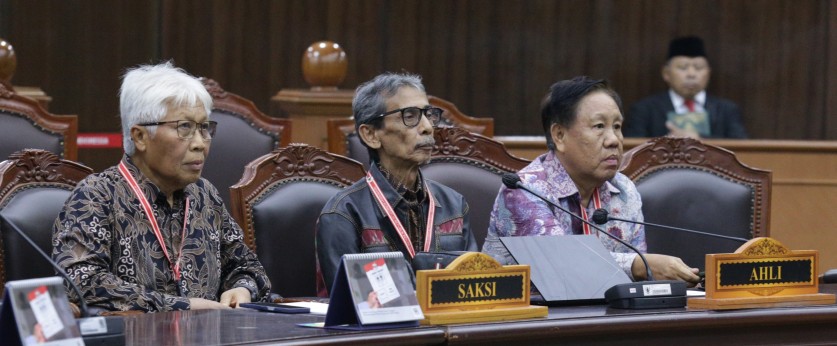
Expert and Petitioners’ witness giving statements for Case No. 184/PUU-XXIII/2025, Thursday (12/4/2025). Photo by MKRI/Bay.
JAKARTA (MKRI) — The Constitutional Court (MK) held another evidentiary hearing for Petition No. 184/PUU-XXIII/2025 on the judicial review of Law No. 4 of 2009 on Mineral and Coal Mining, as last amended by Law No. 2 of 2025, on Thursday, December 4, 2025 in the Court’s courtroom. The hearing featured expert and witness testimony presented by the Petitioners. The experts, Kurnia Toha and Milawarman, elaborated on the concept of state control over mineral and coal (minerba) resources.
Kurnia Toha explained that although surface land may be privately owned, the State retains full control over the mineral resources beneath it. The State is authorized to grant exploration and exploitation rights to private entities or state-owned enterprises as an expression of sovereignty in natural-resource governance. This view aligns with the Regalia doctrine, which positions mineral resources as belonging to the State and requires firm and substantive state control. Diverging from the logic of private ownership, which is driven solely by profit motives, state-led governance is considered better equipped to safeguard the broader public interest.
Kurnia further emphasized that the purpose of state control is to ensure that mineral resources benefit all Indonesians, not merely mining corporations. Sound governance, he noted, could spur national economic growth, strengthen fiscal revenues, fortify sovereignty in the energy and defense sectors, and stabilize long-term economic conditions, including through downstreaming initiatives. Historically, strong state control over mineral resources was common practice in many countries before being weakened by waves of privatization in the early twenty-first century.
He also underscored that prudent mineral management is closely interconnected with achieving the 17 Sustainable Development Goals (SDGs). Many developing countries, he observed, still face significant governance gaps, such as ambiguous legal frameworks, weak enforcement, corruption, conflict, and unequal revenue distribution, which ultimately undermine effective mineral governance and lead to ecological harm.
Turning to the legal provisions at issue, Kurnia argued that Article 35(1) and Article 92 of the Mineral and Coal Law contradict Article 33(3) of the 1945 Constitution, as they do not provide adequate mechanisms for the State to exercise meaningful control over mineral resources. Eight decades since Indonesia’s independence, he said, natural wealth has yet to deliver equitable prosperity and often benefits only a select few. The Petitioners’ judicial review request is therefore aimed at restoring the State’s sovereignty over natural-resource governance for the benefit of both present and future generations. He expressed hope that the Court’s eventual ruling would ensure that Indonesia’s natural wealth becomes a blessing for all, rather than a source of inequality.
Mining expert Milawarman stated in his testimony that the current licensing regime, consisting of the mining business license (IUP) and special mining business license (IUPK), has yet to guarantee optimal state control over mineral reserves, which are finite and non-renewable. Maximum control, in his view, can only be achieved when the State directly holds rights to such reserves through the National Reserve Area (WPN) mechanism and a dedicated state special-purpose vehicle (SPV).
He stressed that the limited duration of mining licenses is not compatible with the lifespan of mineral reserves, which requires reserve-lifetime permits for state entities.
“The limited duration of mining permits is incompatible with the lifespan of the reserves. Thus, special permits with validity equal to the reserve’s lifespan are needed for state entities,” he stated.
Milawarman added that reserve monetization as a state asset can only occur when the State holds direct economic rights, rather than relying solely on a licensing regime. Direct control, he noted, would secure strategic reserves, fulfill domestic needs, sustain exploration for new reserves, and ensure long-term environmental management and post-mining reclamation. He clarified that private-sector participation would still be accommodated through an operatorship model, which maintains an attractive investment climate.
Meanwhile, witness Chairil Abdini recounted his experience working within the Office of the Vice President. He noted that concerns had arisen regarding low state revenues from the mining sector, particularly royalties. Officials at the time offered explanations that the situation mirrored global conditions, but he stated that such comparisons were inaccurate, especially when juxtaposed with the oil and gas sector, which has clearer governance structures and revenue-sharing mechanisms.
Also read
Government Ensures State Control of Mineral and Coal Remains Firm
DPR Asserts Private Ownership of Mines Not a Transfer of State Control
Role of the State and the Private Sector in Mining Governance
State’s Control in Mineral and Coal Mining Governance Questioned
Natural Resource Privatization
Petition No. 184/PUU-XXIII/2025 was filed by six Indonesian citizens: Wahyu Ilham Pranoto (Petitioner I), Muhammad Faza Aulya’urrahman (Petitioner II), Fauzan Akbar Mulyasyah (Petitioner III), Yudi Amsoni (Petitioner IV), Nasidi (Petitioner V), and Sharon (Petitioner VI). They are students, activists, and members of local and Indigenous communities. They question what they consider to be a shift in the State’s role from sovereign controller of natural resources to merely a recipient of fees from mining businesses.
At the preliminary hearing on Monday, October 20, 2025, their legal counsel Aristo Marisi Adiputra Pangaribuan argued that the Mineral and Coal Law enables excessive privatization of natural resources and may violate Article 33 of the 1945 Constitution, which mandates that natural wealth be utilized for the greatest prosperity of the people.
“This law reduces the State to a royalty collector rather than a resource manager. The data we submitted show that the State’s royalty share has never exceeded 20 percent of corporate profits,” Aristo stated at the time.
The Petitioners contest Article 35 and Article 92 of the Law. They argue that these provisions diminish the State’s authority to control and manage natural resources and may undermine the principle of social justice. Article 35 regulates licensing by the central government, whereas Article 92 grants ownership rights over mining products to IUP and IUPK holders.
Through their petitum, the Petitioners request the Constitutional Court to declare the articles unconstitutional and without binding legal force.
Explore the case further: Tracking Case No. 184/PUU-XXIII/2025
Author: Utami Argawati
Editor: Nur R.
PR: Raisa Ayuditha M.
Translator: Yuanna Sisilia
Disclaimer: The original version of the news is in Indonesian. In case of any differences between the English and the Indonesian versions, the Indonesian version will prevail.
Thursday, December 04, 2025 | 13:31 WIB 164