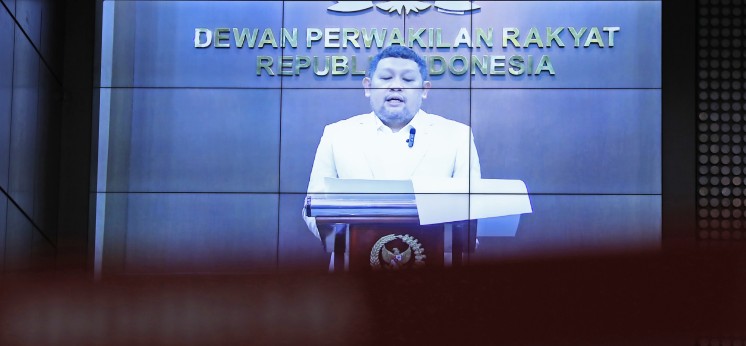
Abdullah of Commission III of the House of Representatives (DPR) giving his statement virtually at the judicial review hearing of Law No. 4 of 2009 on Mineral and Coal Mining, Wednesday (11/19) in the Courtroom of the Constitutional Court. Photo by MKRI/Ifa.
JAKARTA (MKRI) — The Constitutional Court (MK) held another judicial review hearing of Law No. 4 of 2009 on Mineral and Coal Mining (the Mineral and Coal Mining Law) as last amended by Law No. 2 of 2025. The hearing for case No. 184/PUU-XXIII/2025 took place on Wednesday, November 19, 2025 in the Courtroom of the Constitutional Court.
The agenda of the hearing was to hear the statement of the House of Representatives (DPR), represented by Abdullah. The member of Commission III emphasized that the state’s issuance of mining permits does not amount to transferring state control over mineral and coal resources to business entities. According to the DPR, there is a fundamental distinction between ownership of mining assets after production and the state’s authority over natural resources that remain unextracted.
Abdullah explained that the transfer-of-ownership clause under Article 92 of the Mineral and Coal Mining Law is a logical consequence of the extraction process, which must be preceded by the fulfillment of fiscal obligations to the state. Therefore, this clause cannot be interpreted as a relinquishment of state control over natural resources.
He added that the production levy or royalty mechanism, as required under Article 92, serves as an effective instrument for the state to secure optimal economic benefits from the mining sector. The DPR maintained that state oversight remains intact, not only in the fiscal sphere but also through regulatory and supervisory functions as mandated in Article 4 paragraph (3) of the law.
The DPR further asserted that the proprietary rights provided under Article 92 are intended to ensure legal certainty for business actors who have met all financial obligations to the state, including exploration and production levies. The provision is administrative and economic in nature, and does not affect the constitutional principle of state control over natural resources. The rights granted apply solely to extracted materials after the state has received its portion, not to the resources still located beneath the earth’s surface.
The DPR also conveyed that the government continues to take public concerns into account in the permitting process. One of the basic requirements for obtaining an operating license is compliance with environmental approval procedures, including AMDAL, UKL-UPL, or SPPL documents. For activities with significant environmental impact, the obligation to prepare an AMDAL remains in force.
Also read:
State’s Control in Mineral and Coal Mining Governance Questioned
Role of the State and the Private Sector in Mining Governance
As additional information, the petition for case No. 184/PUU-XXIII/2025 was filed by six Indonesian citizens: Wahyu Ilham Pranoto (Petitioner I), Muhammad Faza Aulya’urrahman (Petitioner II), Fauzan Akbar Mulyasyah (Petitioner III), Yudi Amsoni (Petitioner IV), Nasidi (Petitioner V), and Sharon (Petitioner VI). They include students, activists, local residents, and members of indigenous communities. The Petitioners argued that the state’s role has shifted from being the controller of natural resources to merely receiving levies from mining businesses.
Privatization of Natural Resources
At the preliminary hearing held at the Court on Monday, October 20, 2025, the Petitioners, through their legal counsel Aristo Marisi Adiputra Pangaribuan, stated that the Mineral and Coal Mining Law opens excessive space for the privatization of natural resources and potentially contradicts Article 33 of the 1945 Constitution, which requires that natural resources be managed for the greatest prosperity of the people.
“This law reduces the state into a mere recipient of royalties rather than a manager of natural resources. The data we submitted shows that the state’s share from mineral royalties has never exceeded 20 percent of corporate profits,” Aristo said at the time.
In their petition, the Petitioners challenged Articles 35 and 92 of the Mineral and Coal Mining Law. They argued that these provisions diminish the state's role in controlling and managing natural resources and may undermine the principle of social justice.
Article 35 regulates licensing by the central government, while Article 92 concerns ownership of extracted minerals by private entities. Article 92 grants ownership rights over mining products to holders of Mining Business Licenses (IUP) and Special Mining Business Licenses (IUPK).
In their petitum, the Petitioners requested that the Constitutional Court declare the contested provisions unconstitutional and not legally binding.
Explore the Case: Case No. 184/PUU-XXIII/2025
Author: Utami Argawati
Editor: Nur R.
PR: Raisa Ayuditha M.
Translator: Yuanna Sisilia
Disclaimer: The original version of the news is in Indonesian. In case of any differences between the English and the Indonesian versions, the Indonesian version will prevail.
Wednesday, November 19, 2025 | 12:40 WIB 153