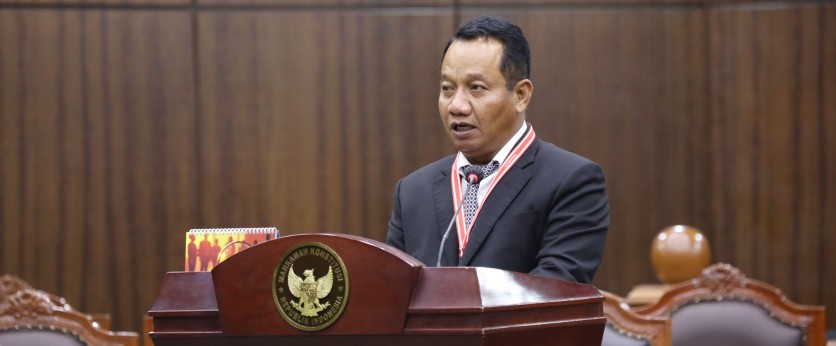
Director-General of Mineral and Coal Tri Winarno delivering the President/Government’s statement at the judicial review hearing of the Mineral and Coal Mining Law in the plenary courtroom, Wednesday (11/26/2025). Photo by MKRI/Panji.
JAKARTA (MKRI) — The Constitutional Court (MK) held another hearing for the material judicial review of Law No. 4 of 2009 on Mineral and Coal Mining, as last amended by Law No. 2 of 2025. The hearing for Petition No. 184/PUU-XXIII/2025 took place on Wednesday, November 26, 2025, in the plenary courtroom.
The agenda was to hear the President/Government’s statement. Representing the Government, Director-General of Mineral and Coal (Dirjen Minerba) Tri Winarno reiterated that the central government continues to provide a clear space of authority for provincial governments in the mining sector. He referred to Article 35(4) of the Mineral and Coal Mining Law as well as Presidential Regulation No. 5 of 2022, which delegates several licensing powers to provincial governments.
According to Tri, this delegated authority includes licensing for non-metal minerals and rocks, community mining permits, and rock mining permits. In addition, regional governments remain responsible for spatial planning (RTRW), issuing regional recommendations, and approving environmental documents.
“So, the narrative that regional authority has been removed is simply inaccurate,” Tri stressed.
Boundaries of Mineral and Coal Ownership
The Government further clarified that Article 92 of the Mineral and Coal Mining Law sets strict boundaries regarding the lawful ownership of minerals and coal, which only becomes effective after business actors fulfill their obligations to the state through royalties or production dues. According to the Government, this article serves as an essential legal tool distinguishing lawful mining, which fulfills state obligations, from illegal mining.
Although ownership of the extracted minerals shifts to business actors, the Government emphasized that the state’s control remains robust through downstreaming policies, refining requirements, distribution oversight, and domestic market obligations. The state also retains the authority to ban raw mineral exports and mandate domestic processing and refining.
The Government added that legal certainty over ownership rights is indispensable to business activities. Without such certainty, banks and financial institutions would struggle to provide financing for large-scale downstreaming projects.
“Repealing Article 92 would disrupt the investment climate and undermine the downstream industries the Government is currently strengthening,” the Government explained in court.
Also read:
DPR Asserts Private Ownership of Mines Not a Transfer of State Control
State’s Control in Mineral and Coal Mining Governance Questioned
Role of the State and the Private Sector in Mining Governance
Petition No. 184/PUU-XXIII/2025 was filed by six Indonesian citizens: Wahyu Ilham Pranoto (Petitioner I), Muhammad Faza Aulya’urrahman (Petitioner II), Fauzan Akbar Mulyasyah (Petitioner III), Yudi Amsoni (Petitioner IV), Nasidi (Petitioner V), and Sharon (Petitioner VI). They are students, activists, local residents, and members of indigenous communities. The Petitioners argue that the Law has shifted the role of the state from the controller of natural resources to merely a recipient of royalties from mining companies.
Privatization of Natural Resources
At the initial hearing on Monday, October 20, 2025, the Petitioners, represented by their legal counsel Aristo Marisi Adiputra Pangaribuan, argued that the Law opens excessive space for privatizing natural resources, potentially violating Article 33 of the 1945 Constitution, which mandates that natural resources must be used for the greatest benefit of the people.
“This Law reduces the state to a mere recipient of royalties, not the manager of natural resources. The data we submitted show that the state’s revenue from mining royalties has never exceeded 20 percent of corporate profits,” Aristo stated.
The Petitioners challenge Article 35 and Article 92 of the Law. They believe these provisions diminish the state’s role in managing and controlling natural resources and may violate the principle of social justice.
Article 35 governs central government authority over mining permits, while Article 92 concerns ownership of extracted minerals by holders of Mining Business Permits (IUP) and Special Mining Business Permits (IUPK).
In their petitum, the Petitioners request the Constitutional Court to declare the reviewed articles in conflict with the 1945 Constitution and not legally binding.
Explore the case: Tracking case No. 184/PUU-XXIII/2025
Author: Utami Argawati
Editor: Nur R.
PR: Raisa Ayuditha M.
Translator: Yuanna Sisilia
Disclaimer: The original version of the news is in Indonesian. In case of any differences between the English and the Indonesian versions, the Indonesian version will prevail.
Wednesday, November 26, 2025 | 12:31 WIB 282