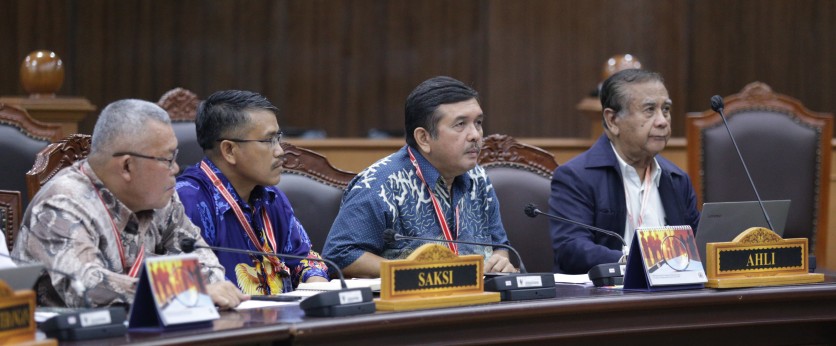
Experts and witnesses for the Petitioners of case No. 139/PUU-XXIII/2025 at a hearing on the Law on Financial Sector Development and Reinforcement, Monday (11/17/2025). Photo by MKRI/Bayu.
JAKARTA (MKRI) — The Petitioners of case No. 139/PUU-XXIII/2025 presented two experts and two witnesses at a hearing for the material judicial review of Article 161 paragraph (2) and Article 164 paragraph (2) of Law No. 4 of 2023 on Financial Sector Development and Reinforcement (P2SK Law) on Monday, November 17, 2025 in the plenary courtroom. The two experts were former constitutional justice Maruarar Siahaan and social security and labor activist Timboel Siregar; the witnesses were Abraham Tandi Datu and Rainot Hutabarat.
Siregar stated that Article 161 paragraph (2) and Article 164 paragraph (2) of the P2SK Law will place workers in a position of uncertainty regarding the security of their pension funds. He explained that, to this day, many independent pension programs managed by financial institutions such as banks and insurance companies—among them DPPK (employer-sponsored pension funds) and DPLK (financial institution pension funds)—have been terminated and faced difficulties fulfilling their obligations, such as the DPPKs of PTPN, Merpati, Kertas Kraft Aceh, and Leces, as well as the DPLKs of Jiwasraya, Bumiputera, Krisna Life, Indo Surya, and Wanarta.
“To this day, no DPPK or DPLK has any guarantee if they encounter difficulties, insolvency, bankruptcy, and so on—there is no guarantee at all,” he said.
He added that those articles would disrupt the rights of workers who have made many plans on their pension funds, particularly those intending to go into business. Pension funds that are paid in full (lump sum) would immediately stimulate household consumption, which contributes to economic growth and supports investment that would create jobs.
Siregar noted that, in general, the rules on severance package require lump sum payment and not in installments. No regulation mandates that severance package in installments. This severance package enables workers to continue seeking employment and having a decent livelihood after being laid off, as mandated by Article 27 paragraph (2) of the 1945 Constitution.
Severance package that is not paid in full and immediately may result in employers being reported for criminal sanctions pursuant to Article 156 paragraph (1) and Article 185 paragraph (1) of Law No. 6 of 2023 on Job Creation. Linking severance package with pension funds would create disharmony in industrial relations in the workplace and thus create a problem for employers.
Two Ministries Hold Different Views
Meanwhile, Maruarar Siahaan highlighted the disharmony and lack of synchronization in the substance of the laws and regulations in the material review of Article 161 paragraph (2) and Article 164 paragraph (2) of the P2SK Law, as reflected in the written testimony submitted by the Ministry of Finance representing the President/Government and the Ministry of Manpower who provided the Government’s testimony. The difference in views between the two ministries indicates a constitutional problem in the norms under review, which do not refer to the same source of constitutional validity under the 1945 Constitution, which binds all state institutions equally and should require a consistent understanding through harmonization and synchronization in joint deliberations, both before the bill was enacted and after it was discussed with the House of Representatives (DPR) for joint approval prior to being passed into law.
“The process of synchronization and harmonization in drafting laws seems very difficult; at the time I indeed saw sectoral ego present,” he said.
The Ministry of Finance essentially asserted that pension payments would be further regulated through Financial Services Authority (OJK) regulations. The P2SK Law regulates pension funds as part of the national financial system aimed at ensuring a welfare state that is responsible for the social protection of citizens facing economic risks in old age, in which payment in installments serve as the dominant method for long-term and sustainable fund protection. Therefore, requests for lump sum payments for all participants would contradict prudential regulation principles commonly adopted in modern pension systems.
Meanwhile, the Ministry of Manpower essentially asserted that the welfare guarantees for workers/laborers entering retirement age have long been regulated both through the Manpower Law and through regulations of the Minister of Manpower, which emphasize the principle that rights of workers/laborers arising from the termination of employment, including retirement, must be paid in cash or lump sum. Payment of severance pay, long-service awards, and compensation for entitlements in companies must be made in cash, and the rights of workers/laborers arising from termination of employment cannot be delayed or converted into periodic payments.
This was also previously noted by Constitutional Justice Saldi Isra, who highlighted the difference in understanding between the two government institutions regarding pension funds, which are essential for workers/laborers in Indonesia. Therefore, he stated that the Government needs to clarify the composition of mandatory and complementary components of pension funds.
“How can two government institutions have different ways of understanding the needs of these workers? So, perhaps the Court’s decision might synchronize this, so that workers may obtain certainty,” he said at a previous hearing on November, 4 2025.
The Petitioners essentially object to the fact that pension funds paid voluntarily could not be disbursed in a lump sum, but only in installments. Yet they stated that they require the full amount of the pension benefits at once in order to start businesses requiring significant capital, rather than receiving payment in installments.
Also read:
Freeport Employees Challenge Periodic Pension Benefit Payments
Freeport Employees Demand Pension Benefits to Be Paid Once in Full
Judicial Review of P2SK Law Postponed as Parliament and President Not Ready to Testify
Government Explains 20 Percent Cap on First Pension Payment
Manpower Ministry: Severance Pay or Pension Must Be Paid in a Lump Sum
PT Freeport Indonesia enrolled the Petitioners in the Freeport Indonesia Pension Fund Program, with all contributions paid in full by company as employer. Under PT Freeport Indonesia’s applicable regulations, the Petitioners are no longer entitled to severance pay or long service awards upon termination of employment due to retirement if the total pension fund contributions and their investment gains—borne by the company—exceed the amount of calculated severance and long service compensation.
The Petitioners requested the Court to declare Article 161 paragraph (2) of Law No. 4 of 2023, which reads, “Payment of pension benefits to participants, widows/widowers, or children shall be made periodically,” and Article 164 paragraph (2), which reads, “Pension fund regulations may contain provisions allowing an initial lump-sum pension payment of up to 20% (twenty percent) of the pension benefits” unconstitutional and not legally binding. They argued that the enforcement of the articles has harmed their constitutional rights to just legal certainty and to a proper livelihood, as well as to just and adequate payment, thus contrary to Article 28D paragraph (1) of the 1945 Constitution.
Therefore, in their petitums, the Petitioners requested the Constitutional Court to reinterpret the two challenged provisions. They asked that Article 161 paragraph (2) of Law No. 4 of 2023 be read as: “Pension benefit payments for participants, surviving spouses, or children may be made periodically; however, if the participant chooses a lump‑sum payment, it must be paid in full.” Meanwhile, they proposed that Article 164 paragraph (2) be reinterpreted as: “Pension Fund Regulations may contain provisions allowing the option for pension benefits to be paid in a single lump sum of 100 percent of the total benefits.”
Author : Mimi Kartika
Editor : Lulu Anjarsari P.
PR : Raisa Ayuditha M.
Translators : Yuniar Widiastuti, Rizky Kurnia Chaesario (NL)
Disclaimer: The original version of the news is in Indonesian. In case of any differences between the English and the Indonesian versions, the Indonesian version will prevail.
Monday, November 17, 2025 | 15:00 WIB 381