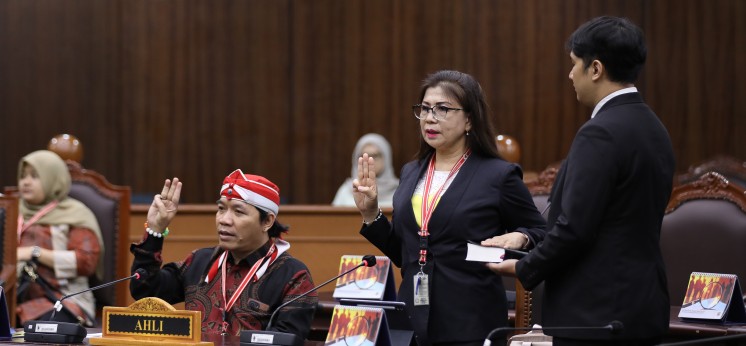
Theresia Isye Mogi and Sunarman Sukamto being sworn in to deliver expert testimony at the judicial review hearing of Law No. 8 of 2016 on Persons with Disabilities, Thursday (11/6). Photo by MKRI/Ifa.
JAKARTA (MKRI) — The Constitutional Court (MK) held another evidentiary hearing for the material judicial review of Law No. 8 of 2016 on Persons with Disabilities against the 1945 Constitution on Thursday, November 6, 2025, in the plenary courtroom.
The petition in Case No. 130/PUU-XXIII/2025 was filed by two individuals living with chronic illnesses, Raissa Fatikha and Deanda Dewindaru, who asserted that their constitutional rights had been impaired due to the absence of an explicit recognition of chronic illness as a distinct category of disability under the Disabilities Law.
The hearing featured expert testimonies presented by the President: Theresia Isye Mogi, a specialist in physical medicine and rehabilitation, and Sunarman Sukamto, Director of the Community-Based Rehabilitation Development and Training Center (PPRBM) Solo.
Theresia explained that under Indonesia’s statutory framework, including Law No. 8 of 2016 on Persons with Disabilities, Government Regulation No. 13 of 2020 on Reasonable Accommodation for Persons with Disabilities, and Minister of Health Regulation No. 82 of 2020 on Health Services for Persons with Disabilities, persons with disabilities are defined as individuals with long-term physical, intellectual, mental, and/or sensory limitations who, in interaction with the environment, may encounter barriers that hinder their full and effective participation in society.
She emphasized that chronic pain is a complex condition often lacking clear objective findings, thus requiring a comprehensive assessment encompassing functional, psychological, emotional, social, and occupational dimensions. Such assessment, she noted, must apply the International Classification of Functioning, Disability, and Health (ICF) to evaluate body functions, daily activities, and social participation.
“Diagnosing disability in patients with chronic pain or chronic illness is not based solely on the pain or the illness itself, but rather on the functional limitations arising from it,” Theresia stated, underscoring the importance of combining anamnesis, physical examination, clinical observation, and accountable functional measurement in determining disability status.
Evolution of the Disability Paradigm
Sunarman Sukamto elaborated that the concept of disability has undergone a paradigmatic shift, from older, charity- and medical-based models toward a human rights–oriented social model. According to him, the charity model regards persons with disabilities as objects of compassion requiring care and support. In contrast, the medical model views disability as an individual disorder to be cured through medical intervention.
“The social model, as defined in the UN Convention on the Rights of Persons with Disabilities (UNCRPD), conceptualizes disability as the result of interactions between a person with disabilities and societal as well as environmental barriers. Its central concern is not the individual condition, but how social structures and public attitudes restrict participation,” Sunarman explained.
He stressed that disability today is understood as a human rights issue, not merely a medical condition. “It is the societal barriers, not the individual’s condition, that must be identified and dismantled to enable full and equal participation,” he asserted.
Sunarman also cautioned that categorizing chronic illness as a type or subtype of disability risks reverting to a medicalized understanding of disability. “Such an approach could undermine the advocacy movement that has successfully shifted the paradigm from a medical to a social model. The medical lens tends to inhibit critical awareness and social transformation,” he concluded.
Also read:
Court Postpones Disability Law Hearing Due to Late Expert Submission
House of Representatives: Medical Assessment Determines Disability Status
Govt: Disability Determination Conducted Through Clinical Assessment by Healthcare Professionals
Government and House Request Postponement of Judicial Review Hearing on Disabilities Law
Convention on the Rights of Persons with Disabilities Continues to Evolve
Chronic Illness Patients Seek Recognition as Persons with Disabilities
Background of the Petition
As previously reported, the Petitioners challenged Article 1 point 1, Article 4 paragraph (1), and the elucidation of Article 4 paragraph (1) of Law No. 8 of 2016. The case, registered under No. 130/PUU-XXIII/2025, was brought because the Petitioners believe their constitutional rights are harmed by the absence of explicit recognition of chronic illness as part of the spectrum of disabilities.
Raissa Fatikha, a survivor of Thoracic Outlet Syndrome (TOS) for ten years, experiences ongoing pain in her arm, shoulder, and upper right chest with fluctuating intensity. This condition limits her mobility, stamina, and functional capacity, particularly during flare-ups. Nonetheless, she remains active in public education through her platform Ragam Wajah Lara.
Deanda Dewindaru, living with autoimmune conditions, Guillain-Barré Syndrome, Sjögren’s Disease, and Inflammatory Bowel Disease, for the past three years, experiences chronic fatigue and flare-ups that restrict her stamina and motor function. She contributes educational content through her Spoonie Story platform.
At the preliminary hearing held on Wednesday, August 13, 2025, the Petitioners’ legal counsel, Reza, argued that the absence of explicit recognition of chronic illness hampers outreach and advocacy regarding rights and public services. “During outreach activities on public services, the Petitioners must explain their conditions in detail. If chronic illness were recognized as a disability category, policymakers would more easily understand and ensure the fulfillment of their rights,” he told the panel chaired by Justice Arief Hidayat, accompanied by Justice Anwar Usman and Justice Enny Nurbaningsih.
The Petitioners attested that the harm they face is real and tangible, particularly when accessing public services designated for persons with disabilities. They requested the Court to include chronic illness as one of the categories of disability under the Disabilities Law.
Explore the Case: No. 130/PUU-XXIII/2025 (in Bahasa Indonesia)
Author: Utami Argawati
Editor: Nur R.
PR: Andhini S. F.
Translator: Yuanna Sisilia
Disclaimer: The original version of the news is in Indonesian. In case of any differences between the English and the Indonesian versions, the Indonesian version will prevail.
Thursday, November 06, 2025 | 16:01 WIB 159