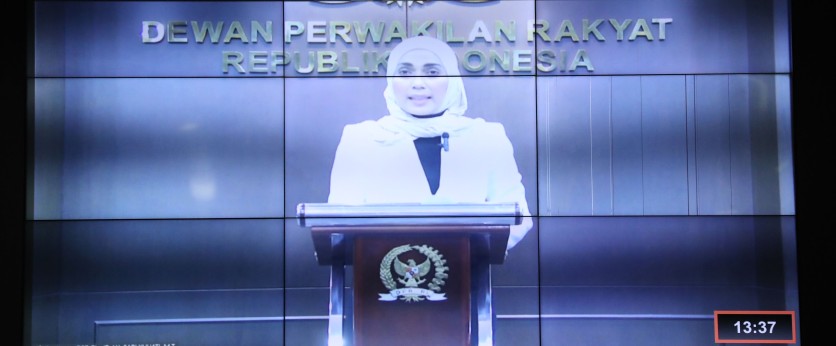
House of Representatives (DPR) Commission III member Sari Yuliati delivering the DPR’s statement online at the judicial review hearing of Law No. 8 of 2016 on Persons with Disabilities, Tuesday (10/21/2025). Photo by PR/ Panji.
JAKARTA (MKRI) — The Constitutional Court (MK) held another judicial review hearing of Article 1 point 1, Article 4 paragraph (1), and the elucidation of Article 4 paragraph (1) of Law No. 8 of 2016 on Persons with Disabilities on Tuesday, October 21, 2025, in the plenary courtroom. The session’s agenda was to hear the statement of the House of Representatives (DPR) as well as the Petitioners’ expert and witness testimonies.
Case No. 130/PUU-XXIII/2025 was filed by two individuals with chronic illnesses, Raissa Fatikha and Deanda Dewindaru, who argued that their constitutional rights had been impaired by the absence of explicit recognition of chronic illnesses as a type of disability under the said law.
During the hearing, DPR Commission III member Sari Yuliati underscored the importance of medical assessment in determining a person’s disability status. She asserted that not all chronic illnesses could automatically be categorized as disabilities.
“Doctors, as competent medical professionals, have the authority to assess whether a person’s chronic illness meets the criteria for disability,” Sari stated before the panel of justices.
Sari further explained that medical assessments must take into account the development of symptoms, recurrence potential, and the long-term nature of the illness. She stressed that the distinction between chronic illness and disability is fundamental, as not all chronic conditions result in significant functional limitations.
The DPR argued that expanding the definition of disability to include chronic, autoimmune, pain-related, and cancer conditions might be counterproductive, as it could lead to multiple interpretations and complicate the implementation of disability protection policies.
Sari also remarked that the Petitioners’ request for the Court to establish policy guidelines for state administrators should be directed to the relevant ministries or agencies, since such matters fall within the realm of policymaking rather than judicial review.
Functional and Interactional Understanding
The Petitioners’ expert, Bahrul Fuad, emphasized that disability should be understood in a functional and interactional sense rather than merely through medical diagnosis. He elaborated that disability results from the interaction between an individual’s limitations and the environmental and social barriers that restrict participation in society.
Bahrul asserted that a narrow interpretation of the elucidation of Article 4 paragraph (1) letter a, which appears to limit physical disabilities to impairments in movement, contradicts the spirit of the Convention on the Rights of Persons with Disabilities (CRPD) and the principle of substantive equality.
“Physical disability should not be confined to impairments in mobility alone but should encompass all forms of physical limitations, including those that are invisible or episodic, that hinder full participation in society,” Bahrul explained.
He added that harmonizing statutory interpretation is crucial to prevent a return to a purely medical model of disability. A functional approach, he noted, could be strengthened through the use of instruments such as the Washington Group Questions (WGQ), which identify participation barriers without relying solely on specific diseases.
Another expert presented by the Petitioners, M. Joni Yulianto, Director of the Center for Disability Studies and Advocacy Movement (SIGAB Indonesia), stated that in cases involving chronic illness, the issue lies not in the disease itself but in the resulting limitations that obstruct individuals’ daily activities. He noted that the current elucidation of Article 4 of the Law on Persons with Disabilities appears to restrict the definition of persons with disabilities to those with physical impairments, thereby excluding individuals with chronic illnesses who also experience real barriers in their daily lives.
Joni emphasized that recognizing persons with chronic illnesses as part of the disability group would not only broaden the legal definition but also provide regulatory protection for them.
Social Stigma
The Petitioners’ witness, Moch Fadel Nooriandi, a Thalassemia Major survivor, testified about the challenges he faces, including discrimination and difficulty securing employment due to his need for regular blood transfusions and the social stigma surrounding his condition.
“I feel like an invisible person with a disability. Physical limitations, medical needs, and social stigma make it hard for us to fully participate at school and in the workplace,” Fadel said.
Also read:
Chronic Illness Patients Seek Recognition as Persons with Disabilities
Convention on the Rights of Persons with Disabilities Continues to Evolve
Government and House Request Postponement of Judicial Review Hearing on Disabilities Law
Govt: Disability Determination Conducted Through Clinical Assessmnt by Healthcare Professionals
The two individuals with chronic illnesses, Raissa Fatikha and Deanda Dewindaru, filed a judicial review petition of Article 1 point 1, Article 4 paragraph (1), and the elucidation of Article 4 paragraph (1) of Law No. 8 of 2016 on Persons with Disabilities with the Constitutional Court (MK). Their petition was registered under Case No. 130/PUU-XXIII/2025. The Petitioners argued that the lack of explicit recognition of chronic illnesses as a form of disability has deprived them of their constitutional rights.
Raissa Fatikha, a survivor of Thoracic Outlet Syndrome (TOS) for the past ten years, experiences persistent pain in her right hand, shoulder, and upper chest, with fluctuating intensity. Her condition limits her mobility and stamina, especially during flare-ups, although she remains active in public education through the platform Ragam Wajah Lara.
Meanwhile, Deanda Dewindaru has lived with autoimmune disorders, Guillain-Barré Syndrome, Sjögren’s Disease, and Inflammatory Bowel Disease, for the past three years. She experiences chronic fatigue and flare-ups that restrict her stamina and movement, and actively educates others through her platform Spoonie Story.
At the preliminary hearing on Wednesday, August 13, 2025, the Petitioners’ legal counsel, Reza, stated that the absence of explicit recognition has hindered public awareness and advocacy for the rights of individuals with chronic illnesses.
“When conducting advocacy or outreach for public services, the Petitioners must explain their conditions in great detail. If chronic illnesses were recognized as a form of disability, this process would be easier for policymakers to understand, ensuring that their rights are fulfilled,” Reza explained before the panel of justices chaired by Constitutional Justice Arief Hidayat, accompanied by Constitutional Justices Anwar Usman and Enny Nurbaningsih.
The Petitioners maintained that the harm they suffered was real and factual, particularly in accessing public services designated for persons with disabilities. They requested the Court to include chronic illnesses as a category of disability within the Law on Persons with Disabilities.
Explore the Case: Case No. 130/PUU-XXIII/2025
Author: Utami Argawati
Editor: Nur R.
PR: Andhini SF
Translator: Yuanna Sisilia
Disclaimer: The original version of the news is in Indonesian. In case of any differences between the English and the Indonesian versions, the Indonesian version will prevail.
Tuesday, October 21, 2025 | 16:09 WIB 149