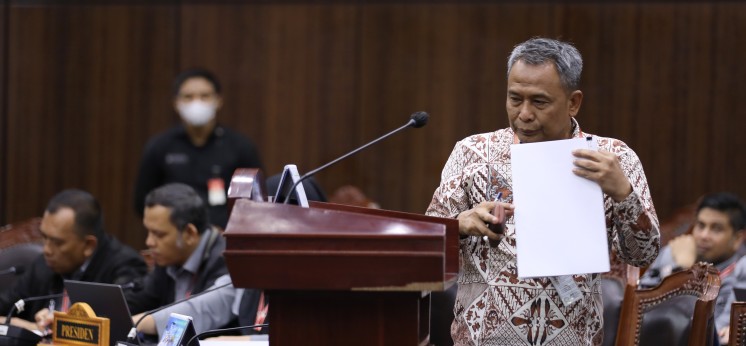
Director General of Social Rehabilitation, Supomo, representing the government, to testify during the material judicial review hearing of Law No. 8 of 2016 on Persons with Disabilities, Tuesday (07/10). Photo by MKRI/Ifa.
Jakarta (MKRI) – The Constitutional Court (MK) resumed hearings on the material judicial review of Article 1 point 1, Article 4 paragraph (1), and the elucidation of Article 4 paragraph (1) of Law No. 8 of 2016 on Persons with Disabilities against the 1945 Constitution on Tuesday, October 7, 2025. The petitioners in Case No. 130/PUU-XXIII/2025, Raissa Fatikha and Deanda Dewindaru, both living with chronic illnesses, argued that their constitutional rights are harmed due to the absence of explicit recognition of chronic illness as a form of disability under the law.
Representing the government, Director General of Social Rehabilitation at the Ministry of Social Affairs, Supomo, explained that Law No. 8 of 2016 accommodates provisions for persons with disabilities in accordance with the principles of the Convention on the Rights of Persons with Disabilities (CRPD), which Indonesia ratified through Law No. 19 of 2011.
The government emphasized that the paradigm of disability protection has shifted from a charity-based approach under Law No. 4 of 1997 to a rights-based approach under Law No. 8 of 2016. Article 4 paragraph (2) specifies that the types of disabilities can be experienced singly, multiply, or for an extended period, as determined by medical professionals.
According to the government, this provision means that individuals with chronic diseases may be recognized as persons with disabilities if a medical assessment confirms significant limitations in their physical, intellectual, mental, or sensory functions that affect their social participation. Thus, chronic illness is not a distinct category of disability but rather a possible cause of disability.
The government further stated that the authority to determine a person's disability status lies with healthcare professionals, as regulated by law and the Indonesian Medical Code of Ethics. “This is consistent with Article 4 paragraph (2) of the Disability Law,” Supomo added.
As a result, individuals diagnosed with chronic illnesses that cause long-term limitations in physical, intellectual, mental, and/or sensory functions, which restrict interaction and participation in daily life, may be categorized as persons with disabilities by medical professionals in accordance with the classifications set out in Law No. 8 of 2016.
Supomo explained that the petitioners already recognize that a chronic illness does not automatically result in a disability determination, but instead requires a clinical assessment by qualified healthcare personnel. Therefore, he argued, there is no need for the petitioners to request that chronic illness be added as a distinct form of disability under Law No. 8 of 2016.
During the hearing, the government also asserted that if the petitioners' request were granted to define the phrase as “continuously or fluctuating physical function and causing significant difficulties in daily activities,” and to divide physical disabilities into ‘visible physical disabilities’ and ‘invisible physical disabilities,’ it would result in norm ambiguity and expand the scope beyond the law’s intent.
Additionally, changing the interpretation of “motor function” to “physical function” would conflict with provisions in Article 4 and violate international conventions such as the CRPD and the ICF by the WHO. The government questioned the legal basis for the petitioners' distinction between “visible” and “invisible” disabilities, suggesting that such distinctions could covertly alter existing regulations.
Finally, the government argued that the petition is legally unfounded, as the rights of those living with chronic illnesses are already protected under other laws, including Law No. 39 of 1999 on Human Rights, Law No. 40 of 2004 on the Social Security System, and Law No. 17 of 2023 on Health.
Also read:
Chronic Illness Patients Seek Recognition as Persons with Disabilities
Convention on the Rights of Persons with Disabilities Continues to Evolve
Government and House Request Postponement of Judicial Review Hearing on Disabilities Law
As additional information, the petition for Case No. 130/PUU-XXIII/2025 was lodged by Raissa Fatikha and Deanda Dewindaru to the Constitutional Court. Both asserted that chronic illnesses should be explicitly acknowledged as a type of disability under the Disabilities Law.
Raissa has been living with Thoracic Outlet Syndrome (TOS) for ten years, causing persistent pain in her hands, shoulders, and upper right chest, with fluctuating intensity. This condition limits her mobility, stamina, and motor functions, particularly during flare-ups. Despite these limitations, she actively raises public awareness through her platform Ragam Wajah Lara.
Deanda has lived with multiple autoimmune diseases—Guillain-Barré Syndrome, Sjögren’s Disease, and Inflammatory Bowel Disease, over the past three years. She experiences chronic fatigue and flare-ups that restrict her stamina and mobility. She also shares educational content through her platform Spoonie Story.
At the preliminary hearing on Wednesday, August 13, 2025, the Petitioners’ legal counsel, Reza, contended that the lack of explicit recognition hinders outreach and advocacy for people with chronic illnesses. “When conducting outreach on public services, the Petitioners must explain their conditions in detail. If chronic illnesses were acknowledged as a form of disability, this process would be more comprehensible to policymakers and ensure that their rights are fulfilled,” he stated before a panel chaired by Constitutional Justice Arief Hidayat, accompanied by Constitutional Justices Anwar Usman and Enny Nurbaningsih.
The Petitioners emphasized that the harm they suffer is concrete and factual, particularly in accessing public services reserved for persons with disabilities. They petitioned the Court to recognize chronic illnesses as a category of disability under the Disabilities Law.
Author: Utami Argawati
Editor: Nur R.
PR: Andhini SF.
Translator: Rizky Kurnia Chaesario/Yuanna Sisilia
Disclaimer: The original version of the news is in Indonesian. In case of any differences between the English and the Indonesian versions, the Indonesian version will prevail.
Tuesday, October 07, 2025 | 14:47 WIB 239