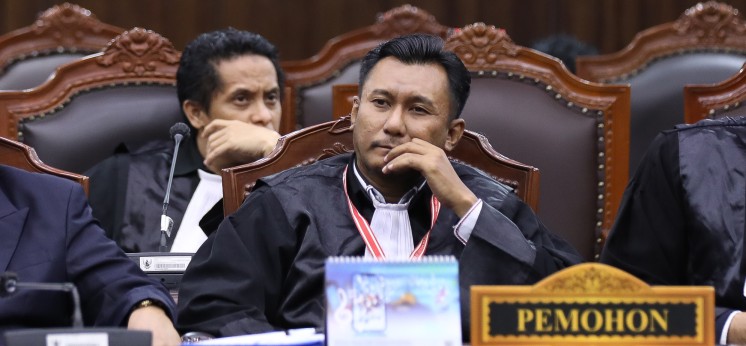
The Petitioner’s legal counsel Ardin Firanata attending the ruling hearing of the judicial review of Law No. 2 of 2002 on the National Police, Thursday (10/30) in the plenary courtroom of the Constitutional Court. Photo by MKRI/Ifa.
JAKARTA (MKRI) — The Constitutional Court ruled that the House of Representatives’ (DPR) approval for the appointment and dismissal of the National Police Chief (Kapolri) by the President is not a deviation from the presidential system, but rather an embodiment of accountability that reflects the principle of checks and balances as implied in the 1945 Constitution. This mechanism aims to ensure good governance.
This was one of the Court’s legal considerations in the judicial review of Article 11 paragraph (1) of Law No. 2 of 2002 on the Indonesian National Police (Police Law). The ruling hearing for case No. 167/PUU-XXIII/2025, filed by Windu Wijaya, was held on Thursday, October 30, 2025.
Constitutional Justice Daniel Yusmic P. Foekh explained that the Court had previously reviewed and ruled on the same provision in Decision No. 22/PUU-XII/2015. In essence, the provision on DPR’s approval for certain appointments is already regulated in Article 226 of the DPR Standing Orders No. 1 of 2020, as amended by DPR Standing Orders No. 1 of 2025.
Although the grounds for this petition differ from those in case No. 22/PUU-XII/2015, the substance of the request remains the same. Therefore, the Court found no compelling legal reason to deviate from its previous stance. The legal considerations in that decision thus apply mutatis mutandis to this case.
Justice Foekh further addressed the Petitioner’s argument that DPR’s approval should be based on objective, transparent, and accountable criteria.
“If the purpose of DPR’s approval for the appointment and dismissal of the Police Chief is to ensure that the President’s prerogative power is exercised transparently, accountably, and participatively, then those very elements are inherently fulfilled by the President at the time of proposing the candidate to the DPR,” he stated. “A prospective public official, particularly a Police Chief, would not be nominated by the President without meeting the general qualifications as described by the Petitioner.”
Reinforcing the President’s Prerogative Power
Justice Foekh went on to emphasize that, while the DPR’s approval mechanism remains constitutional, in the context of checks and balances, the nomination of a Police Chief by the President should ideally reinforce the President’s prerogative authority. Such reinforcement, he said, upholds accountability and transparency within Indonesia’s presidential system, as mandated by the 1945 Constitution. The involvement of DPR, in turn, serves to strengthen good governance and ensure that the appointed Police Chief possesses integrity, competence, leadership, and acceptability to effectively assist the President in governing.
“Thus, without modifying the wording of Article 11 paragraph (1) of Law No. 2 of 2002 as requested by the Petitioner, the essential conditions have already been satisfied by the President before seeking the DPR’s approval,” he asserted. “Based on the above legal considerations, the Court concluded that the Petitioner’s arguments concerning the unconstitutionality of Article 11 paragraph (1) of the Police Law are legally groundless.”
The plenary session was presided over by Chief Justice Suhartoyo, alongside the other eight constitutional justices.
Also read:
Provision on Appointment and Dismissal of Police Chief Challenged Again
Petition on Appointment and Dismissal of Police Chief Revised
The Petitioner had argued that the phrase “DPR approval” in Article 11 paragraphs (1) and (2) and their elucidation of the Police Law lacks clarity, as it does not specify the criteria or rationale for such approval, potentially resulting in legal uncertainty. The Petitioner questioned whether DPR’s approval serves an administrative function—verifying compliance with statutory requirements such as those in paragraph (6)—or whether it extends to subjective political considerations, thereby undermining the President’s prerogative authority.
The Petitioner also claimed a constitutional loss due to the absence of clear legal parameters for DPR’s approval or rejection of the President’s nominee, making the President’s power entirely dependent on DPR’s discretion without definite legal grounds. Furthermore, the law does not stipulate minimum qualifications for the Police Chief candidate (e.g., rank, tenure, achievements), criteria for nomination, mechanisms for multiple candidates, or procedures in case DPR rejects the proposed candidate.
Author: Sri Pujianti
Editor: Lulu Anjarsari P.
PR: Andhini S. F.
Translator: Yuanna Sisilia
Full decision of Case No. 167/PUU-XXIII/2025 (in Bahasa Indonesia)
Disclaimer: The original version of the news is in Indonesian. In case of any differences between the English and the Indonesian versions, the Indonesian version will prevail.
Thursday, October 30, 2025 | 13:23 WIB 200