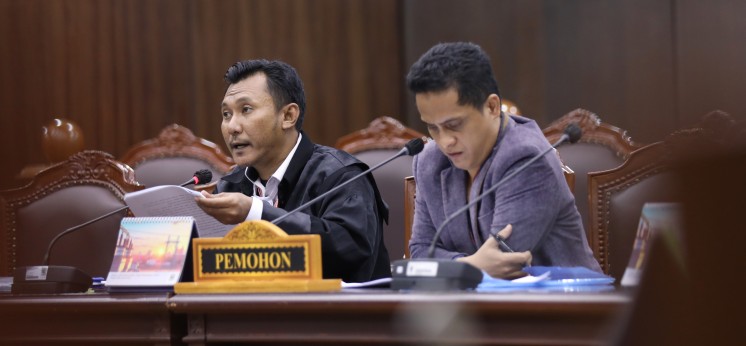
Windu Wijaya (Petitioner) and counsel Ardin Firanata at the preliminary hearing for the material judicial review of Law No. 2 of 2002 on the National Police, Thursday (9/25/2025). Photo by MKRI/Ifa.
JAKARTA (MKRI) — The provision on the appointment and dismissal of the Chief of the Indonesian National Police (Kapolri) under Article 11 paragraph (1) of Law No. 2 of 2002 on the Indonesian National Police has once again been brought for judicial review before the Constitutional Court (MK). This time, an individual citizen, Windu Wijaya, challenges the authority of the president to appoint and dismiss the chief of police with the approval of the House of Representatives (DPR). The preliminary hearing for case No. 167/PUU-XXIII/2025 was chaired by Chief Justice Suhartoyo on Thursday, September 25, 2025 in the plenary courtroom.
Article 11 paragraph (1) of the Police Law provides that: “The Chief of Police shall be appointed and dismissed by the President with the approval of the House of Representatives.” This provision is alleged to be inconsistent with Article 28D paragraph (1) of the 1945 Constitution, which states that: “Every person shall have the right to recognition, guarantees, protection, and fair legal certainty as well as equal treatment before the law.”
The Petitioner, represented by legal counsel Ardin Firanata, stated that with respect to the House’s approval of the appointment and dismissal of the chief of police as proposed by the president, the Constitutional Court had previously stated its consideration in Decision No. 22/PUU-XIII/2015. Nevertheless, the Petitioner observed that the appointment of the chief of police by the president, as regulated in Article 11 paragraphs (1) and (2) and their elucidation, merely states “with the approval of the House” without specifying the requirements, criteria, or reasons for such appointment. As a result, the provision lacks clarity, which potentially leads to legal uncertainty in constitutional practice.
“The phrase ‘approval by the House’ in the provision a quo does not clearly define whether such approval is administrative in nature, intended to ensure compliance with the requirements stipulated in Article 11 paragraph (6) of the Police Law, or whether such approval also relates to the physical and mental health condition and/or legal status of the candidate for chief of police, or whether it functions as a political instrument that could impede the president’s prerogative to appoint the chief of police,” the Petitioner explained.
Absence of Legal Basis for Approval or Rejection
Moreover, the Petitioner claims to have suffered constitutional harm due to the absence of clear legal grounds underlying the House’s approval or rejection of the president’s proposed appointment of the chief of police. Consequently, the president’s authority to appoint the chief of police becomes entirely dependent on the House’s approval, without legal certainty regarding the parameters or legal grounds that may be used as the basis for approving or rejecting the president’s nominee.
Regarding the appointment, the Petitioner argues that the provision does not further regulate the minimum qualifications for candidates for chief of police (such as rank, term of service, or record of achievement); the reasons or grounds for proposing a candidate’s name; the mechanism for selection if more than one candidate is considered; or the procedure to follow if the House rejects the proposed candidate.
For these reasons, the Petitioner requests the Court to grant the petition in its entirety and to declare the phrase “approval of the House of Representatives” in Article 11 paragraph (1) of Law No. 2 of 2002 constitutional insofar as it is interpreted to mean that the approval of the House shall be given to the president’s nomination of a chief of police only if it meets legitimate grounds, namely: 1) The candidate for chief of police is an Indonesian citizen and an active high-ranking officer with rank and career progression as regulated under Article 11 paragraph (6) of the Police Law; 2) The candidate for chief of police is devoted to God Almighty, loyal to Pancasila as the foundation of the State, the 1945 Constitution, and the ideals of the Proclamation of Independence; 3) The candidate for chief of police is physically and mentally healthy; and 4) The candidate for chief of police possesses integrity and good character and has never been sanctioned for ethical violations within the Police nor convicted by a court decision having permanent legal force.
Justices’ Advice
In response to the petition, Constitutional Justice Daniel Yusmic P. Foekh stated that the constitutional harm alleged by the Petitioner as an advocate had not yet been demonstrated in the petition. “If, as an advocate, there are matters directly related to the chief of police or the police apparatus, this must be elaborated so that the constitutional loss and a causal connection between the challenged provision and the Petitioner’s legal standing are apparent,” he said.
Meanwhile, Constitutional Justice M. Guntur Hamzah commented on the inconsistency between the claim of legal uncertainty and the petitums, which declares the challenged provision constitutional. “If it remains constitutional, then there is no harm to you. In this case, you are requesting an advisory opinion—there is no problem with the provision itself, but you are seeking criteria, and that is not for the Court but for the House. Here we must consider the legal logic,” he said.
Furthermore, Chief Justice Suhartoyo advised that the petition must demonstrate an actual or potential violation of the Petitioner’s constitutional rights in connection with his professional duties that are related to the position of chief of police. “Explain the constitutional harm in a more concrete way, not merely in the context of being a voter—the connection is too remote,” he suggested.
Before adjourning the session, the chief justice announced that the Petitioner would have 14 days to revise the petition and is to submit it no later than Wednesday, October 8, 2025 at 12:00 WIB. The Court will then schedule the second hearing to hear the revisions to the petition.
Author : Sri Pujianti
Editor : Lulu Anjarsari P.
PR : Andhini S. F.
Translator : Yuniar Widiastuti (NL)
Disclaimer: The original version of the news is in Indonesian. In case of any differences between the English and the Indonesian versions, the Indonesian version will prevail.
Thursday, September 25, 2025 | 13:21 WIB 132