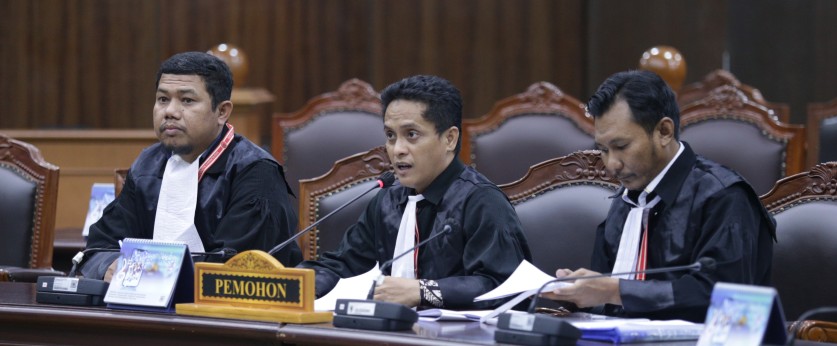
The Petitioner at the second hearing for the material judicial review of Law No. 2 of 2002 on the National Police for case No. 167/PUU-XXIII/2025, Wednesday (10/8/2025). Photo by MKRI/Bayu.
JAKARTA (MKRI) —The Constitutional Court (MK) held the second hearing for the material judicial review of Article 11 paragraph (1) of Law No. 2 of 2002 on the Indonesian National Police on Wednesday, October 8, 2025. Individual citizen Windu Wijaya delivered the revisions to the petition for case No. 167/PUU-XXIII/2025. He believes that the article under review fails to substantively explain the approval process, criteria, and grounds on which the House of Representatives (DPR) bases its approval or rejection of the president’s nominee for chief of police.
Windu further elaborated that the House’s authority to grant such approval is regulated under the DPR Regulation No. 1 of 2020. However, this provision only concerns technical and procedural mechanisms such as scheduling, examination, administration, presentation of vision, and the conduct of a fit-and-proper test, without providing clear and objective legal parameters regarding the reasons that the House may use in granting its approval. As a result, the approval process becomes merely formalistic, without any obligation to provide objective, transparent, and accountable reasoning.
The absence of such reasoning in the House’s approval mechanism, Windu continued, creates legal uncertainty for the Petitioner as decisions may be made based on subjective considerations rather than rationally testable criteria.
“This situation has resulted in a constitutional loss for me as a citizen guaranteed by Article 28D paragraph (1) of the 1945 Constitution of the Republic of Indonesia. Therefore, the enforcement of the phrase ‘approval of the House of Representatives’ in the article a quo is inconsistent with Article 28D paragraph (1) of the 1945 Constitution,” he asserted at the panel hearing presided over by Chief Justice Suhartoyo (chair) alongside Constitutional Justices Daniel Yusmic P. Foekh and M. Guntur Hamzah.
Also read: Provision on Appointment and Dismissal of Police Chief Challenged Again
At the preliminary hearing on Thursday, September 25, the Petitioner stated that the Constitutional Court had previously ruled a case on the House’s approval of the appointment and dismissal of the chief of police as proposed by the president in Decision No. 22/PUU-XIII/2015. Nevertheless, he observed that the appointment of the chief of police by the president, as regulated in Article 11 paragraphs (1) and (2) and their elucidation, merely states “with the approval of the House” without specifying the requirements, criteria, or reasons for such appointment. As a result, the provision lacks clarity, which potentially leads to legal uncertainty in constitutional practice.
“The phrase ‘approval by the House’ in the provision a quo does not clearly define whether such approval is administrative in nature, intended to ensure compliance with the requirements stipulated in Article 11 paragraph (6) of the Police Law, or whether such approval also relates to the physical and mental health condition and/or legal status of the candidate for chief of police, or whether it functions as a political instrument that could impede the president’s prerogative to appoint the chief of police,” the Petitioner explained.
Moreover, the Petitioner claims to have suffered constitutional harm due to the absence of clear legal grounds underlying the House’s approval or rejection of the president’s proposed appointment of the chief of police. Consequently, the president’s authority to appoint the chief of police becomes entirely dependent on the House’s approval, without legal certainty regarding the parameters or legal grounds that may be used as the basis for approving or rejecting the president’s nominee.
Regarding the appointment, the Petitioner argues that the provision does not further regulate the minimum qualifications for candidates for chief of police (such as rank, term of service, or record of achievement); the reasons or grounds for proposing a candidate’s name; the mechanism for selection if more than one candidate is considered; or the procedure to follow if the House rejects the proposed candidate.
Author : Sri Pujianti
Editor : Lulu Anjarsari P.
PR : Andhini S. F.
Translator : Yuniar Widiastuti (NL)
Disclaimer: The original version of the news is in Indonesian. In case of any differences between the English and the Indonesian versions, the Indonesian version will prevail.
Wednesday, October 08, 2025 | 15:46 WIB 236