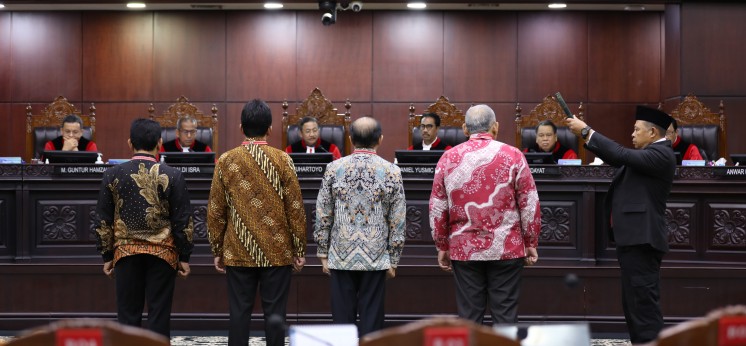
Experts and witnesses presented by the Government took their oaths before the panel of justices during the follow-up judicial review hearing of Law No. 6 of 2023 on Job Creation, held on Monday (20/10) in the Constitutional Court courtroom. Photo by the Constitutional Court Public Relations/Ifa.
JAKARTA, MKRI – The Constitutional Court (MK) once again convened a follow-up hearing for the judicial review of Law No. 6 of 2023 on the Stipulation of Government Regulation in Lieu of Law (Perppu) No. 2 of 2022 on Job Creation into Law (the Job Creation Law) on Monday (20/10/2025). This seventh hearing in the case filed by the Indonesian Forum for the Environment (WALHI) aimed to examine Articles 13(b), 22(1), 22(3), 22(5), 22(8), 22(9), 22(10), 22(14), 22(15), 22(16), 22(17), 22(18), and 22(28) of the Job Creation Law.
The session’s agenda was to hear testimony from two expert witnesses representing the Government/President, namely Dwi Purwantoro Sasongko and Bambang Hendroyono, as well as factual witnesses Suwandi and Ika Bagus Priyambada.
Streamlined AMDAL Process While Preserving Ecological Balance
In his expert testimony, Dwi Purwantoro Sasongko, former Head of the Center for Environmental Studies at Diponegoro University (2014–2024), explained that the streamlining of the Environmental Impact Assessment (AMDAL) process is accompanied by an integrated assessment mechanism covering environmental feasibility and/or infeasibility. This integration involves the management systems of production, environment, and social aspects in a holistic manner. According to Dwi, all these measures are directed toward maintaining the ecological functions of ecosystems and minimizing social impacts, rather than prioritizing investment interests over environmental sustainability.
He elaborated that the terminological change from “environmental permit” to “environmental approval”, supported by stronger procedural frameworks under implementing regulations and Norms, Standards, Procedures, and Criteria (NSPK), reinforces this approach. Specifically, the issuance of Ministerial Decree No. 1637 of 2025 concerning the Integration of Environmental Approvals, Technical Approvals, Technical Details, and Detailed Technical Documents within the Ministry of Environment/Environmental Control Agency provides legal certainty for business activities by integrating environmental approval processes with the business licensing system.
The integration stipulated in the Ministerial Decree allows parallel or simultaneous submissions for environmental document assessments along with applications for Initial Approval, Basic Requirements such as Spatial Utilization Compatibility (KKPR), and Technical Approvals—including compliance with Wastewater Quality Standards, Emission Standards, Hazardous Waste (B3) Management, and Traffic Impact Analysis (Andalalin). Previously, these steps had to be completed sequentially, thus the integration significantly reduces processing time.
“This integration has become even more efficient with the availability of the Amdalnet system, which is connected to the Online Single Submission (OSS) platform. The fulfillment of service-level agreements (SLAs) is now system-executed, ensuring all deadlines are met due to the presence of ‘maximum time limits.’ Even SPPL integrated with NIB and UKL-UPL for low- and medium-risk activities can be processed in real time, as the standard guidelines are now fully integrated into the Amdalnet and OSS systems,” Dwi explained.
Environmental Protection Remains Intact
Meanwhile, Bambang Hendroyono, an Environmental Science expert from Brawijaya University, emphasized that the amendments introduced by the Job Creation Law do not eliminate environmental protection principles. According to him, the core principles of environmental management—including state responsibility, sustainability, and public participation which remain embedded in the law and continue to serve as the foundation for environmental protection and management.
He clarified that the shift in terminology from “environmental permit” to “environmental approval” was driven by public policy considerations, particularly in response to spatial development dynamics that necessitated regulatory reform to facilitate business activities. Thus, the system was redesigned to adopt a risk-based business licensing approach, aligning environmental governance with the principles of safety, health, and environmental quality.
“Therefore, the change from environmental permits to environmental approvals means that environmental procedures are now fully integrated into business licensing, monitored through the Amdalnet information system, and supported by SLAs to ensure coherence throughout the regulatory transformation,” Bambang stated.
The Process of Environmental Document Preparation
Ika Bagus Priyambada, a witness for the Government, testified that he has served as a lecturer in Environmental Engineering at Diponegoro University since 1998 and has been actively involved in environmental document preparation since 2005. He previously served on the AMDAL Evaluation Commission before the enactment of the Job Creation Law and currently participates as a member of the AMDAL evaluation team under the new legal framework.
“Based on my experience, there is no significant difference in the stakeholders involved in public participation for AMDAL preparation before and after the enactment of the Job Creation Law, as detailed in Government Regulation No. 22 of 2021. Previously, public consultations involved affected communities, environmental observers, and stakeholders influenced by AMDAL decisions. After the regulation’s enactment, consultations now include environmental observers, researchers or NGOs, and directly affected communities,” Ika Bagus explained.
Also read:
State Role in Supervising Business Licenses and Environmental Management Questioned
Petitioner Affirm State's Key Role in Supervising Business License and Environmental Management
House Absent, Govt Asks to Postpone Hearing on Job Creation Law
Govt: Changing Environmental Permit to Environmental Approval to Reduce Overlapping Bureaucracy
House Absent, Experts Not Ready, Job Creation Law Hearing Postponed
House: Job Creation Law Streamlines Licensing by Merging Environmental Permits into Business Approvals
In prior sessions, the Indonesian Forum for the Environment (WALHI), as the petitioner, argued that the Job Creation Law had amended, removed, or introduced new provisions to Law No. 32 of 2009 on Environmental Protection and Management (PPLH Law) in a manner that weakens environmental safeguards. The petitioner contended that the law’s relaxed environmental requirements for business actors could generate negative externalities, threatening intergenerational justice and exacerbating environmental degradation from industrial and infrastructure projects.
WALHI further asserted that by transforming environmental permits into environmental approvals as part of business licensing, the law diminishes the regulatory rigor of environmental oversight. Not all business activities are now required to obtain “permits,” depending on risk classification, a concept that, according to the petitioner, lacks sufficient explanation to prevent pollution and environmental damage. Consequently, WALHI argued, the law undermines legal certainty, public participation, access to environmental information, and the constitutional right to a clean and healthy environment, as well as the protection and fulfillment of human rights in the environmental context.
From the petitioner’s perspective, one of the state’s fundamental roles is to grant authority over natural resource management through licensing instruments that ensure legal certainty for all citizens. However, this must be grounded in statutory principles that balance resource utilization with sustainable and equitable intergenerational protection.
Author: Sri Pujianti
Editor: Lulu Anjarsari P.
PR: Andhini Sayu Fauzia.
Translator: SO
Disclaimer: The original version of the news is in Indonesian. In case of any differences between the English and the Indonesian versions, the Indonesian version will prevail.
Monday, October 20, 2025 | 16:13 WIB 368