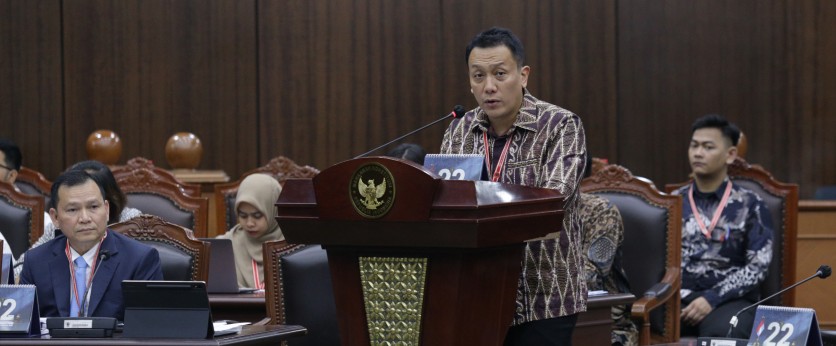
Deputy Minister of Environment Diaz Hendropriyono represented Government in Constitutional Court Hearing on Job Creation Law follow-up hearing of Case Number 100/PUU-XXIII/2025, Monday (August 25, 2025). Public Relations/Bay.
JAKARTA (MKRI) - The Constitutional Court (Mahkamah Konstitusi, MK) held another follow-up hearing in Case Number 100/PUU-XXIII/2025 on Monday, August 25, 2025, regarding the judicial review petition filed by the Indonesian Environmental Forum Foundation (WALHI). The petition challenges several provisions in Law Number 6 of 2023 concerning the Enactment of Government Regulation in Lieu of Law Number 2 of 2022 on Job Creation (commonly referred to as the Job Creation Law). The articles under review include Article 13(b), and Articles 22 paragraphs (1), (3), (5), (8), (9), (10), (14), (15), (16), (17), (18), and (28).
The hearing, chaired by Deputy Chief Justice Suhartoyo, was convened to hear the responses of the Government and the House of Representatives (DPR RI). However, the DPR RI was unable to provide a statement during this session.
Representing the Government, Deputy Minister of Environment Diaz Hendropriyono addressed the Petitioners’ objections regarding the change in terminology from “Environmental Permit” to “Environmental Approval.” According to the Government, this change is a form of bureaucratic simplification aimed at streamlining processes to encourage investment, without compromising environmental protection.
Hendropriyono emphasized that the terminological change does not alter the substantive legal force or essence of environmental impact control instruments. Businesses are still required to obtain an Environmental Approval prior to commencing operations.
An Environmental Approval is only granted after a proposed business activity has been declared environmentally viable, based on a thorough and scientifically grounded assessment through the Environmental Impact Assessment (AMDAL) or the Environmental Management and Monitoring Program (UKL-UPL). Without approval from an environmental standpoint, no business license may be issued.
Thus, integrating Environmental Approvals into the electronically integrated Business Licensing System (OSS) reflects the principles of good governance by reducing overlapping, inefficient, and fragmented bureaucracy.
“With an integrated system, state oversight becomes stronger, more centralized, measurable, and transparent. This is a concrete manifestation of Article 33 paragraph (4) of the 1945 Constitution of the Republic of Indonesia, where economic and environmental considerations are no longer viewed as opposing poles, but as a synergistic whole within the framework of sustainable development,” said Hendropriyono.
Standardization of AMDAL Assessments
The Government also elaborated on the establishment of a new Environmental Feasibility Testing Team, which replaces the former AMDAL Assessment Commissions (KPA) previously managed at regional levels. The primary aim is to enhance standardization, professionalism, and accountability in the AMDAL evaluation process.
According to the Government, the previous KPA system suffered from inconsistent quality, capacity, and independence across regions. These disparities often resulted in legal uncertainty, unequal standards, and potential conflicts of interest or political intervention at the local level.
Under the revised legal framework, AMDAL assessments are now conducted by a Feasibility Testing Team composed of government-appointed representatives and certified environmental experts. The focus has shifted from institutional representation to verified expertise.
This change is intended to ensure that all AMDAL documents nationwide are assessed based on uniform scientific principles and technical standards, leading to more objective and accountable evaluations.
“Furthermore, with the establishment of a centralized Feasibility Testing Institution, a clear path of accountability is in place. A centralized monitoring and evaluation mechanism strengthens independence from non-technical pressures,” Hendropriyono added.
State Responsibility and Discretionary Authority
The Government also addressed WALHI’s concerns over the amendment to Article 37 of the Environmental Protection and Management Law, where the word “obligatory” was changed to “may” in relation to the revocation of environmental approvals. The Petitioners argued this change weakened environmental protections.
However, the Government clarified that the use of the word “may” (in Indonesian: dapat) does not reduce the Government’s responsibility, but instead confers discretionary authority to state officials in accordance with administrative law principles.
This discretion is essential for enabling proportional, fair, and comprehensive decisions based on a holistic assessment of facts, rather than rigidly relying on a single factor. Nonetheless, this authority is not arbitrary—it is bounded by existing laws and the General Principles of Good Governance (Asas Umum Pemerintahan yang Baik, or AUPB), including the principles of accuracy, fairness, and the public interest.
“Every decision made based on this authority must be legally accountable. The Government will continue to exercise this authority to take firm action, including revoking approvals that violate or threaten environmental sustainability, as such violations constitute breaches of the law,” Hendropriyono asserted.
Also read:
State’s Role in Supervising Business Licenses and Environmental Management Questioned
Petitioner Affirm State's Key Role in Supervising Business License and Environmental Management
House Absent, Govt Asks to Postpone Hearing on Job Creation Law
In the previous hearing, the Petitioner mentioned that the Job Creation Law had altered, removed, and/or created new regulations to Law No. 32 of 2009 on the Protection and Management of the Environment (Environment Law). The loose environmental regulations imposed on businesses under the Job Creation Law may have a potentially negative impact, threatening future generations.
Primarily concerning the ongoing environmental pollution and degradation occurring in various industrial and infrastructure development projects. The Job Creation Law, in fact, degrades the status of an environmental license to merely an Environmental Approval as a requirement for business licensing, and does not mandate that all business activities obtain a "license," depending instead on a risk-based approach whose prerequisites lack sufficient explanation to address issues of environmental pollution and degradation. As a result, the Petitioners are deprived of legal certainty, public participation, access to public information, the right to a good and healthy environment, as well as the protection, promotion, enforcement, and fulfillment of human rights in the context of environmental protection.
The Petitioner argued that one of the essential roles of the state is to grant authority over the management of natural resources through licensing instruments, thereby providing legal certainty to every citizen. However, this must be based on statutory regulations that take into account protection aspects within the framework of fair, sustainable management, and utilization for both present and future generations.
Author: Sri Pujianti
Editor: Lulu Anjarsari P.
PR: Andhini Sayu F.
Translator: SO
Disclaimer: The original version of the news is in Indonesian. In case of any differences between the English and the Indonesian versions, the Indonesian version will prevail
Monday, August 25, 2025 | 13:40 WIB 536