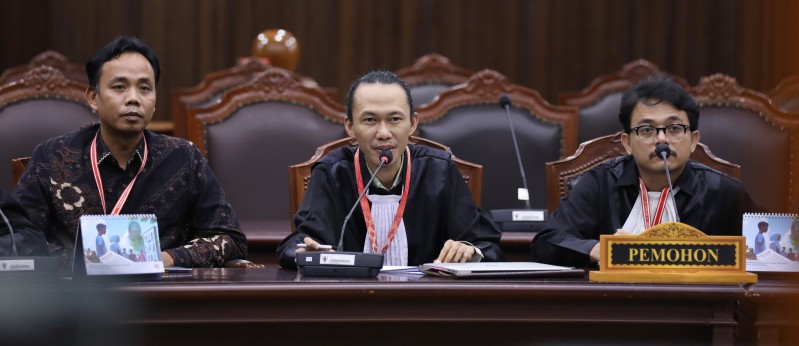
Petitioner’s legal counsel delivering the petition’s subject matter during the preliminary panel hearing of material judicial review of Law No. 2 of 2022 on Job Creation, Tuesday (24/6). Photo by MKRI/Ifa.
Jakarta (MKRI) – The Indonesian Forum for the Environment (Yayasan Wahana Lingkungan Hidup – WALHI) filed a material judicial review of Article 13 letter B, Article 22 point 1, Article 22 point 3, Article 22 point 5, Article 22 point 8, Article 22 point 9, Article 22 point 10, Article 22 point 14, Article 22 point 15, Article 22 point 16, Article 22 point 17, Article 22 point 18, and Article 22 point 28 of Law No. 6 of 2023 on the Stipulation of Government Regulation in Lieu of Law No. 2 of 2022 on Job Creation into Law (Job Creation Law) against the 1945 Constitution of the Republic of Indonesia. The preliminary hearing of Case No. 100/PUU-XXIII/2025 was heard by Chief Justice Suhartoyo (chair), Justice Daniel Yusmic P. Foekh, and Justice M. Guntur Hamzah on Tuesday, June 24, 2025.
Legal counsel Muhammad Fadhil Alfathan mentioned that the Job Creation Law had altered, removed, and/or created new regulations to Law No. 32 of 2009 on the Protection and Management of the Environment (Environment Law). The loose environmental regulations imposed on businesses under the Job Creation Law may have a potentially negative impact, threatening future generations.
Primarily concerning the ongoing environmental pollution and degradation occurring in various industrial and infrastructure development projects. The Job Creation Law, in fact, degrades the status of an environmental license to merely an Environmental Approval as a requirement for business licensing, and does not mandate that all business activities obtain a "license," depending instead on a risk-based approach whose prerequisites lack sufficient explanation to address issues of environmental pollution and degradation. As a result, the Petitioners are deprived of legal certainty, public participation, access to public information, the right to a good and healthy environment, as well as the protection, promotion, enforcement, and fulfillment of human rights in the context of environmental protection.
The Petitioner argued that one of the essential roles of the state is to grant authority over the management of natural resources through licensing instruments, thereby providing legal certainty to every citizen. However, this must be based on statutory regulations that take into account protection aspects within the framework of fair, sustainable management, and utilization for both present and future generations.
“To declare the provision of Article 22 point 16 of the Appendix of Law No. 6 of 2023 on the Stipulation of Government Regulation in Lieu of Law No. 2 of 2022 on Job Creation into Law, which replaces the provision of Article 38 of Law No. 32 of 2009 on the Protection and Management of the Environment contrary to the 1945 Constitution and does not have legally binding force as long as it is not interpreted as: except for the provision as refered to in Article 22 point 15, business licence may be annulled by the decision of state administrative court,” Teo Reffelson read out the Petitums.
Revival of the Norm
Responding to the petition, Justice Daniel requested that the petitioner study the norms that have been invalidated and reinstated. Additionally, they were asked to mention decisions from other countries that are similar to their request.
"How can we convince the Panel that this norm has been revived, and what are the implications in terms of environmental protection and management? This needs further reinforcement in the posita section," Daniel explained.
Justice M. Guntur Hamzah then requested the Petitioners to construct a legal argument concerning the norm they seek to revive. “Present to the Court why this norm was previously removed, and disclose the considerations behind it—such as any legislative deliberation transcripts—so that the justices may properly assess them. Only then should the Petitioners argue that the removal was inappropriate due to the norm’s continued relevance, so that we can more quickly grasp the core of this petition,” Justice Guntur advised.
Before closing the session, Chief Justice Suhartoyo stated that the Petitioners were granted 14 days to refine their petition. The revised petition must be submitted to the Registrar’s Office of the Constitutional Court no later than Monday, July 7, 2025. The Court will subsequently schedule a second hearing to address the points of the revised petition. (*)
Author: Sri Pujianti
Editor: Lulu Anjarsari P.
PR: Andhini Sayu F.
Translator: Rizky Kurnia Chaesario
Disclaimer: The original version of the news is in Indonesian. In case of any differences between the English and the Indonesian versions, the Indonesian version will prevail
Tuesday, June 24, 2025 | 17:57 WIB 228