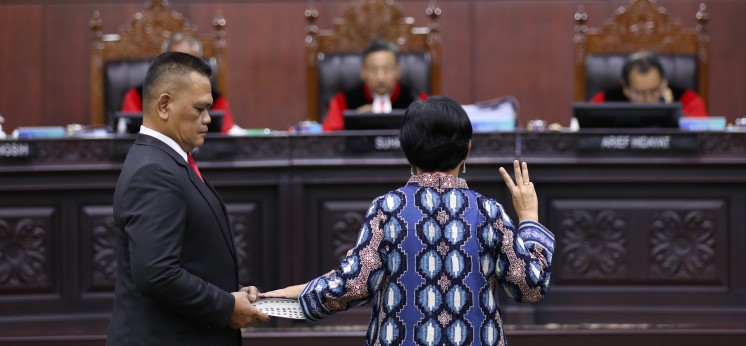
Gandes Retno Rahayu being sworn in as expert witness at the judicial review hearing of Law No. 17 of 2023 on Health, Tuesday (10/14/2025. Photo by MKRI/Ifa.
JAKARTA (MKRI) — The Constitutional Court (MK) once again held a judicial review hearing on Law No. 17 of 2023 on Health (Health Law). Case No. 111/PUU-XXII/2024, filed by Djohansjah Marzoeki, was scheduled to hear expert testimony presented by the Court. The hearing, held on Tuesday, October 14, 2025, was presided over by Chief Justice Suhartoyo along with the other constitutional justices in the plenary courtroom.
The Court presented Gandes Retno Rahayu, Professor of Medical and Health Education at Gadjah Mada University (UGM), as an expert witness. In her testimony, she explained that collegia in most countries do not operate under the Ministry of Health. Such an arrangement, she warned, could endanger the maintenance of standards and quality due to potential conflicts of interest and politicization. In this situation, competency or examination standards might be driven by political priorities rather than patient safety and scientific evidence. Furthermore, she cautioned, it could undermine scientific independence, as evidence-based curriculum reforms would be delayed by bureaucracy.
Gandes further elaborated that this structure could erode the principles of professional self-regulation and medical ethics; weaken due process and disciplinary fairness due to possible interference in sensitive or high-profile cases; diminish public trust and international recognition since a government-centric certification system would be difficult to gain cross-border acknowledgment; impede innovation and curriculum responsiveness due to challenges in adopting emerging fields; and create a policy monoculture, leading to the loss of checks and balances as well as critical feedback from the profession.
Therefore, she warned, a dual medical education system would pose significant risks, fragmented standards and quality, overlapping authorities, public confusion, disrupted international recognition and mobility, duplication of costs and human resources, and difficulties in aligning education, services, and research. Divergent research agendas and guidelines could result in inconsistent national health policies.
“The existence of Article 451 of Law No. 17 of 2023 has effectively abolished collegia established by professional organizations without systematic evaluation, disregarding their long-standing and substantial role. This could pose strategic risks to the quality of medical education and healthcare services, both now and in the future,” emphasized Gandes.
She further asserted that, ideally, a collegium must remain independent, free from political or governmental intervention, pressure, or intimidation, and perform its duties based on scientific evidence. However, under the current Health Law, the Collegium is positioned as part of the Health Council, which falls under the Ministry of Health, making it vulnerable to political exploitation.
Also Read:
Petitioner Insists Collegiums Should Be Independent Academic Bodies
Plastic Surgeon Affirms Collegiums as Independent Academic Body
The Difference in the Meaning of Collegium between Health Law, Medicine Practice Law, and Health Workers Law
House: Reformation of the Health System to Improve Service Quality
Defending Collegium as an Autonomous Body
Maintaining Collegium Independence from the Government Political Influence
Sukman Tulus Putra: The Collegium’s Existence in the Health Law Should Be Revised
Transformation of Collegium under the Ministry of Health
Debate over Collegium’s Status under Health Ministry
Confirmation of the Polemic Hearing on Collegium Under the Ministry of Health
AIPKI Hopes for the Restoration of Collegium’s Original Role
Changing Role of the Collegium Following the Health Law’s Enforcement
The Petition for Case No. 111/PUU-XXII/2024 concerning the judicial review of the Health Law was filed by Djohansjah Marzoeki, a medical doctor and emeritus professor of plastic surgery at Airlangga University. The Petitioner challenges Articles 451, 272 paragraph (2), 1 point 26, 272 paragraph (5), and 421 paragraph (2) letter b of the Health Law.
At the preliminary hearing held on Tuesday, August 27, 2024, the Petitioner’s legal counsel, Muhammad Joni, argued that the contested articles contradict Article 28C paragraph (1), Article 28D paragraph (1), Article 28H paragraph (1), and the Preamble of the 1945 Constitution of the Republic of Indonesia. According to the Petitioner, the new legal norms on collegia as stipulated in Article 451 nullified the legitimacy of existing collegia, rendering their scientific recognition invalid. Moreover, he contended that the provisions transformed legitimate collegia into illegitimate entities by introducing repressive, authoritarian, and arbitrary rules without proper legal reasoning.
About Article 421 paragraph (2) letter b, the Petitioner asserted that the provision was detrimental because it granted the central and regional governments the authority to supervise professional ethics and discipline, an area that, in his view, should remain within the professional domain rather than governmental control.
As scientific bodies, collegia are tasked with upholding medical disciplines. However, institutionalizing them as government apparatuses would strip them of their foundation, as they could then be controlled by political authorities or state institutions. Therefore, the Petitioner emphasized the importance of maintaining the legitimacy of independent collegia, whose existence and functions must reflect scientific principles and the essence of medical science. He argued that as independent academic bodies, collegia must be guaranteed, respected, and protected, not made part of the government structure. Consequently, their duties, functions, and authority would be unconstitutional if established by the Minister of Health and incorporated into the executive apparatus, as stipulated under Government Regulation No. 28 of 2024 on the Implementation of Law No. 17 of 2023 on Health (PP 28/2024), referring to Article 272 paragraph (5) of the Health Law.
In his petitum, the Petitioner requested the Court to declare Article 272 paragraph (2) of the Health Law conditionally constitutional, insofar as it is interpreted to mean “facilitated by the state without interference or conflict of interest.” Accordingly, Article 272 paragraph (2) would read, “The collegium as referred to in paragraph (1) shall perform its role independently and be facilitated by the state without interference or conflict of interest.”
Explore more: Case Number 111/PUU-XXII/2024
Author: Sri Pujianti.
Editor: Nur R.
PR: Raisa Ayuditha Marsaulina.
Translator: Jessica Rivena Meilania/Yuanna Sisilia
Disclaimer: The original version of the news is in Indonesian. In case of any differences between the English and the Indonesian versions, the Indonesian version will prevail.
Tuesday, October 14, 2025 | 17:00 WIB 187