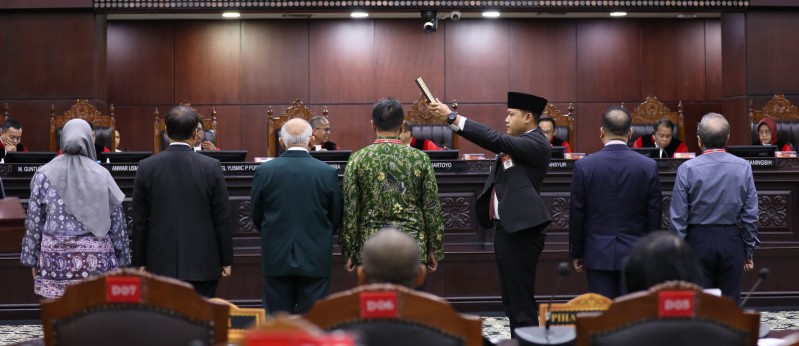
Expert witnesses from both the Petitioner and the Government taking an oath before testifying at the evidentiary hearing of the judicial review of Law No. 17 of 2023 on Health, Thursday (5/15/2025) in the plenary courtroom of the Constitutional Court. Photo by MKRI/Ifa.
JAKARTA (MKRI) — The Constitutional Court (MK) held another evidentiary hearing for the judicial review of Law No. 17 of 2023 on Health (the Health Law) on Thursday, May 15, 2025. The hearing for case No. 111/PUU-XXII/2024 heard testimonies from the Government’s experts and factual witnesses as well as factual witnesses for the Petitioner, Djohansjah Marzoeki.
Presided over by Chief Justice Suhartoyo, the hearing featured expert witnesses Anwar Santoso (Chair of the Cardiology Collegium 2017–2019) and Ahmad Redi (legal expert), and factual witnesses Renan Sukmawan (Chair of the Heart and Vascular Collegium 2024–2028) and Roro Vera Yuwantari Susilastuti for the Government. The Petitioner presented Zainal Muttaqin and Piprim Basarah Yanuarso as factual witnesses.
Reaffirming Collegium’s Scientific Autonomy
Anwar Santoso argued that the Health Law redefines the collegium as an academic body comprising experts and professors, independent from professional organizations. According to him, concerns over diminished autonomy are unfounded, as the State’s involvement, through Government Regulation No. 28 of 2024, limited to ensuring the collegium functions properly, without interfering in scientific matters.
He emphasized that the regulation aims to avoid conflicts of interest and preserve academic freedom. The Government, he added, lacks the authority to regulate scientific substance, which must remain within the collegium’s domain.
Supervision as Part of Licensing
Legal expert Ahmad Redi explained that the Government and local administrations are responsible for supervising licensed medical personnel. Since they issue professional licenses, they also have the authority to oversee ethical and professional conduct. This ensures the public’s rights are protected from negligence or abuse.
Such supervision, he noted, is not merely internal but involves the State’s external oversight, especially when professional conduct affects public safety. Therefore, this regulatory role is integral to the healthcare system.
Collegium’s Shift toward Public Interest
Renan Sukmawan testified that the collegium, as an auxiliary body to the Council, is no longer accountable to professional associations but to the public. Nonetheless, it remains responsive to the profession since its members also belong to professional organizations.
Roro Vera Yuwantari added that the collegium plays a crucial role in developing competency and curriculum standards for medical personnel. These standards are vital to the Ministry of Health’s responsibilities in managing and improving human resources for health services.
She stressed the need for collaboration between the Government, collegium, and the Council to build an ecosystem that enhances the quality of healthcare professionals.
Challenges in Certification Governance
Witness for the Petitioner, neurosurgeon Zainal Muttaqin, criticized the lack of clarity in the collegium’s authority after its integration under the Ministry of Health. Although the law stipulates that the collegium issues competency certificates, in practice, the Ministry and the Indonesian Medical Council (KKI) have intervened in this process, creating legal uncertainty.
He also noted that despite functioning as a state entity, the collegium still charges students exam fees IDR 4.5 million per person for surgery and IDR 12.5 million for pediatrics.
Meanwhile, Piprim Basarah Yanuarso, Chair of the Indonesian Pediatricians Association (IDAI), shared the impact of the Health Law on pediatric education, especially regarding the role of the Indonesian Pediatric Health Sciences Collegium (KIKAI).
Also read:
Sukman Tulus Putra: The Collegium’s Existence in the Health Law Should Be Revised
Maintaining Collegium Independence from the Government Political Influence
Defending Collegium as an Autonomous Body
House: Reformation of the Health System to Improve Service Quality
The Difference in the Meaning of Collegium between Health Law, Medicine Practice Law, and Health Workers Law
Plastic Surgeon Affirms Collegiums as Independent Academic Body
Petitioner Insists Collegiums Should Be Independent Academic Bodies
As additional information, the petition was filed by Djohansjah Marzoeki, a physician and emeritus professor at Airlangga University, challenging Articles 451, 272(2), 1(26), 272(5), and 421(2)(b) of the Health Law.
At the preliminary hearing on August 27, 2024, his legal counsel, Muhammad Joni, argued that these provisions violate Article 28C(1), Article 28D(1), Article 28H(1), and the Preamble of the 1945 Constitution. The petitioner asserted that redefining collegium as state bodies undermines their legitimacy and risks political interference in scientific affairs.
The petition also seeks a constitutional interpretation of Article 272(2) to affirm the collegium’s independence and require the State to support it “without interference or conflict of interest.”
Also read: Case No. 111/PUU-XXII/2024
Author: Sri Pujianti
Editor: Nur R.
PR: Raisa Ayuditha Marsaulina
Translator: Yuanna Sisilia
Disclaimer: The original version of this news article is in Indonesian. In case of discrepancies, the Indonesian version shall prevail.
Thursday, May 15, 2025 | 17:03 WIB 371