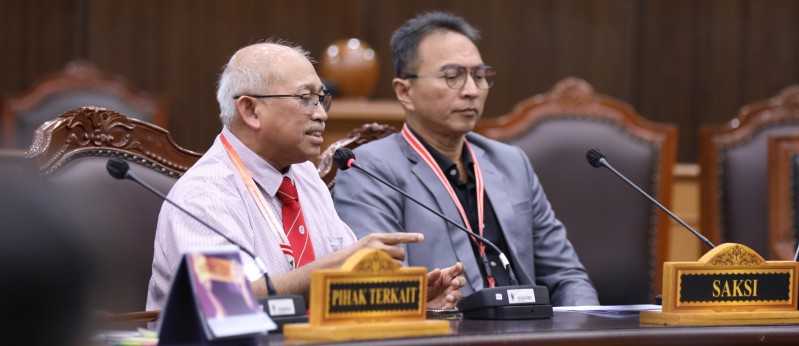
Petitioner’s witnesses Zainal Muttaqin and Piprim Basarah Yunarso presenting their statements at the evidentiary hearing for the judicial review of Law No. 17 of 2023 on Health, Thursday (5/22/2025). Photo by MKRI/Ifa.
JAKARTA (MKRI) — The Constitutional Court (MK) held another evidentiary hearing for the judicial review of Law No. 17 of 2023 on Health on Thursday, May 22, 2025. This ninth hearing of case No. 111/PUU-XXII/2024 was chaired by Chief Justice Suhartoyo and heard additional statements from the President’s/Government’s experts and witnesses as well as from the Petitioner’s expert. The Government presented two experts, Anwar Santoso (Chairman of the Cardiology Collegium for the 2017–2019 period) and legal expert Ahmad Redi, along with two witnesses, Renan Sukmawan (Chairman of the Collegium of Cardiology and Vascular Medicine for 2024–2028) and Roro Vera Yuwantari. The Petitioner presented Zainal Muttaqin and Piprim Basarah Yunarso.
Dismissed for Expressing Opinion
Zainal Muttaqin, a professor at the Faculty of Medicine of Diponegoro University (UNDIP), recounted the chronology and supporting evidence of his dismissal from his role as a clinical medical educator. “Since the drafting of this law, I’ve written several articles in print and online media. Then, between late 2022 and early 2023, on March 27, I was summoned by the Director of Dr. Kariadi Hospital. The Health Minister, apparently offended by my writings, conveyed that feedback must go through https://partisipasisehat.kemkes.go.id. Anything outside the Ministry's official channels was deemed unacceptable. On April 4, I underwent an ethics hearing—originally meant to discuss patient matters—but this time it centered on my published articles, especially one titled 'The Importance of Upholding Medical Professional Ethics' (published 4/2/2023). The outcome? No ethical or medical violations were found. However, I was asked to submit all future writings for prior censorship, which I refused. Only the ITE Law can assess whether a publication is unlawful. Then, on April 5, I was handed a dismissal letter,” said Zainal, who had been a contract-based clinical educator at the hospital since 1995, with a contract valid until March 15, 2024.
No Competency Standards Yet
Responding to questions on the impact of collegiums formed by the Ministry of Health, expert Piprim Basarah Yunarso explained that their main task is to develop education standards, competencies, and curriculum. According to the bylaws of the Indonesian Pediatric Society (IDAI) for 2024, the collegium may evaluate and enhance the pediatric specialist curriculum, and offer input for curricula in other fields requiring pediatric expertise.
“In contrast, the Ministry-formed collegiums are expected to draft competency standards for medical and health professionals. Yet, to date, no such standards or curricula have been produced. Instead, we still rely on the standards developed by IDAI, which have evolved through scientific and medical advancements contributed by experts across Indonesia. This depth of experience is lacking in the Ministry-formed collegiums, which have limited capacity,” said Piprim.
State’s Supervisory Role
Government expert Anwar Santoso emphasized the state’s role in ensuring healthcare services comply with professional and competency standards. These standards represent the minimum qualifications required for practitioners to provide healthcare services. According to Article 200(2) of the Health Law, competency standards are to be developed by the collegium and formalized by the Minister. Meanwhile, Article 291(1) and (2) stipulate that professional standards are to be jointly formulated by the council and collegium, also to be established by the Minister.
“These provisions are crucial to ensure public interest, legal certainty, and patient safety. It is the Government’s responsibility to optimize regulation, guidance, and oversight—including the collegium’s role—in maintaining quality assurance through accreditation processes,” said Anwar.
"Born of the State"
Legal expert Ahmad Redi addressed the question of whether an independent body must be completely detached from the Government. “Theoretically, no,” he said. “According to Article 5(1) of the 1945 Constitution, state institutions are born out of governmental authority. Even so-called independent institutions are still part of the administrative system under government oversight, although their functions must remain independent. Thus, while a collegium may operate independently, it cannot be fully removed from state regulation or structure.”
Collegium Financing
Witness Renan Sukmawan explained the difference in funding mechanisms between the old and new collegiums. Previously, collegiums relied on public funds, such as exam fees or certificate issuance fees, managed under the accounts of professional associations. Budget accountability was reported at annual congresses.
“In contrast, the new collegiums operate under a single account name and a regulated expenditure system. The Indonesian Medical Council (KKI) has set clear guidelines on exam venues and systems. Funding proposals are underway, and the applicable fee standards have already been established. Eventually, independent audits will be carried out,” Renan stated.
Governance Alignment
Roro Vera Yuwantari responded to inquiries regarding the working relationship between healthcare administrative governance and medical science governance. She stressed the importance of harmonizing roles without interference. “The aim is to synchronize duties and functions, both administrative and professional, through effective coordination. The Ministry develops and implements policies, while the collegium should serve as the expert authority. These two components must complement each other,” she conveyed.
Transformation of Collegium under the Ministry of Health
Sukman Tulus Putra: The Collegium’s Existence in the Health Law Should Be Revised
Maintaining Collegium Independence from the Government Political Influence
Defending Collegium as an Autonomous Body
House: Reformation of the Health System to Improve Service Quality
The Difference in the Meaning of Collegium between Health Law, Medicine Practice Law, and Health Workers Law
Plastic Surgeon Affirms Collegiums as Independent Academic Body
Petitioner Insists Collegiums Should Be Independent Academic Bodies
The petition for Case No. 111/PUU-XXII/2024 was filed by Djohansjah Marzoeki, an emeritus professor of plastic surgery at Airlangga University. He challenges Article 451, Article 272(2), Article 1(26), Article 272(5), and Article 421(2)(b) of the Health Law.
In the preliminary hearing on Tuesday, August 27, 2024, the Petitioner’s legal counsel, Muhammad Joni, argued that these provisions violate Article 28C(1), Article 28D(1), Article 28H(1), and the Preamble of the 1945 Constitution. He contended that Article 451 renders pre-existing collegiums legally null by replacing their scientific legitimacy with state-defined legal status. This, he claims, creates a repressive and authoritarian legal framework.
Regarding Article 421(2)(b), the Petitioner objected to the provision granting the central and regional governments authority over professional ethics and discipline, which should fall under professional bodies’ purview.
The Petitioner seeks the Court’s conditional constitutionality ruling on Article 272(2), requesting it be interpreted as: “The collegium, as referred to in paragraph (1), shall perform its role independently and be facilitated by the state without intervention or conflicts of interest.”
Author: Sri Pujianti
Editor: Nur R.
PR: Raisa Ayuditha Marsaulina
Translator: Yuanna Sisilia
Also read: Petition Revision Hearing for Case No. 111/PUU-XXII/2024
Disclaimer: The original version of this news is in Indonesian. In case of any differences between the English and Indonesian versions, the Indonesian version shall prevail.
Thursday, May 22, 2025 | 17:03 WIB 205