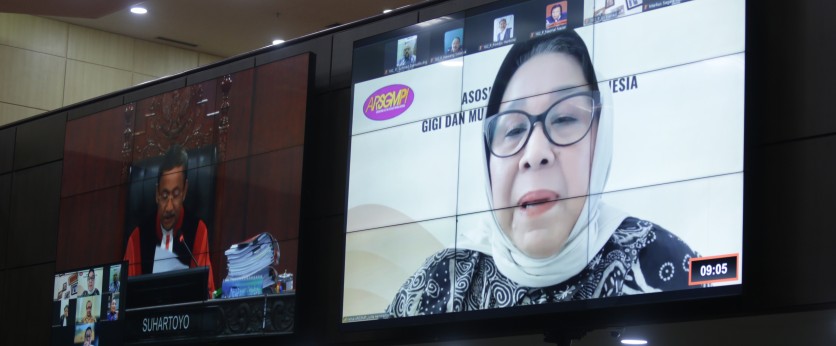
Julita Hendrartini, Chairperson of the Association of Indonesian Dental and Oral Teaching Hospitals (ARSGMPI), delivering her statement during the judicial review hearing of Law No. 17 of 2023 on Health, Tuesday (10/14/2025). Photo by MKRI/Bay.
JAKARTA (MKRI) — The Constitutional Court (MK) held another hearing in the judicial review of Law No. 17 of 2023 on Health (Health Law) on Tuesday, October 14, 2025. This twelfth hearing for Case No. 111/PUU-XXII/2024, filed by Djohansjah Marzoeki (the Petitioner), was scheduled to hear statements from the Ministry of Education, Culture, Research, and Technology (Kemdiktisaintek) and the Association of Indonesian Dental and Oral Teaching Hospitals (ARSGMPI).
During the session held in the Court’s plenary courtroom, Julita Hendrartini, Chairperson of ARSGMPI, presented several statements concerning the role of the collegium in higher education. Referring to the Petitioner’s arguments, ARSGMPI emphasized that the collegium and teaching hospitals (RSP) maintain a complementary functional relationship in ensuring both academic and service quality. The collegium is authorized to set competency standards incorporated into professional and specialist curricula, serving as a guideline for clinical education at RSPs to achieve the required competencies.
Julita elaborated that with the enactment of the Health Law, the collegium’s position has shifted. Previously, it operated under the Indonesian Dental Association (PDGI), but it now falls under the Indonesian Health Council (KKI), which is within the Ministry of Health (Kemenkes). According to ARSGMPI, the collegium should ideally remain an independent body, free from external interference, to safeguard academic freedom in the advancement of knowledge and remain insulated from political or bureaucratic pressure, as it is an academic professional institution rather than a governmental body.
“The collegium’s function is to ensure the quality of science, professional competency, and ethics, areas that must remain free from political or bureaucratic intervention. This principle aligns with global standards and practices in other countries, where collegia operate under professional self-regulation. If the collegium falls under the Ministry of Health, its focus will shift toward healthcare service rather than education. Consequently, the role of dental and oral hospitals (RSGM) may weaken and find it difficult to keep up with global academic developments. Quality assurance for clinical education should follow educational needs, not merely service-oriented policies,” Julita explained.
Shaking the Foundations of RSGM
Julita went on to explain that the enactment of the Health Law has triggered regulatory changes that have significantly impacted dental and oral teaching hospitals (RSGM). Referring to Article 54 of the Health Law, as well as Law No. 20 of 2013 on Medical Education and Law No. 44 of 2009 on Hospitals, she stated that hospitals play a crucial role as centers for education and professional training. These laws designate teaching hospitals as the primary facilities for attaining professional medical competence. Furthermore, Article 24 paragraph (1) of Law No. 44 of 2009 stipulates that to organize tiered healthcare services and referral functions, general hospitals (RSU) and specialized hospitals (RSK) are classified based on their facilities and capabilities.
Subsequently, Article 24 paragraph (3) provides that specialized hospitals are classified into Classes A, B, and C. Meanwhile, Law No. 17 of 2023 Article 184 paragraph (1) stipulates that hospitals provide individual healthcare services in the form of specialist and subspecialist care, while paragraph (2) adds that hospitals may also provide basic health services.
“In both Law No. 17 of 2023 and Government Regulation No. 28 of 2024, the terminology ‘specialized hospital’ is not mentioned at all. This omission affects RSGMs because it will be difficult for them to transform into general hospitals, which require a broader range of medical services. As a result, RSGMs would no longer focus solely on dental and oral care, services that have long supported their educational, clinical, and research functions. Most RSGM services are outpatient, consistent with the characteristics of dental and oral diseases, which do not require a large number of inpatient beds,” Julita explained.
However, Article 168 of the Health Law stipulates that hospitals must comply with government regulations within one year after the law’s enactment. As of now, Julita continued, RSGMs still refer to Government Regulation No. 47 of 2021 on Hospital Administration until new implementing regulations are issued under the new law. Article 17 of that regulation stipulates minimum requirements for inpatient beds and dental units in specialized hospitals and RSGMs: Class A must have at least 14 beds and 75 dental units; Class B, at least 12 beds and 50 dental units; and Class C, at least 10 beds and 25 dental units.
This indicates that RSGMs with around 108 dental units are sufficiently equipped to support dental and specialist education. Therefore, she expressed hope that the derivative regulations of Law No. 17 of 2023 will accommodate the existence of RSGMs, which play a vital role in training dentists and dental specialists.
Scientific Autonomy and Academic Integrity
Khairul Munadi, representing the Minister of Higher Education, Science, and Technology, explained that based on Article 1 point 26 of the Health Law, there are two key characteristics of the collegium: independence and competence. Independence, he said, is a fundamental criterion for the collegium as it performs scientific and academic, not representational, functions. As an entity that holds scientific authority across diverse health disciplines, the collegium must be free to think and act independently in setting competency standards and learning outcomes, without external pressure.
Article 272 paragraph (2) of the Health Law affirms that the collegium is independent, meaning it has autonomy to establish its scientific perspectives based on verifiable and accountable methodologies grounded in academic integrity. This independence, Khairul added, is reflected in the law's bottom-up formation model, which allows expert groups within each health discipline to form their own collegium.
This provision underscores that the collegium originates from the initiative of the scientific community, not through bureaucratic establishment by the ministry. Such a mechanism reflects the democratization of science, where academic authority is distributed among experts according to their respective fields of competence. Consequently, the direction of scientific and professional development is not dictated by administrative structures but grows organically from the dynamics of knowledge itself.
Khairul noted that this bottom-up approach ensures that the collegium remains within the sphere of scientific inquiry rather than absorbed into governmental hierarchy. “Through this model of establishment,” he said, “the state acknowledges the self-governing nature of scientific and professional communities while strengthening the foundation of independence that characterizes the collegium within higher education for medical and health professionals.”
The Role of the State
Khairul further explained that the second defining characteristic of the collegium is competence. The collegium is not established as an administrative body, but as a scientific forum comprising experts and professional educators with in-depth mastery of specific health disciplines. Therefore, every policy, recommendation, or standard formulated by the collegium must rest on sound academic judgment, accountable methodology, and practical experience relevant to healthcare needs. Within higher health education, competence is not merely an individual attribute but an institutional character inherent to the collegium as a scientific body.
“Constitutionally, the principles of independence and competence inherent in the collegium represent the state’s responsibility to uphold a national education system that is free from vested interests and oriented toward scientific progress, as mandated by Article 31 paragraph (3) of the 1945 Constitution. In this context, the state does not directly control academic processes but ensures that scientific institutions such as the collegium have autonomous space to develop and uphold scientific standards for the benefit of the wider public,” Khairul concluded.
Also read:
Petitioner Insists Collegiums Should Be Independent Academic Bodies
Plastic Surgeon Affirms Collegiums as Independent Academic Body
The Difference in the Meaning of Collegium between Health Law, Medicine Practice Law, and Health Workers Law
House: Reformation of the Health System to Improve Service Quality
Defending Collegium as an Autonomous Body
Maintaining Collegium Independence from the Government Political Influence
Sukman Tulus Putra: The Collegium’s Existence in the Health Law Should Be Revised
Transformation of Collegium under the Ministry of Health
Debate over Collegium’s Status under Health Ministry
Confirmation of the Polemic Hearing on Collegium Under the Ministry of Health
AIPKI Hopes for the Restoration of Collegium’s Original Role
Author : Utami Argawati.
Editor : Nur R.
PR : Raisa Ayuditha Marsaulina.
Translator: Jessica Rivena Meilania/Yuanna Sisilia
Disclaimer: The original version of the news is in Indonesian. In case of any differences between the English and the Indonesian versions, the Indonesian version will prevail.
Tuesday, October 14, 2025 | 16:27 WIB 182