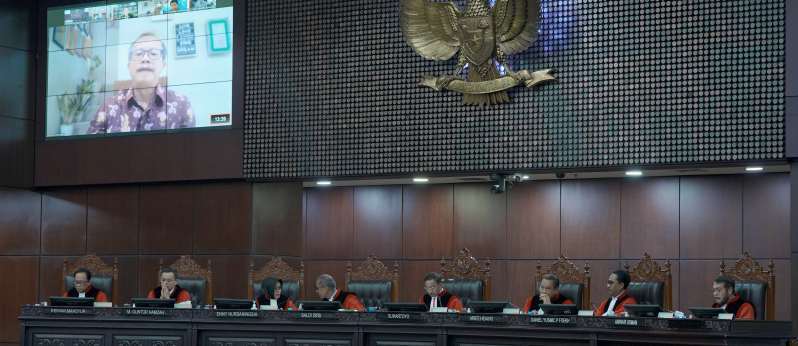
Doni Koesoema Albertus testifying as an expert for the Petitioner at a judicial review hearing of Law No. 14 of 2005 on Teachers and Lecturers, Thursday (9/4/2025). Photo by MKRI/Hamdi.
JAKARTA (MKRI) — The Constitutional Court (MK) held another hearing for the judicial review of Law No. 14 of 2005 on Teachers and Lecturers for case No. 99/PUU-XXIII/2025 on Thursday, August 4, 2025 in the plenary courtroom. The petition was filed by Sri Hartono, a certified civil-servant teacher, who challenges the retirement age for teachers, which is set at sixty years of age.
At this hearing, the Petitioner presented Doni Koesoema Albertus as an expert. Doni testified that the Petitioner’s claim should not be reduced to a mere technical demand for amendments to several provisions in the Teacher-Lecturer Law, nor confined to consistency in the implementation of existing legislation, as has often been the case. Rather, he emphasized, this demand represents a moral struggle to uphold legal equality and ensure fair recognition of the teaching profession.
“Article 28D paragraphs (1) and (2) of the 1945 Constitution affirm that every person has the right to equal treatment before the law, and the right to work and to receive fair and proper remuneration and treatment. The difference in retirement age between teachers and lecturers violates this principle, as both are educators holding functional positions,” Doni stated.
He added that both teachers and lecturers are noble professions entrusted with advancing the nation’s intellectual life, and thus should not be subject to discrimination. Differentiating retirement ages, he argued, is no longer relevant, especially given the steady improvement in public health in Indonesia. Statistics Indonesia (BPS) recorded in 2024 that life expectancy reached 74.15 years for women and 70.32 years for men.
Doni further pointed out that in many countries the retirement age for teachers exceeds 60 years. In Japan, for instance, civil servants may have their tenure extended until the age of 70. The fact that many teachers and lecturers remain productive beyond 60, he said, demonstrates that rigid retirement age limits are no longer compatible with present realities.
According to him, unequal retirement regulations ultimately harm the nation by restricting the contribution of experienced teachers in fulfilling citizens’ right to education. “Teachers are the primary actors in realizing the right to education, particularly basic education. If retirement ages are limited in a discriminatory way, then the nation’s opportunity to receive the best education from experienced teachers is obstructed,” he stressed.
In the same session, the constitutional justices also heard testimony from two experts presented by the Government: Eko Prasojo, professor at the Faculty of Administrative Sciences of Universitas Indonesia, and Bahrul Hayat, lecturer at the Faculty of Psychology of Syarif Hidayatullah State Islamic University Jakarta and at the Faculty of Education of the Indonesian International Islamic University.
Eko Prasojo argued that the policy distinction regarding the mandatory retirement age (BUP) between teachers and lecturers arises from differences in the nature of their work and context. “Given the current quality and quantity of teachers, extending the retirement age for teachers would disrupt the process of generational renewal with younger, more productive, and higher-quality teachers,” he explained.
He added that under Indonesia’s decentralized governance system, authority over teachers lies with districts and cities (for elementary and junior high schools) and with provinces (for senior high schools). With limited fiscal capacity and already high personnel expenditure, increasing the BUP would further expand the fiscal burden. Nevertheless, Eko noted that considering the process and requirements for appointment to the position of associate teacher, the wisdom and experience required, and the limited number of such positions, it could be reasonable to extend the retirement age for it up to 65 years.
Different Roles and Functions
Meanwhile, Bahrul Hayat stressed that Law No. 14 of 2005 on Teachers and Lecturers is a vital instrument for positioning both professions as dignified and equal to other established professions. The law provides the foundation for legal protection, career development, recognition, and adequate welfare guarantees, enabling teachers and lecturers to fulfill their duties optimally in advancing national education.
Nonetheless, despite their shared status as professional educators, teachers and lecturers serve fundamentally different roles and functions, which necessitate distinctions in qualifications, career progression, and, among others, retirement age. Accordingly, the difference in retirement age does not constitute discrimination but is a logical consequence of the distinct nature of their professions. For this reason, Bahrul asserted, the differentiated provisions on retirement age under Law No. 14 of 2005 on Teachers and Lecturers reflect proportional justice and should be preserved. Equal treatment of both professions without regard to their different responsibilities, he cautioned, could in fact lead to injustice.
Also read:
Civil-Servant Teacher Asks for Higher Retirement Age
Civil-Servant Teacher Revises Petition on Higher Retirement Age
Govt Gives Reasons Why Teachers Are to Retire at Sixty
Nasir Djamil: Teachers’ Retirement Above Sixty Non-Ideal
Hearing on Teachers’ Retirement Age Postponed
At the preliminary hearing on Tuesday, June 24, the Petitioner, who appeared virtually at the hearing, argued that the regulation stipulating a lower retirement age for teachers compared to lecturers contradicts the principle of meritocracy in civil service (ASN) policy. “The provision establishing different retirement ages for teachers and lecturers does not reflect the principle of meritocracy,” he said.
He further emphasized that such disparity not only creates injustice but also fosters social tension between the teaching and academic professions. According to him, mandatory retirement at the age of 60 has had a direct and tangible impact on him, both administratively and psychologically.
He also highlighted the fact that Indonesia is currently facing a shortage of educators, as reported by the Ministry of Administrative and Bureaucratic Reform and the Ministry of Education, Culture, Research, and Technology. Therefore, enforcing retirement for experienced teachers at 60 years of age is seen as counterproductive to the Government’s efforts to strengthen the quality of human resources in the education sector.
For these reasons, Sri Hartono requested that the Constitutional Court declare the provision regulating the retirement age for teachers in the Teacher and Lecturer Law unconstitutional and not legally binding unless interpreted to mean that the retirement age for teachers should be equal to that of lecturers at 65 years.
Author : Utami Argawati
Editor : N. Rosi
PR : Raisa Ayuditha Marsaulina
Translator : Yuniar Widiastuti (NL)
Disclaimer: The original version of the news is in Indonesian. In case of any differences between the English and the Indonesian versions, the Indonesian version will prevail.
Thursday, September 04, 2025 | 22:17 WIB 1180