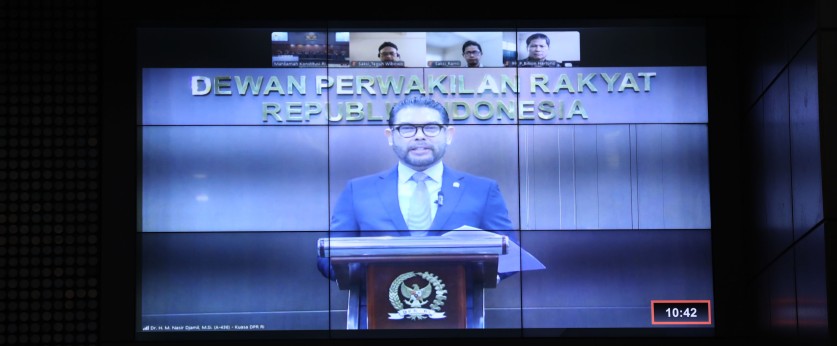
Commission III member Muhammad Nasir Djamil presenting the House’s testimony at a judicial review hearing of Law No. 14 of 2005 on Teachers and Lecturers, Thursday (8/21/2025). Photo by MKRI/Panji.
JAKARTA (MKRI) — The Constitutional Court (MK) held the another hearing for the judicial review of Law No. 14 of 2005 on Teachers and Lecturers for case No. 99/PUU-XXIII/2025 on Thursday, August 21, 2025 in a panel courtroom. The petition was filed by Sri Hartono, a certified civil-servant teacher, who challenges the retirement age for teachers, which is set at sixty years of age.
The constitutional justices heard the testimonies of the House of Representatives’ (DPR), delivered by Commission III member Muhammad Nasir Djamil, and the Petitioner’s witnesses. At the hearing, Nasir emphasized that the determination of the retirement age for teachers must be recognized in light of the historical context of previous regulations on retirement. “Sixty is categorized as old age. At this stage, concentration and physical endurance declines, which will inevitably have a direct impact on teaching effectiveness,” he stated.
Nasir further explained that in early childhood, primary, and secondary education, teachers play roles beyond merely delivering subject matter; they also serve as facilitators of children’s emotional, social, and motor development. This role requires considerable patience and physical energy. Therefore, from a rational standpoint, the age of sixty and above is not ideal for teachers who remain actively engaged in formal education at the early childhood, primary, and secondary levels.
The House argued that setting a retirement age limit for teachers is part of the effort to maintain the quality of education while optimizing human resources. Although both teachers and lecturers are professional educators, their tasks, qualifications, and responsibilities differ in complexity. Accordingly, the distinction in retirement age regulation between the two professions under the Teacher and Lecturer Law is considered reasonable and proportionate.
The House also stressed that determining retirement age falls within the legislature’s open legal policy. As long as it does not result in injustice, such a policy is not deemed inconsistent with morality, rationality, or the 1945 Constitution. Therefore, they maintained that the statutory retirement age for teachers, as regulated in the Teacher and Lecturer Law, is constitutional and nondiscriminatory, having been formulated proportionately in line with the burdens and complexities of each profession.
Healthy and Fit at Sixty
At the hearing, the Petitioner presented two witnesses—teachers Teguh Wibowo and Ramli. Appearing virtually, Teguh testified that, in reality, many of his colleagues remain healthy and fit to serve as civil servants at sixty. He argued that teachers perform tasks similar to those of lecturers, including lesson planning, delivering material, conducting evaluations, and mentoring students. “We are still assigned supervisory responsibilities, just like lecturers. The work undertaken by teachers is no less complex than that of lecturers,” Teguh asserted.
Meanwhile, the other witness, Ramli, expressed hope that the Constitutional Court would grant the petition, allowing him to continue contributing to the development of education in Indonesia.
Also read:
Civil-Servant Teacher Asks for Higher Retirement Age
Civil-Servant Teacher Revises Petition on Higher Retirement Age
Govt Gives Reasons Why Teachers Are to Retire at Sixty
At the preliminary hearing on Tuesday, June 24, the Petitioner, who appeared virtually at the hearing, argued that the regulation stipulating a lower retirement age for teachers compared to lecturers contradicts the principle of meritocracy in civil service (ASN) policy. “The provision establishing different retirement ages for teachers and lecturers does not reflect the principle of meritocracy,” he said.
He further emphasized that such disparity not only creates injustice but also fosters social tension between the teaching and academic professions. According to him, mandatory retirement at the age of 60 has had a direct and tangible impact on him, both administratively and psychologically.
He also highlighted the fact that Indonesia is currently facing a shortage of educators, as reported by the Ministry of Administrative and Bureaucratic Reform and the Ministry of Education, Culture, Research, and Technology. Therefore, enforcing retirement for experienced teachers at 60 years of age is seen as counterproductive to the Government’s efforts to strengthen the quality of human resources in the education sector.
For these reasons, Sri Hartono requested that the Constitutional Court declare the provision regulating the retirement age for teachers in the Teacher and Lecturer Law unconstitutional and not legally binding unless interpreted to mean that the retirement age for teachers should be equal to that of lecturers at 65 years.
Author : Utami Argawati
Editor : N. Rosi
PR : Raisa Ayuditha Marsaulina
Translator : Yuniar Widiastuti (NL)
Disclaimer: The original version of the news is in Indonesian. In case of any differences between the English and the Indonesian versions, the Indonesian version will prevail.
Thursday, August 21, 2025 | 12:29 WIB 271