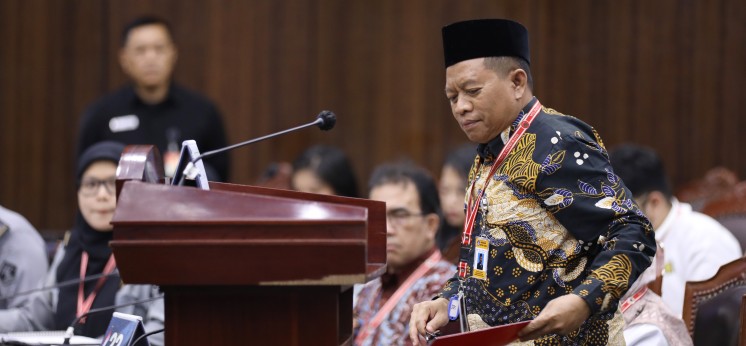
Biyanto, Ministry of Education’s advisor for regulations and interagency relations testifying on behalf of the Government at a judicial review hearing of Law No. 14 of 2005 on Teachers and Lecturers, Tuesday (8/12/2025). Photo by MKRI/Ifa.
JAKARTA (MKRI) — The Constitutional Court (MK) held the another hearing for the judicial review of Law No. 14 of 2005 on Teachers and Lecturers for case No. 99/PUU-XXIII/2025 on Tuesday, August 12, 2025. The petition was filed by Sri Hartono, a certified civil-servant teacher, who challenges the retirement age for teachers, which is set at 60 years of age.
At the hearing, which took place at the plenary courtroom, the constitutional justices heard the President’s/Government’s testimony.
On behalf of the Government, Biyanto, advisor for regulations and interagency relations of the Ministry of Primary and Secondary Education, outlined the historical development of regulations on the retirement age of teachers. Under Government Regulation (PP) No. 32 of 1979, the retirement age for civil servant (PNS) teachers was set at 56, with the possibility of extension to 60 for those teaching full-time in elementary (SD), junior high (SMP), and senior high (SMA) schools. Meanwhile, the retirement age for university lecturers was set at 65.
“Referring to the provisions on the retirement age of teachers under Article 30 paragraph (4) of Law No. 14 of 2005, and taking into account the retirement age provisions in PP No. 32 of 1979, it is evident that Article 30 paragraph (4) of Law No. 14 of 2005 actually seeks to provide a broader opportunity by extending the teacher retirement age from the previous 56 years—extendable to 60 as provided under PP No. 32 of 1979—to 60 years outright, without the need for a retirement extension mechanism as stipulated under Law No. 14 of 2005. Furthermore, the provision on the retirement age for lecturers, from a legal-historical perspective, has also set the retirement age at 65. Therefore, the difference in retirement ages between teachers and lecturers under Law No. 14 of 2005 is based on a sound legal rationale. Accordingly, it can be concluded that the determination of the teacher retirement age in Law No. 14 of 2005 has duly taken into consideration and is based on the maximum retirement age obtainable under PP No. 32 of 1979,” explained Biyanto.
This provision was later amended through Government Regulation (PP) No. 1 of 1994, which did not alter the teacher retirement age but extended the retirement age for full professors to 70.
In addition to legal-historical consideration, the Government also presented scientific grounds. Based on research by Dewi Rosita Rusdi, there is a correlation between the aging of teachers and physiological decline, which can affect performance. The research indicates that physiological functions begin to decline in the age range of 30–45 years. Therefore, setting the retirement age at 60 is deemed logically, contextually, and empirically appropriate.
The Government considers the policy of a 60-year retirement age for teachers a form of recognition of their strategic role while providing legal certainty. As of July 2025, data recorded 982,111 junior teachers and 334,765 senior teachers benefiting from this provision, allowing them to serve until the age of 60.
The Government also cautioned that extending the teacher retirement age to 65 would restrict available positions for graduates of teacher education programs. Data from 2024 show that there were 224,866 such graduates, while only 68,390 teachers were scheduled to retire in 2025. Raising the retirement age could hinder the regeneration of teaching personnel and reduce employment opportunities for prospective new teachers.
Also read:
Civil-Servant Teacher Asks for Higher Retirement Age
Civil-Servant Teacher Revises Petition on Higher Retirement Age
At the preliminary hearing on Tuesday, June 24, the Petitioner, who appeared virtually at the hearing, argued that the regulation stipulating a lower retirement age for teachers compared to lecturers contradicts the principle of meritocracy in civil service (ASN) policy. “The provision establishing different retirement ages for teachers and lecturers does not reflect the principle of meritocracy,” he said.
He further emphasized that such disparity not only creates injustice but also fosters social tension between the teaching and academic professions. According to him, mandatory retirement at the age of 60 has had a direct and tangible impact on him, both administratively and psychologically.
He also highlighted the fact that Indonesia is currently facing a shortage of educators, as reported by the Ministry of Administrative and Bureaucratic Reform and the Ministry of Education, Culture, Research, and Technology. Therefore, enforcing retirement for experienced teachers at 60 years of age is seen as counterproductive to the Government’s efforts to strengthen the quality of human resources in the education sector.
For these reasons, Sri Hartono requested that the Constitutional Court declare the provision regulating the retirement age for teachers in the Teacher and Lecturer Law unconstitutional and not legally binding unless interpreted to mean that the retirement age for teachers should be equal to that of lecturers at 65 years.
Author : Utami Argawati
Editor : N. Rosi
PR : Raisa Ayuditha Marsaulina
Translator : Yuniar Widiastuti (NL)
Disclaimer: The original version of the news is in Indonesian. In case of any differences between the English and the Indonesian versions, the Indonesian version will prevail.
Tuesday, August 12, 2025 | 12:23 WIB 842